
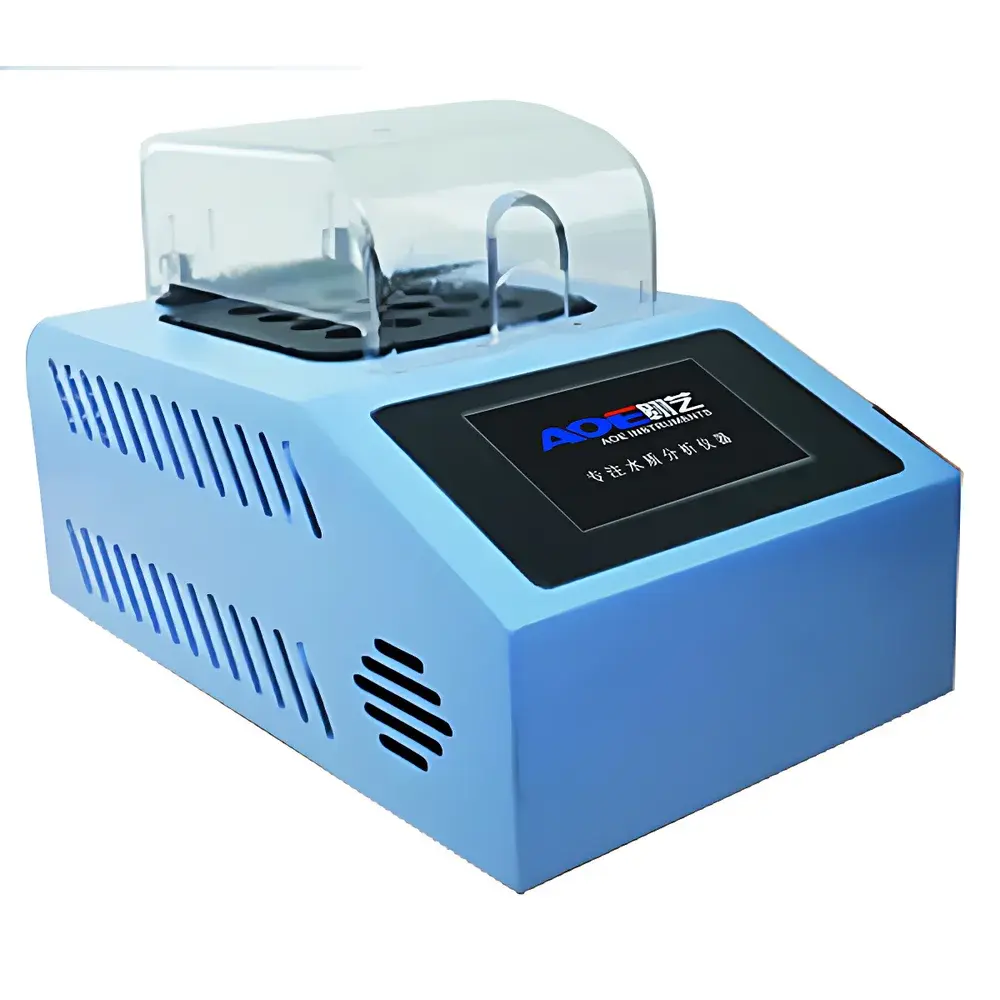
AOE WA655 Multi-Parameter Water Quality Analyzer
| Brand | AOE |
|---|---|
| Origin | Shanghai, China |
| Model | WA655 |
| Instrument Type | Benchtop Laboratory Analyzer |
| Measurement Principle | UV-Vis Absorption Spectrophotometry |
| Wavelength Range | 190–1100 nm |
| Wavelength Accuracy | ±0.5 nm |
| Photometric Accuracy | <0.5% T |
| Photometric Repeatability | <0.2% T |
| Stray Light | <0.05% T |
| Optical Stability | ±0.002 A/h |
| Detection Limits | TN: 0.1 mg/L, TP: 0.05 mg/L, NH₃-N: 0.01 mg/L, COD: 0.02 mg/L |
| Measurement Ranges | TN: 2–15,000 mg/L, TP: 1–10 mg/L, NH₃-N: 0.01–30 mg/L, COD: 0.02–100 mg/L |
| Measurement Error | TN < ±8%, TP < ±5%, NH₃-N < ±5%, COD < ±5% |
| Digestion Temperature Control | TN: 122 °C ±0.5 °C, TP: 120 °C ±0.5 °C, COD: 165 °C ±0.5 °C |
| Digestion Time | TN: 40 min, TP: 30 min, NH₃-N: 10 min, COD: 10 min |
| Digestion Mode | Sealed (TN, TP), Sealed or Open (NH₃-N, COD) |
| Sample Throughput | 16 samples per batch (TN/TP/COD), 20 samples per batch (NH₃-N), expandable |
| Display | 65K-color TFT LCD |
| Interface | USB |
Overview
The AOE WA655 Multi-Parameter Water Quality Analyzer is a benchtop spectrophotometric system engineered for standardized, high-reproducibility quantification of key water quality parameters—including total nitrogen (TN), total phosphorus (TP), ammonia nitrogen (NH3-N), and chemical oxygen demand (COD)—in compliance with widely adopted environmental testing protocols. It employs dual-beam UV-Vis absorption spectroscopy across a broad spectral range (190–1100 nm), enabling selective detection of analyte-specific chromophores formed during standardized colorimetric reactions. Unlike flow-based online sensors, the WA655 implements discrete sample digestion followed by photometric measurement in quartz or glass cuvettes, ensuring methodological alignment with ISO 11905-1 (TN), ISO 6878 (TP), ISO 7150-1 (NH3-N), and ISO 15705 (COD). Its optical architecture features thermally stabilized optics, low-stray-light monochromators (<0.05% T), and real-time baseline correction—critical for minimizing matrix interference in complex wastewater, surface water, and effluent matrices.
Key Features
- High-fidelity dual-beam UV-Vis spectrophotometer with wavelength accuracy ±0.5 nm and photometric repeatability <0.2% T over extended operation
- Integrated programmable digestion module with independent temperature control for four distinct reaction protocols: TN (122 °C ±0.5 °C), TP (120 °C ±0.5 °C), NH3-N (100–120 °C), and COD (165 °C ±0.5 °C)
- Digestion chamber supports both sealed-vessel (for TN and TP) and configurable open/sealed modes (for NH3-N and COD), accommodating EPA Method 351.2, ISO 15705, and Hach-approved digestion chemistries
- Benchtop cuvette-based design optimized for laboratory workflow: accommodates standard 10 mm pathlength cuvettes; no fluidic tubing or pump maintenance required
- 65K-color TFT LCD interface with on-device method selection, calibration curve management, and real-time absorbance monitoring
- USB interface for data export (CSV), firmware updates, and integration with LIMS via standard serial command protocol (SCPI-compatible)
- Optical stability maintained at ±0.002 A/h—validated over 8-hour continuous operation—ensuring reliability during multi-batch analysis
Sample Compatibility & Compliance
The WA655 is validated for use with raw influent, secondary effluent, drinking water pre-treatment samples, and industrial process streams. It meets performance criteria outlined in ISO/IEC 17025:2017 for analytical method validation when operated under documented SOPs. Digestion protocols align with regulatory frameworks including EU Directive 2000/60/EC (Water Framework Directive), US EPA Methods 353.2 (TP), 351.2 (TN), and Standard Methods 5210 B (COD). The system supports GLP-compliant data integrity through user-access logging, audit-trail-enabled calibration history, and timestamped result storage—fully traceable to individual operator IDs. All reagent kits referenced in factory calibration are CE-marked and supplied with CoA documentation.
Software & Data Management
The WA655 operates without proprietary PC software: all calibration, measurement, and reporting functions are executed onboard. Preloaded method templates include built-in calibration curves (linear and quadratic) with up to six-point standardization. Each measurement record stores raw absorbance values at specified wavelengths (e.g., 220/275 nm for TN, 880 nm for TP, 630 nm for COD), digest temperature/time logs, and operator ID. Data export via USB generates ISO 8601-formatted CSV files containing metadata fields compliant with ASTM E1447-18 (Standard Practice for Electronic Data Exchange in Environmental Testing). Optional firmware modules support 21 CFR Part 11-compliant electronic signatures and audit trail encryption upon customer request.
Applications
- Wastewater treatment plant (WWTP) laboratories performing routine compliance monitoring per national discharge permits
- Environmental testing labs accredited to ISO/IEC 17025 conducting TN, TP, NH3-N, and COD analysis for regulatory reporting
- Research institutions studying nutrient dynamics in eutrophication modeling or sediment-water interface flux experiments
- Industrial QA/QC labs validating pretreatment efficiency in food processing, pharmaceutical manufacturing, and textile dyeing facilities
- Educational laboratories delivering hands-on training in EPA and ISO-standardized water analysis techniques
FAQ
Does the WA655 comply with ISO 15705 for COD determination?
Yes—the instrument implements the closed-reflux colorimetric method per ISO 15705, using dichromate oxidation at 165 °C with ferroin endpoint detection. Calibration is traceable to NIST SRM 2120a.
Can the system be used for drinking water analysis?
It is validated for raw and treated drinking water sources; however, for potable water compliance (e.g., WHO or EU Drinking Water Directive), users must verify LOD/LOQ against regulatory thresholds (e.g., NH3-N ≤ 0.5 mg/L) and apply matrix-matched calibration.
Is third-party verification of accuracy available?
AOE provides factory-issued calibration certificates traceable to NIM (National Institute of Metrology, China); independent verification per ISO/IEC 17025 may be arranged through authorized calibration laboratories.
What maintenance is required beyond routine cleaning?
No optical alignment or lamp replacement is needed within the first 5,000 hours of operation; the xenon flash lamp has a rated lifetime of ≥1×10⁹ flashes. Cuvette holder and digestion block surfaces require weekly ethanol wipe-down.
How does the WA655 handle turbid or colored samples?
The dual-beam architecture compensates for background absorbance; for highly turbid samples (>100 NTU), users may apply optional blank subtraction at 700 nm or implement centrifugation/filtration per Standard Methods 2540 D.
Related Products







