
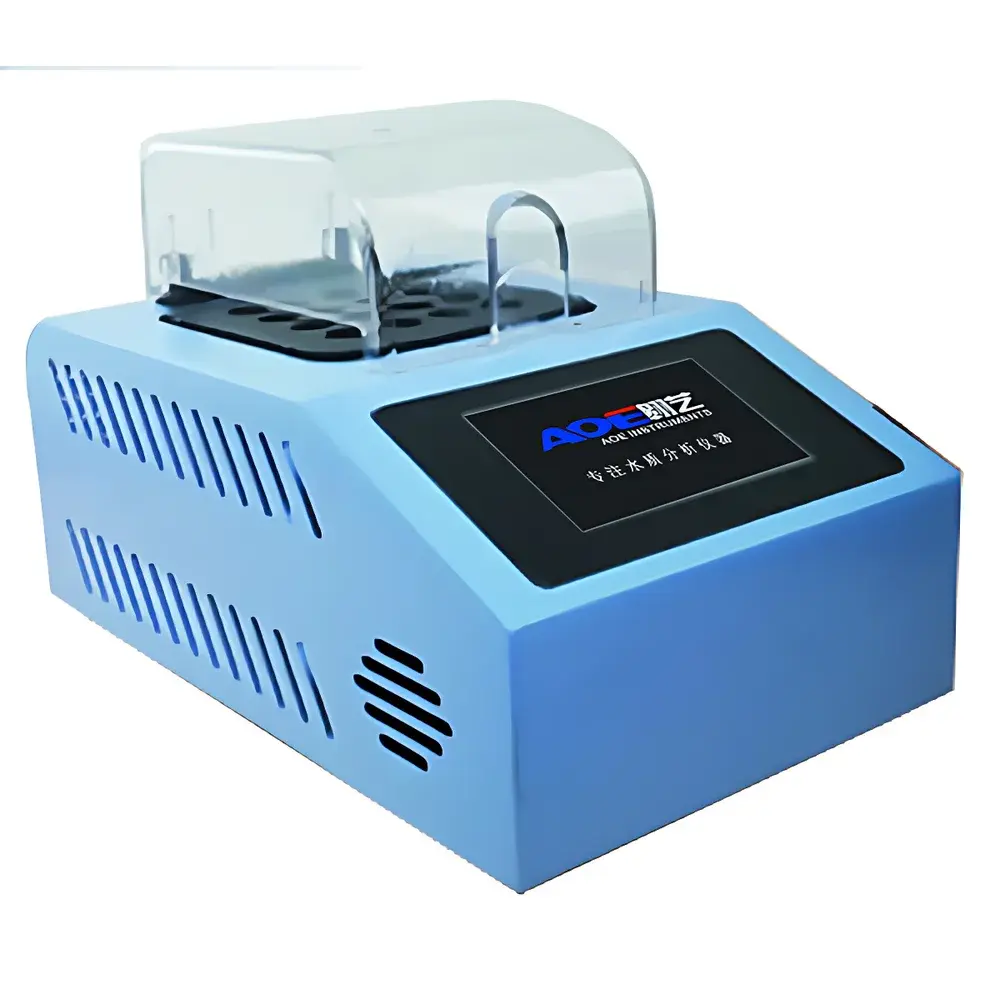
AOE WA755 Multi-Parameter Water Quality Analyzer
| Brand | AOE |
|---|---|
| Origin | Shanghai, China |
| Manufacturer Type | Authorized Distributor |
| Product Origin | Domestic (China) |
| Model | WA755 |
| Instrument Type | Benchtop Laboratory Analyzer |
| Measurement Principle | Colorimetric Method (with Predefined Reagent-Based Reaction Chemistry) |
| Wavelength Range | 190–1100 nm |
| Wavelength Accuracy | ±0.5 nm |
| Photometric Accuracy (Transmittance) | <0.5% T |
| Photometric Repeatability | <0.2% T |
| Stray Light | <0.05% T |
| Optical Stability | ±0.002 A/h |
| Display | 65K-color TFT LCD |
| Interface | USB Data Export |
| Measured Parameters | COD, Ammonia Nitrogen (NH₃-N), Total Nitrogen (TN), Total Phosphorus (TP) |
| Measurement Ranges | COD: 0.02–100 mg/L |
| NH₃-N | 0.01–30 mg/L |
| TN | 2–15,000 mg/L |
| TP | 1–10 mg/L |
| Detection Limits | NH₃-N: 0.01 mg/L |
| COD | 0.02 mg/L |
| TN | 2 mg/L |
| TP | 1 mg/L |
| Measurement Time per Parameter | NH₃-N: 15 min |
| TP | 40 min |
| TN | 50 min |
| COD | 20 min |
| Batch Capacity | 16 samples (COD/TN/TP) |
| Digestion Temperature Control | COD: 165 °C ±0.5 °C |
| TN | 122 °C ±0.5 °C |
| TP | 120 °C ±0.5 °C |
| NH₃-N | adjustable (sealed or open-mode) |
| Digestion Duration | COD/TN/TP/NH₃-N: 10–40 min (parameter-specific) |
| Digestion Mode | Sealed (TN, TP), Sealed or Open (NH₃-N, COD) |
| Calibration Curve Storage | 200 preloaded & user-defined curves |
| Data Storage Capacity | 40,000 test records |
| Compliant Standards | GB/T 11893–1989 (TP), GB/T 11894–1989 (TN), HJ 535–2009 (NH₃-N), HJ 399–2007 (COD) |
Overview
The AOE WA755 Multi-Parameter Water Quality Analyzer is a benchtop laboratory spectrophotometer engineered for precise, standardized colorimetric quantification of key water quality indicators—including chemical oxygen demand (COD), ammonia nitrogen (NH3-N), total nitrogen (TN), and total phosphorus (TP). It operates on the principle of absorbance measurement at defined wavelengths (190–1100 nm), where analyte-specific chromophores generated via controlled digestion and reagent reactions produce optical signals proportional to concentration. The system integrates dual-function hardware: a high-stability optical module with ±0.5 nm wavelength accuracy and <0.05% T stray light performance, and a synchronized 16-position intelligent digester capable of independent thermal programming per parameter. Designed for routine compliance testing in environmental labs, municipal wastewater facilities, and industrial effluent monitoring centers, the WA755 supports methodologically traceable analysis aligned with Chinese national standards (e.g., HJ 399–2007 for COD, HJ 535–2009 for NH3-N) and international best practices for photometric water analysis.
Key Features
- High-fidelity optical architecture: Double-beam-equivalent stability (±0.002 A/h), <0.5% T photometric accuracy, and 65K-color TFT display for real-time spectral verification and intuitive operation.
- Modular digestion control: Independent temperature and time programming for four core parameters—COD (165 °C ±0.5 °C, 10 min), TN (122 °C ±0.5 °C, 40 min), TP (120 °C ±0.5 °C, 30 min), and NH3-N (variable sealed/open mode, 10 min)—ensuring stoichiometric reaction completeness and inter-laboratory reproducibility.
- Built-in method library: 200 stored calibration curves—including factory-loaded and user-customizable polynomials—enabling rapid switching between standard methods without recalibration.
- Robust data governance: Local storage of up to 40,000 test records with timestamp, operator ID, curve ID, raw absorbance, and final concentration; exportable via USB to CSV or PDF for audit-ready reporting.
- Compliance-enabling design: Supports GLP-aligned workflows through mandatory entry fields (sample ID, batch number, analyst signature), automatic instrument self-check logs, and non-editable result archives.
Sample Compatibility & Compliance
The WA755 accepts standard 10–30 mm rectangular cuvettes and accommodates raw, filtered, or centrifuged aqueous matrices—including surface water, groundwater, domestic sewage, electroplating effluents, and agricultural runoff—without dilution in most cases. Its digestion protocols adhere to regulatory digestion requirements: alkaline persulfate oxidation for TN, molybdate-antimony color development for TP, indophenol blue formation for NH3-N, and dichromate reflux for COD. All operational parameters satisfy metrological criteria outlined in JJG 975–2002 (Chinese Verification Regulation for Spectrophotometers) and align with ISO 8466-1:1990 (calibration function validation) and ISO 7027-1:2016 (turbidity-corrected absorbance measurement). While not FDA 21 CFR Part 11-certified out-of-box, its audit trail functionality and password-protected method editing support GxP-compliant adaptation under lab-specific SOPs.
Software & Data Management
Data acquisition and processing are handled internally via embedded firmware—no external PC required for routine operation. Each measurement cycle automatically logs absorbance at peak wavelength, calculates concentration using the selected calibration curve, applies matrix correction factors (if enabled), and appends metadata (digestion temperature, duration, reagent lot). USB export generates timestamped files containing full analytical context: sample IDs, measured values, uncertainty flags (e.g., “out-of-range”, “low signal”), and instrument status snapshots. Optional PC software (available upon request) enables advanced curve fitting (linear, quadratic, cubic), statistical summary reports (mean, SD, CV%), and integration with LIMS via delimited text import. All stored data retain immutable creation timestamps and cannot be modified post-acquisition—ensuring integrity during internal QA reviews or third-party accreditation audits (e.g., CNAS, CMA).
Applications
- Regulatory wastewater discharge monitoring per local environmental protection bureau mandates.
- Source water quality assessment in drinking water treatment plants (pre- and post-coagulation).
- Process control in bioreactors and activated sludge systems—tracking NH3-N removal efficiency and TN/TP loading rates.
- Educational laboratories requiring multi-analyte training platforms compliant with standard method pedagogy.
- Third-party testing labs performing contract analyses for industrial clients under GB or ISO-based reporting frameworks.
FAQ
Does the WA755 require external calibration standards for each test?
No—factory-calibrated curves are preloaded, but users must verify accuracy before daily use with at least one certified reference material (CRM) per parameter group. Traceable CRMs (e.g., NIST SRM 2172 for COD) are recommended.
Can digestion temperature profiles be modified beyond default settings?
Yes—advanced mode allows manual override of temperature and time within hardware safety limits (max 180 °C), subject to method validation per ISO/IEC 17025 clause 7.2.2.
Is the instrument compatible with non-AOE reagents?
It accepts any ASTM/ISO-compliant reagent kit; however, curve coefficients and interference corrections are optimized for AOE’s proprietary formulations. Cross-reagent validation is required prior to deployment.
How is optical drift compensated during extended batch runs?
The system performs automatic zero-reference correction every 30 minutes using an air blank or deionized water reference, logged in the audit trail.
What cybersecurity safeguards exist for USB data export?
No network connectivity is present; USB export is read-only. Files contain no executable code, and firmware prohibits write-access to internal memory via USB port.
Related Products







