
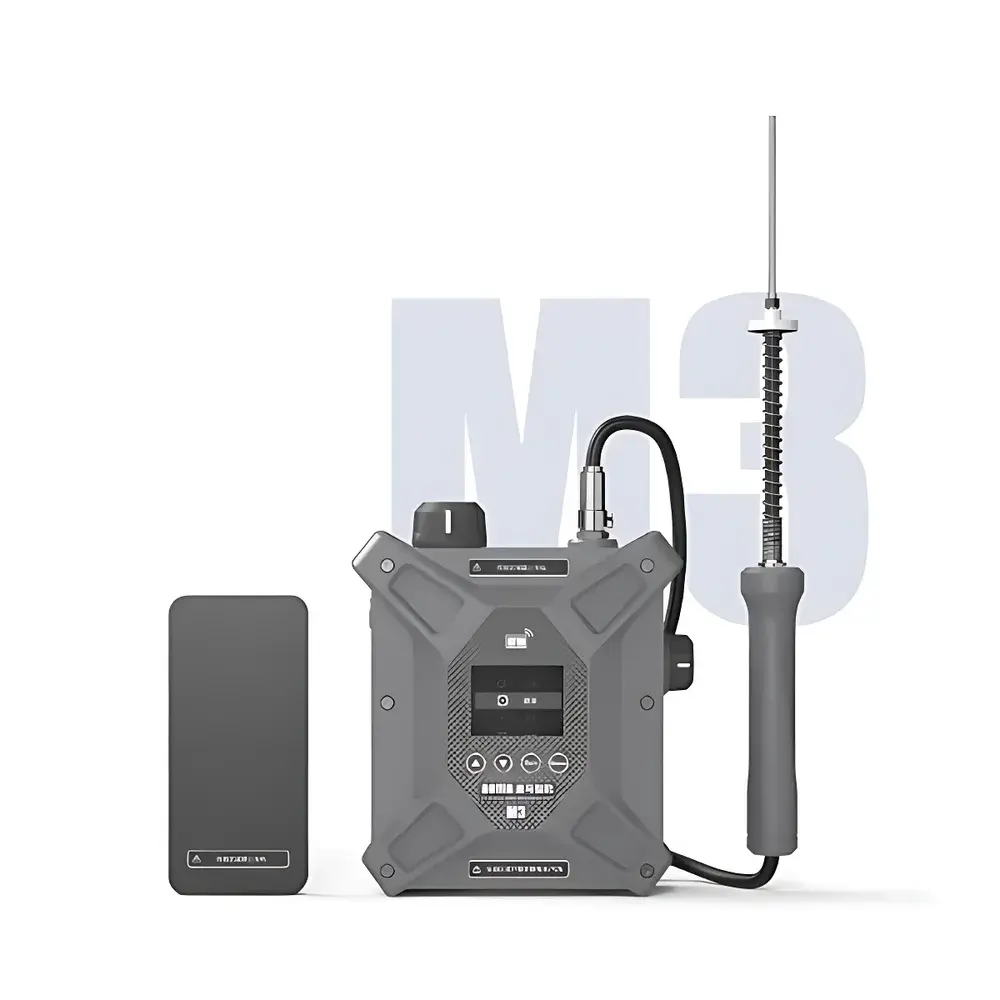
AOMA MINI FID M3 Portable VOC Analyzer
| Brand | AOMA |
|---|---|
| Origin | Anhui, China |
| Manufacturer Type | Authorized Distributor |
| Country of Origin | Domestic (China) |
| Model | MINI FID M3 |
| Price | Upon Request |
| Detection Limit | 0.5 ppm methane (defined as 7× peak-to-peak noise standard deviation) |
| Detector Types | FID (primary), with optional PID, O₂, CO, SO₂, H₂S sensors |
Overview
The AOMA MINI FID M3 Portable VOC Analyzer is a field-deployable, intrinsically safe hydrocarbon measurement system engineered for real-time detection and quantification of total hydrocarbons (THC), methane (CH₄), and non-methane volatile organic compounds (NMVOCs) across industrial emission sources. It operates on the principle of flame ionization detection (FID), a well-established, highly sensitive, and universally accepted method for carbon-containing compound analysis per ASTM D1945, ISO 8573-5, and HJ 1012–2018. Unlike conventional FID instruments requiring high-pressure hydrogen cylinders, the M3 integrates a low-pressure solid-state metal hydride hydrogen storage module—enabling safe, lightweight, and logistically streamlined operation in hazardous locations (Ex db ia IIC T4 Gb certified per GB/T 3836.1–4:2021). Its core sensing architecture features a patented low-temperature co-fired ceramic (LTCC) micro-FID cell, delivering rapid thermal stabilization (<5 min warm-up), exceptional signal reproducibility (±2% RSD at 500 ppm CH₄), and long-term detector stability (≤±5% drift over 8 h). Designed specifically for LDAR (Leak Detection and Repair) compliance workflows, it meets or exceeds key performance benchmarks in HJ 1230–2021 and GB 37822–2019, including response time (T₉₀ < 3 s), linearity (±2% full-scale), and detection limit (0.5 ppm CH₄).
Key Features
- Ultra-compact design: Dimensions 200 × 182 × 59 mm; total mass ≤1.25 kg (battery + hydride cartridge), the lightest certified FID-based portable analyzer commercially available.
- Intrinsically safe & explosion-proof: Certified to Ex db ia IIC T4 Gb (GB/T 3836), enabling direct use in Zone 1/21 hazardous areas without external barriers.
- Integrated low-pressure hydrogen supply: Solid-state metal hydride cartridge (20 L H₂ equivalent at STP, 0.7 MPa nominal charge pressure, ≥2000 charge/discharge cycles) eliminates high-pressure gas handling risks and regulatory burdens.
- Multi-sensor expandability: Optional modular integration of PID (10.6 eV lamp), electrochemical O₂, CO, SO₂, and H₂S sensors—fully software-coordinated within a single data stream.
- Intelligent calibration architecture: Supports two-point manual calibration and automated baseline correction; built-in algorithmic compensation for ambient temperature (–20°C to +50°C) and dynamic backpressure (±50 kPa).
- Extended operational endurance: Dual hot-swappable lithium-ion battery (7.4 V, 5000 mAh) and hydride cartridge deliver >20 h continuous FID operation at 25°C; >4 h at –20°C with integrated cartridge heating.
Sample Compatibility & Compliance
The M3 detects >95% of industrially relevant VOCs—including alkanes (e.g., CH₄, C₂H₆), aromatics (benzene, toluene, xylene), alkenes (ethylene, propylene), halogenated compounds (chloroform, DCM), esters (ethyl acetate), aldehydes (formaldehyde), ketones (acetone), and heterocyclics (pyridine, naphthalene)—with uniform sensitivity across the 0–50,000 µmol/mol (ppm) methane-equivalent range. It complies with national and sector-specific regulatory frameworks: HJ 1012–2018 (portable THC analyzers), HJ 1230–2021 (LDAR technical guidelines), HJ 733–2014 (leak detection methodology), and GB 37822–2019 (uncontrolled VOC emissions control). All firmware and data handling routines adhere to GLP-aligned audit trail requirements, supporting traceable calibration records, user authentication logs, and timestamped measurement metadata—critical for EPA Method 21–aligned reporting and third-party verification.
Software & Data Management
Data acquisition, visualization, and export are managed via an embedded Linux-based OS with a 3.5″ color LCD (backlit, 320 × 240 resolution) and intuitive four-button interface. Measurement data—including real-time value, max/avg values, trend curves, background subtraction status, and instrument health parameters (FID flame temp, H₂ pressure, pump vacuum, battery SOC)—are stored locally on 8 GB internal flash memory (≥1 million records). Files export natively in .CSV format compatible with Excel and LIMS platforms. Wireless connectivity (Bluetooth 5.0, Wi-Fi 802.11 b/g/n) enables remote monitoring and firmware updates via the AOMA LDAR Manager mobile application (Android/iOS). Optional RFID tagging supports asset-level tracking within enterprise instrument management systems. All data transfers comply with TLS 1.2 encryption standards; local storage implements write-protection and cyclic overwrite policies per ISO/IEC 27001–aligned data governance protocols.
Applications
The M3 serves as a primary field instrument for regulatory-compliant LDAR programs across petroleum refining, petrochemical processing, fine chemical synthesis, pharmaceutical manufacturing, coating and printing operations, and wastewater treatment facilities. It is routinely deployed for: (1) component-level leak screening per EPA Method 21 and HJ 1230–2021; (2) post-repair verification of seal integrity; (3) fugitive emission quantification from flanges, valves, pumps, and connectors; (4) effectiveness assessment of VOC abatement technologies (e.g., thermal oxidizers, carbon adsorption units); (5) ambient workplace air monitoring in confined or semi-enclosed spaces; and (6) emergency response characterization of uncontrolled releases during process upsets or transport incidents. Its IP66-rated enclosure and 1 m drop resistance (IEC 60068-2-32) ensure reliability under harsh field conditions.
FAQ
What is the detection limit for methane, and how is it defined?
The stated detection limit is 0.5 ppm methane, calculated as seven times the peak-to-peak noise standard deviation under standardized sampling conditions (0.7 L/min flow, 25°C ambient).
Can the M3 operate in explosive atmospheres?
Yes—it carries full Ex db ia IIC T4 Gb certification per GB/T 3836.1–4:2021, permitting direct deployment in classified hazardous zones without additional safety infrastructure.
How does the solid-state hydrogen storage compare to traditional gas cylinders?
The metal hydride cartridge operates at ≤1.0 MPa, eliminating high-pressure hazards, transportation restrictions, and recurring cylinder rental fees while maintaining ≥99.995% H₂ purity required for stable FID operation.
Is multi-gas detection truly simultaneous and co-registered?
Yes—when configured with optional sensors, all measurements (FID, PID, O₂, etc.) are acquired synchronously at 1 Hz, time-stamped to ±10 ms, and logged as a unified dataset with cross-channel correlation metadata.
Does the instrument support regulatory audit requirements such as 21 CFR Part 11?
While not formally validated for FDA-regulated environments, its firmware implements electronic signature-capable user authentication, immutable audit trails, and calibrated data provenance—features aligned with GLP/GMP documentation expectations for environmental compliance reporting.




