
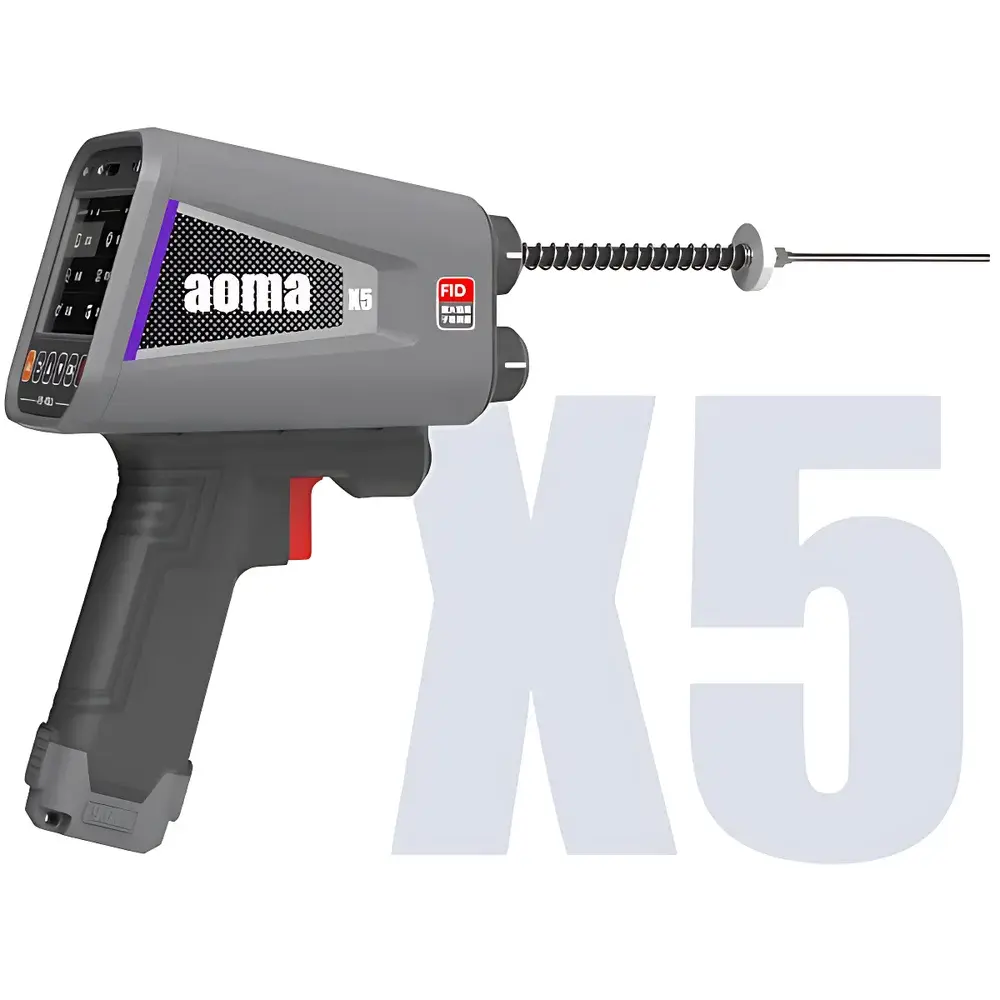
Aoma MINI FID X5 Portable Total Hydrocarbon & VOC Analyzer
| Brand | Aoma |
|---|---|
| Model | MINI FID X5 |
| Detection Principle | Flame Ionization Detection (FID) + Photoionization Detection (PID) |
| Detection Limits | FID – 0.5 ppm methane |
| Detector Options | FID (standard), PID/O₂/CO/CO₂/H₂S (optional) |
| Operating Temperature | −20 °C to +60 °C |
| Relative Humidity | 0–95% RH |
| Explosion Protection | Ex db ia IIC T4 Gb |
| IP Rating | IP66 |
| Weight (incl. battery & hydride cartridge) | 1.4 ± 0.05 kg |
| Dimensions | 267 × 172 × 98 mm |
| Sampling Flow Rate | 0.7 L/min (nominal) |
| Preheat Time | ≤5 min |
| Battery Life | ~10 h (25 °C), ≥4 h (−20 °C) |
| Data Storage | 32 GB internal flash (expandable to 128 GB) |
| Connectivity | Wi-Fi, Bluetooth, USB 2.0 |
| Display | 3.5″ color LCD touchscreen (640 × 480 px) |
| Hydrogen Source | Low-pressure solid-state metal hydride cartridge (0.3–0.75 MPa, 99.99% H₂, ~10 L equivalent capacity) |
| Calibration | Multi-point, user-configurable, ≥2 points |
| Accuracy | FID ±2% of reading (1–10,000 ppm CH₄) |
| Repeatability | FID ±2% (500 ppm CH₄) |
| Stability | ≤±3% drift over 4 h continuous operation |
| Response Time (T90) | FID <2.5 s (10,000 ppm CH₄) |
| Resolution | 0.01 μmol/mol |
| Compliance | HJ 1012–2018, HJ 1230–2021, HJ 733–2014, GB 37822–2019, GB/T 3836–2021 |
Overview
The Aoma MINI FID X5 Portable Total Hydrocarbon & VOC Analyzer is an intrinsically safe, field-deployable gas analysis instrument engineered for high-precision quantification of total hydrocarbons (THC), methane (CH₄), and volatile organic compounds (VOCs) in real time. It employs dual detection architecture—hydrogen flame ionization detection (FID) as the primary quantitative method for broad-spectrum organic compounds, supplemented by photoionization detection (PID) for enhanced sensitivity toward aromatic, olefinic, and heteroatom-containing VOCs. Unlike conventional FID analyzers requiring high-pressure hydrogen cylinders, the X5 integrates a low-pressure solid-state metal hydride hydrogen storage system, eliminating explosion hazards while enabling air-transport compliance and simplified logistics. Its compact form factor, combined with on-board GPS, digital imaging, and AI-assisted workflow guidance, supports Leak Detection and Repair (LDAR) programs under EPA Method 21, ISO 16000-28, and China’s HJ 1230–2021 technical guidelines for industrial VOC emission control.
Key Features
- Dual-Detector Architecture: Simultaneous FID and PID measurement channels ensure comprehensive coverage across aliphatic, aromatic, chlorinated, oxygenated, and sulfur-containing VOCs—including methane, benzene, toluene, xylene, formaldehyde, acetone, chloroform, and naphthalene—without cross-interference or reconfiguration.
- Intrinsic Safety & Hazardous Area Certification: Certified to Ex db ia IIC T4 Gb per GB/T 3836–2021 and rated IP66 per GB/T 4208, the X5 operates safely in Zone 1 explosive atmospheres typical of refineries, chemical plants, pharmaceutical cleanrooms, and paint spray booths.
- Integrated Visual Documentation: Built-in 5-megapixel camera with LED illumination overlays real-time concentration values, timestamp, geolocation (GPS/BeiDou), and instrument ID directly onto captured JPEG images and MP4 video clips—enabling auditable, traceable leak records compliant with GLP and regulatory reporting requirements.
- Intelligent On-Device Analytics: Embedded AI assistant provides voice-guided calibration, context-aware alarm thresholds, automatic baseline correction, and adaptive zeroing—reducing operator dependency and minimizing training burden in multi-shift field operations.
- Modular Sensor Expansion: Optional electrochemical or NDIR sensors for O₂, CO, CO₂, and H₂S can be integrated via standardized interface, supporting multi-gas risk assessment during confined space entry, stack testing, or fugitive emission surveys.
- Field-Optimized Power & Gas Management: Dual hot-swappable lithium-ion batteries (6600 mAh each) and replaceable metal hydride cartridges deliver >10 h runtime at 25 °C. Hydrogen generation requires only deionized water via optional electrolytic generator—eliminating cylinder procurement, handling, and regulatory oversight associated with compressed H₂.
Sample Compatibility & Compliance
The X5 is validated for direct sampling of ambient air, process vents, flanges, valves, pumps, and storage tank surfaces using its heated stainless-steel probe and sintered PTFE filter. It complies with national and international standards governing portable VOC monitoring, including HJ 1012–2018 (China’s technical specification for portable THC analyzers), HJ 1230–2021 (LDAR implementation guidelines), HJ 733–2014 (leak detection methodology), and GB 37822–2019 (unorganized VOC emission control). Instrument performance metrics—including linearity (≤±1.5% FS), repeatability (≤±1.0% for PID, ≤±2.0% for FID), stability (≤±3% over 4 h), and response time (<3 s)—exceed minimum requirements defined in these standards. All firmware and data logging modules support audit-ready metadata tagging, electronic signatures, and export formats compatible with enterprise environmental management systems (EMS).
Software & Data Management
Data acquisition, annotation, and export are managed through a unified embedded OS supporting multiple file formats: CSV/Excel for time-series concentration logs, JPEG for annotated stills, and MP4 for synchronized video+sensor streams. Files are stored on internal eMMC flash (32 GB standard, expandable to 128 GB) and transferable via USB 2.0, Wi-Fi (802.11 b/g/n), or Bluetooth 5.0 to smartphones, tablets, or cloud-based VOC management platforms. The optional RFID module enables automated instrument lifecycle tracking—linking calibration history, maintenance logs, and deployment assignments to facility asset databases. Firmware updates are performed securely over-the-air or via microSD card, with version rollback capability and cryptographic signature verification. All data exports include embedded timestamps, GPS coordinates, detector status flags, and operator ID—ensuring full traceability for regulatory submissions under China’s MEE reporting framework or ISO 14001 EMS audits.
Applications
- Leak Detection and Repair (LDAR) programs across petrochemical refineries, LNG terminals, and pipeline compressor stations
- Compliance monitoring of unorganized VOC emissions from coating lines, printing presses, and pharmaceutical synthesis suites
- Rapid source identification and plume mapping during emergency VOC releases or odor complaints
- Performance verification of abatement technologies—including thermal oxidizers, carbon adsorption beds, and biofilters
- Workplace exposure assessment in confined spaces and maintenance zones where hydrocarbon accumulation poses fire or health risks
- Mobile ambient air quality screening near landfills, wastewater treatment lagoons, and distribution terminals
FAQ
What certification standards does the X5 meet for hazardous area use?
The instrument carries Ex db ia IIC T4 Gb certification per GB/T 3836–2021 and IP66 ingress protection rating per GB/T 4208, permitting deployment in Zone 1 classified locations with gas groups IIC and temperature class T4.
How is hydrogen supplied—and is refilling safe in the field?
Hydrogen is stored in low-pressure solid-state metal hydride cartridges (0.3–0.75 MPa), certified for air transport under IATA Packing Instruction 950. Refilling is performed using either an on-site electrolytic hydrogen generator (pure water input only) or a regulated high-pressure cylinder—both methods avoid open-flame or spark hazards.
Can the X5 generate regulatory-compliant LDAR reports?
Yes. All image/video captures embed GPS coordinates, UTC timestamps, concentration values, and instrument serial numbers. Exported Excel logs include calibrated readings, alarm flags, and operator annotations—fully aligned with HJ 1230–2021 reporting templates and compatible with third-party LDAR software such as LDAR Pro and EnviroTrak.
What gases does the FID detect—and how selective is it?
FID responds to nearly all organic compounds containing C–H bonds (e.g., alkanes, alkenes, aromatics, esters, ketones), with near-uniform sensitivity (~1.00 ± 0.05 relative to methane). It exhibits negligible response to CO, CO₂, NOₓ, SO₂, or H₂O—making it ideal for total hydrocarbon quantification without spectral interference.
Is remote firmware update supported?
Yes. Over-the-air (OTA) updates via Wi-Fi or local microSD card installation are supported. Each firmware release includes SHA-256 checksums, version history, and rollback capability—ensuring integrity and continuity in regulated environments.






