
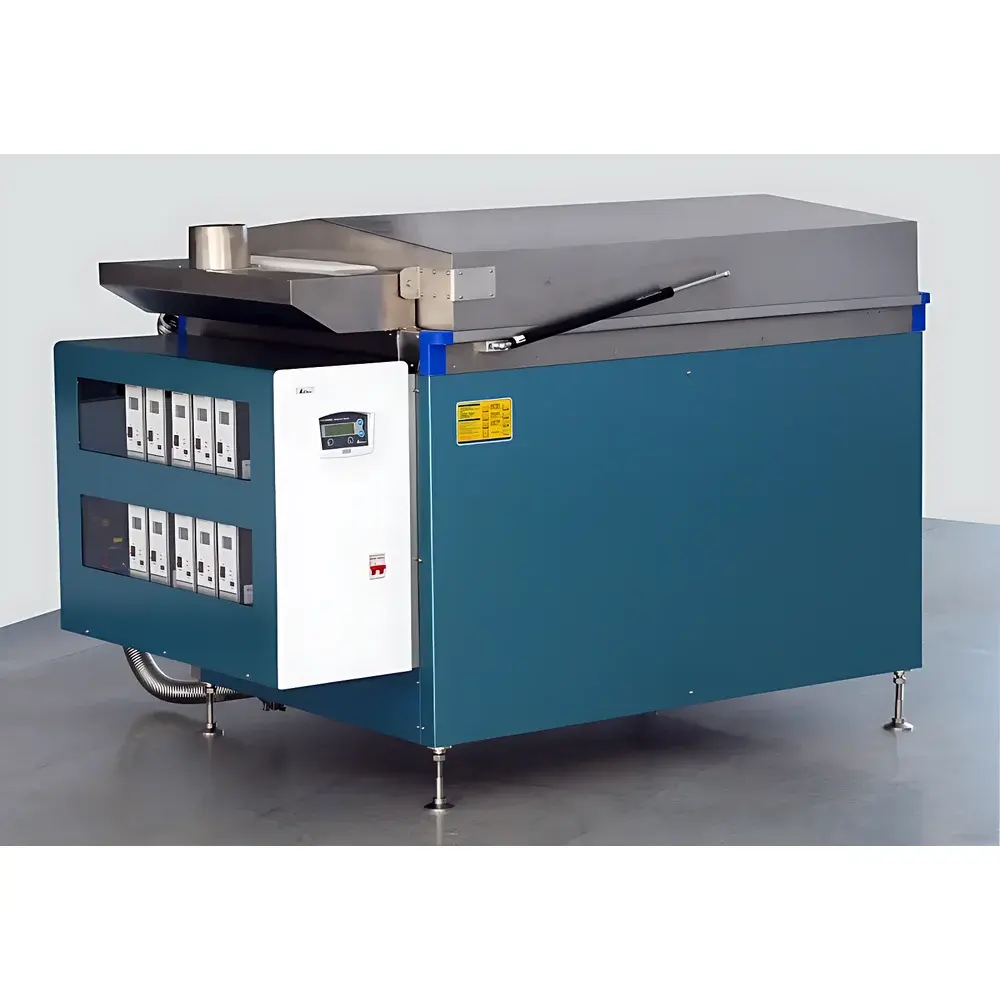
Aoteseins AS8800BT Industrial-Scale Ultrasonic Cleaner
| Brand | Aoteseins |
|---|---|
| Origin | Tianjin, China |
| Model | AS8800BT |
| Capacity | 800 L |
| Ultrasonic Frequency | 28 kHz |
| Total Ultrasonic Power | 8000 W (adjustable) |
| Heating Range | Ambient to 80 °C (adjustable) |
| Timer Range | 1–999 min (adjustable) |
| Sound-Dampening Lid | Included |
| Auto Fill/Drain System | Integrated |
| Power Supply | 380 V AC, 50 Hz, 3-phase 4-wire with dedicated grounding |
| Dimensions (W×L×H) | 1618 × 970 × 1200 mm |
| Tank Internal Dimensions (W×L×D) | 1100 × 800 × 820 mm |
| Max. Load per Trolley | 150 kg × 2 |
| Max. Rail Load Capacity | 300 kg |
Overview
The Aoteseins AS8800BT Industrial-Scale Ultrasonic Cleaner is engineered for high-throughput, precision cleaning of large or complex components in regulated laboratory, R&D, and manufacturing environments. It operates on the principle of acoustic cavitation: high-frequency ultrasonic energy (28 kHz) induces rapid formation and collapse of microscopic vapor cavities in aqueous or solvent-based cleaning media. This transient implosion generates localized pressures exceeding 1000 atm and temperatures up to 5000 K—sufficient to dislodge sub-micron particulates, organic residues, oxides, and biofilms without mechanical abrasion or surface damage. Unlike benchtop units, the AS8800BT integrates a modular transducer architecture with distributed power delivery, enabling stable cavitation intensity across variable liquid depths, temperature gradients, and load geometries—critical for reproducible cleaning validation under GLP, ISO 13485, or ASTM D2603 protocols.
Key Features
- Modular 15-channel ultrasonic generator system (500 W per channel), each with independent digital display and real-time parameter monitoring (frequency, power output, duty cycle)
- Three-dimensional transducer array configuration—bottom-mounted and sidewall-embedded elements ensure uniform energy distribution and eliminate dead zones in large-volume tanks
- Multi-level water-level sensing system automatically activates/deactivates transducer banks based on fill height, optimizing energy efficiency and preventing dry-run damage
- Heavy-duty dual trolley system with 150 kg capacity per carriage and 300 kg rail-rated load support—designed for safe handling of semiconductor wafer carriers, optical lens assemblies, and medical device trays
- Integrated heating (dual 6.5 kW heaters) with PID-controlled temperature regulation (±1 °C accuracy from ambient to 80 °C), supporting aqueous alkaline, acidic, or enzymatic cleaning chemistries
- Sound-dampening lid with hydraulic assist and interlocked safety cutoff—reduces operational noise to <65 dB(A) at 1 m and prevents operator exposure to airborne aerosols
- Automated fill/drain circuit with level sensors and solenoid valves—enables programmable rinse cycles and reduces manual intervention in validated cleaning workflows
Sample Compatibility & Compliance
The AS8800BT accommodates substrates ranging from fragile silicon wafers (≥200 mm diameter) and coated optical lenses to stainless-steel surgical instruments and polymer-based microfluidic chips. Its non-contact cleaning mechanism preserves surface integrity of soft metals (e.g., aluminum alloys), anodized finishes, and thin-film coatings. The unit complies with IEC 61000-6-3 (EMC emissions) and IEC 61000-6-2 (immunity), and its electrical design meets IP54 ingress protection requirements. When operated with validated cleaning agents and documented SOPs, it supports compliance with ISO 14644-1 (cleanroom component cleaning), USP (cleaning validation), and FDA 21 CFR Part 11–ready data logging when paired with optional audit-trail software modules.
Software & Data Management
The AS8800BT includes an embedded industrial controller with RS-485/Modbus RTU interface for integration into centralized lab automation systems (e.g., LabVantage, Thermo Fisher SampleManager). All critical process parameters—including time, temperature, ultrasonic power setpoint, actual power draw, and cycle completion status—are timestamped and stored locally for ≥10,000 cycles. Optional Ethernet-enabled firmware upgrade enables remote monitoring via web-based HMI and export of CSV-formatted logs compliant with ALCOA+ (Attributable, Legible, Contemporaneous, Original, Accurate, Complete, Consistent, Enduring, Available) data integrity principles. Audit trail functionality records user logins, parameter changes, and emergency stops—fully traceable for GMP or ISO 17025 accreditation audits.
Applications
- Semiconductor fabrication: removal of photoresist residues, CMP slurry, and metal contaminants from 300 mm wafers and reticle carriers
- Medical device manufacturing: cleaning of endoscopic channels, orthopedic implants, and electrosurgical handpieces prior to sterilization
- Optics & photonics: particle-free decontamination of anti-reflective coated lenses, laser crystals, and fiber optic ferrules
- Electroplating & surface finishing: pre-treatment of aerospace turbine blades and automotive fuel injectors to ensure adhesion uniformity
- Pharmaceutical R&D: cleaning of glass vials, bioreactor manifolds, and chromatography column hardware between batches
- Academic research: sample preparation for TEM grid mounting, AFM tip cleaning, and nanomaterial dispersion stabilization
FAQ
What is the maximum allowable liquid temperature during ultrasonic operation?
The system supports continuous operation at up to 80 °C; however, sustained use above 60 °C requires compatibility verification with cleaning chemistry and tank liner material (standard 316L stainless steel).
Can the AS8800BT be integrated into a cleanroom environment (ISO Class 5 or better)?
Yes—its sealed transducer housings, low-particulate drain/fill system, and optional HEPA-filtered lid exhaust make it suitable for cleanroom installation when coupled with appropriate facility HVAC and gowning protocols.
Is frequency sweeping or pulse modulation supported?
No—the AS8800BT operates at fixed 28 kHz for optimal cavitation efficiency in large-volume aqueous systems; frequency modulation is not implemented to maintain regulatory consistency in validated cleaning processes.
How is calibration and performance qualification performed?
Users perform daily verification using aluminum foil erosion test (per ASTM E1755) and weekly thermometric mapping; full IQ/OQ/PQ documentation templates are available upon request for GxP-regulated sites.



