
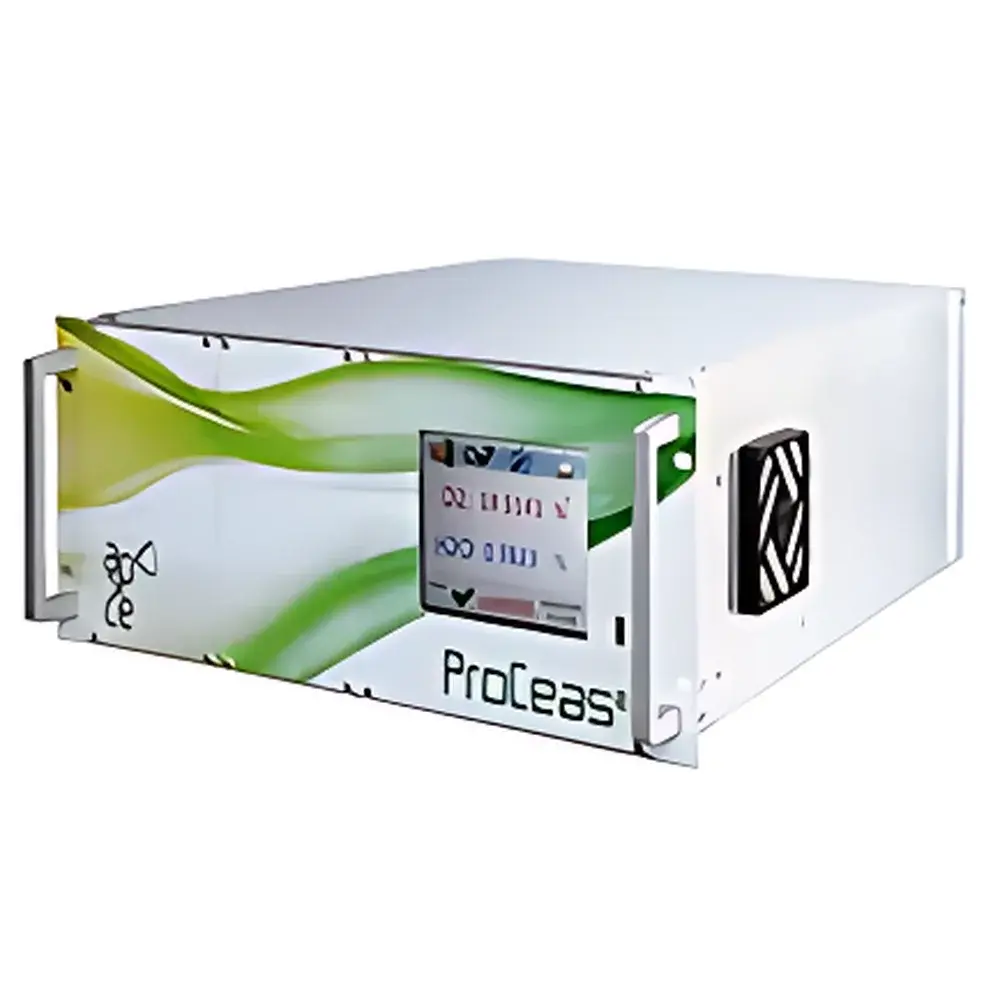
AP2E ProCeas OFCEAS Laser Infrared Multicomponent Gas Analyzer
| Brand | AP2E |
|---|---|
| Origin | Imported (France) |
| Model | ProCeas |
| Principle | Tunable Diode Laser Infrared Absorption Spectroscopy (TDLAS) with Optical Feedback Cavity-Enhanced Absorption Spectroscopy (OFCEAS) |
| Configuration | Online, Rack-Mountable (19", 4U) |
| Response Time | <1 s |
| Detection Limits | Sub-ppb to low-ppm (gas-dependent) |
| Measured Gases | HCHO, H₂S, CH₄, CO, CO₂, H₂, H₂O, HCl, HCN, HF, N₂O, NH₃, O₂, NO, NO₂ |
| Sampling | Low-Pressure Sampling (LPS) System with Sonic Nozzle |
| Zero Drift | None (real-time cavity ring-down noise monitoring & auto-zero compensation) |
| Calibration | Factory pre-calibrated |
Overview
The AP2E ProCeas OFCEAS Laser Infrared Multicomponent Gas Analyzer is an industrial-grade, online trace gas measurement platform engineered for high-fidelity, multi-species quantification in demanding environmental, process, and safety-critical applications. It operates on the physical principle of tunable diode laser absorption spectroscopy (TDLAS), enhanced by patented Optical Feedback Cavity-Enhanced Absorption Spectroscopy (OFCEAS; WO 03031949). This technique leverages a high-finesse optical cavity formed by mirrors with reflectivity >99.99%, yielding an effective optical path length exceeding 50 km within a compact footprint. Combined with active laser current tuning, ProCeas achieves ultra-high spectral resolution of 0.0014 nm (1.4 pm), enabling unambiguous discrimination of closely spaced rovibrational absorption lines. This eliminates spectral overlap and cross-sensitivity—critical for accurate simultaneous quantification of chemically similar species (e.g., NH₃ and H₂O, NO and NO₂, or HCl and HF) in complex matrices. The absence of optical drift and intrinsic real-time zero-point correction via cavity ring-down noise analysis ensure long-term stability without scheduled recalibration or reference gas consumption.
Key Features
- True Multi-Component Simultaneity: Up to two independent measurement cells, each accommodating two tunable diode lasers—supporting concurrent detection of up to 15 gases without time multiplexing or signal averaging compromises.
- Sub-ppb Detection Capability: Achieved through OFCEAS-enhanced sensitivity and pressure-broadening reduction in the Low-Pressure Sampling (LPS) system (WO 2010058107), where sample pressure is reduced 10–20× via sonic nozzle expansion—narrowing absorption linewidths and improving selectivity.
- Zero Maintenance Baseline Stability: Real-time cavity ring-down decay monitoring enables continuous noise subtraction and automatic zero compensation—eliminating baseline drift and obviating external zero gas or manual intervention.
- Low-Cost Installation & Operation: LPS design reduces or eliminates need for heated sample lines (standard operation at ambient temperature when T > 10°C and RH < 65% vol); optional 80°C heating available for cold/humid environments. Sample flow rate: only 3–9 L/h, minimizing filter consumption and pump load.
- Rugged Industrial Architecture: 19-inch, 4U rack-mount chassis (20 kg); optional ATEX/IECEx-certified explosion-proof enclosure for Zone 1/21 hazardous areas; integrated 5.7″ Windows-based touchscreen HMI with WinProCeas software.
- Flexible Integration: Native support for Ethernet (TCP/IP), RS-232/RS-485, Modbus RTU/TCP, and 4–20 mA analog outputs; configurable data logging, alarm thresholds, and remote diagnostics.
Sample Compatibility & Compliance
ProCeas accepts raw, unconditioned sample streams across a wide thermal and compositional envelope: inlet temperature up to 600°C (with optional high-temp probe), total pressure ±100 mbar around 1 atm, and particulate loading compatible with standard sintered metal or ceramic filters. Its LPS architecture inherently suppresses condensation and adsorption artifacts—particularly advantageous for reactive or polar species (e.g., NH₃, HCl, HCN, HCHO). The analyzer complies with key regulatory frameworks governing continuous emission monitoring (CEMS) and occupational hygiene: it supports audit-ready data integrity per FDA 21 CFR Part 11 (electronic records/signatures), meets GLP/GMP data traceability requirements, and aligns with ISO 14644-1 (cleanroom air purity), ISO 21873 (process gas purity), and ASTM D6348 (standard test method for gaseous contaminants in semiconductor process gases). No internal consumables beyond replaceable particulate filters are required during normal operation.
Software & Data Management
WinProCeas—a dedicated Windows Embedded application—provides full instrument control, real-time spectral visualization, calibration management, and configurable reporting. Each measurement cycle captures full absorbance spectra (not just peak heights), enabling retrospective reprocessing and interference validation. Data export supports CSV, XML, and SQL formats; time-stamped records include raw cavity decay curves, laser wavelength scans, and diagnostic flags (e.g., mirror contamination index, pressure deviation alerts). The system logs all user actions and parameter changes with timestamps and operator IDs—ensuring full ALCOA+ (Attributable, Legible, Contemporaneous, Original, Accurate, Complete, Consistent, Enduring, Available) compliance for regulated laboratories and manufacturing sites. Remote firmware updates and secure SSH access are supported via Ethernet.
Applications
- Industrial Emissions Monitoring: Real-time stack gas analysis for NOx, SO2 (via HCl/HF proxy), CO, CO2, N2O, and CH4 in cement, power, and waste incineration plants—meeting EU IED and US EPA PS-11 requirements.
- Semiconductor Fab Ambient Control: ppt-level detection of airborne molecular contaminants (AMCs)—NH3, HCl, HF, HCHO—in cleanroom supply air and tool exhaust ducts per SEMI F21/F25 standards.
- Combustion Optimization & Safety: In-situ monitoring of O2, CO, CH4, and H2 in boiler flue gas and syngas streams for efficiency tuning and explosion risk mitigation.
- Environmental Research: Long-term ambient air monitoring of reactive nitrogen species (NO, NO2, NH3), greenhouse gases (CH4, N2O, CO2), and toxic volatiles (H2S, HCN, HCHO) in urban, agricultural, and landfill settings.
- Chemical Process Analytics: Reaction endpoint detection, catalyst deactivation tracking, and impurity profiling in fine chemical synthesis and polymerization reactors.
FAQ
Does ProCeas require periodic calibration with certified gas standards?
No. ProCeas is factory pre-calibrated using NIST-traceable reference spectra and employs real-time cavity ring-down noise monitoring for automatic zero-point compensation. No span gas or manual calibration is needed under normal operating conditions.
Can ProCeas measure moisture (H₂O) simultaneously with other gases without interference?
Yes. Its ultra-high spectral resolution (0.0014 nm) resolves individual H₂O rotational lines distinct from NH₃, HCl, and HF transitions. The LPS system further minimizes water condensation and surface adsorption artifacts.
What is the maximum allowable particulate concentration in the sample stream?
ProCeas requires particulate filtration to <1 µm. Standard sintered stainless-steel or ceramic filters (included) are sufficient for most industrial applications; upstream cyclonic or coalescing pre-filters are recommended for high-dust environments.
Is the system compliant with hazardous area classification standards?
Yes. Optional ATEX II 2G Ex db IIB T4 Gb and IECEx Ex db IIB T4 Gb certified explosion-proof enclosures are available for installation in Zone 1 (gas) and Zone 21 (dust) locations.
How does the Low-Pressure Sampling (LPS) system improve measurement accuracy?
LPS reduces sample pressure via sonic nozzle expansion, narrowing absorption linewidths (reducing pressure broadening), lowering dew point (minimizing condensation), and increasing gas exchange rate—enhancing both selectivity and response speed while reducing maintenance frequency.
Related Products







