
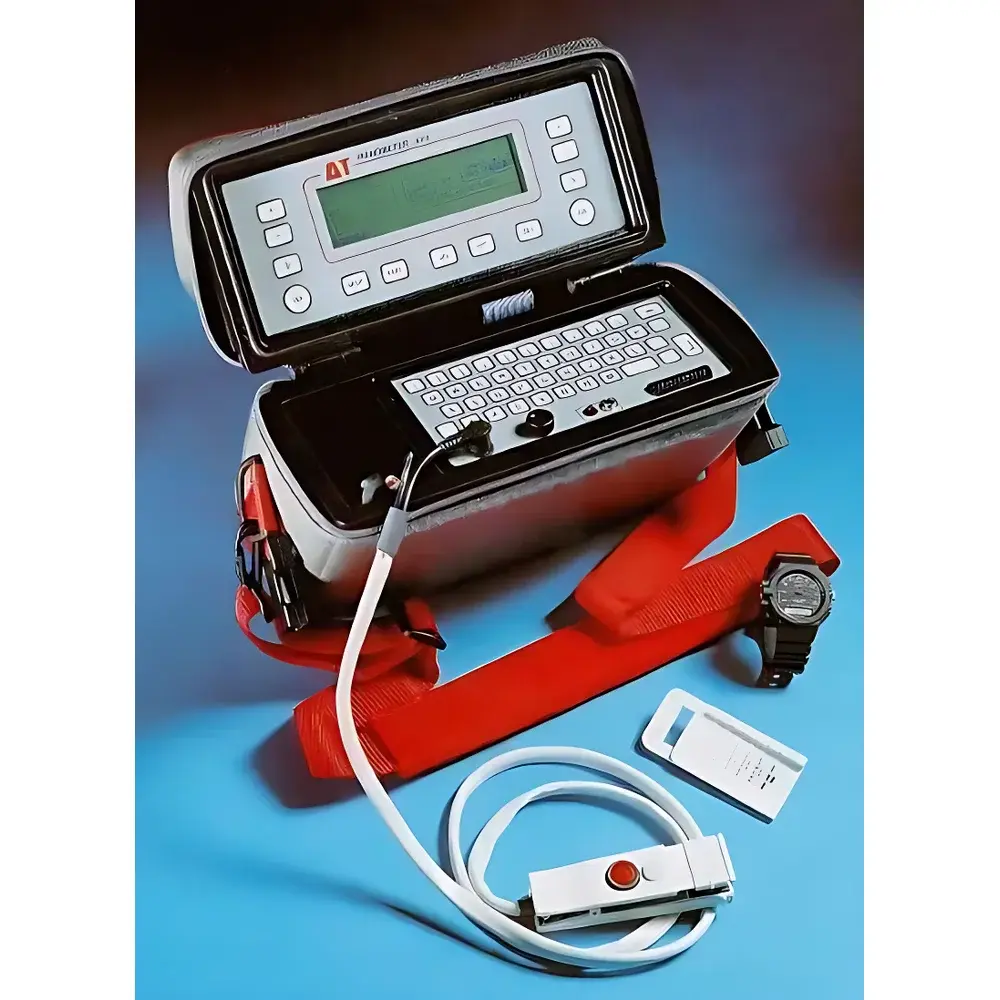
AP4 Portable Leaf Porometer
| Origin | UK |
|---|---|
| Manufacturer Type | Authorized Distributor |
| Origin Category | Imported |
| Model | AP4 |
| Pricing | Available Upon Request |
Overview
The AP4 Portable Leaf Porometer is a field-deployable, diffusion-based porometer engineered for precise, non-destructive quantification of stomatal conductance (gs) and stomatal resistance (rs) in intact plant leaves. It operates on the principle of steady-state water vapor diffusion across a defined leaf chamber boundary, where real-time changes in humidity gradient—measured between ambient air and the leaf surface—are used to calculate stomatal behavior under natural or controlled environmental conditions. Unlike transient or infrared-based methods, the AP4 employs a dual-chamber design with active humidity control and temperature-compensated sensing, enabling high reproducibility in variable field settings. Its core measurement architecture conforms to established physiological protocols aligned with ASTM E1368 (Standard Guide for Measuring Stomatal Conductance) and supports data acquisition consistent with FAO-56 and IPCC vegetation modeling requirements.
Key Features
- Dual interchangeable leaf chambers: one narrow-slot chamber for linear or needle-like leaves (e.g., grasses, conifers), and one circular chamber optimized for broadleaf species—both minimize mechanical stress on the epidermis during clamping.
- Integrated micro-heated RH sensor with ±4% accuracy (0–100% RH range) and PAR (Photosynthetically Active Radiation) sensor (400–700 nm) calibrated traceably to NIST standards.
- Onboard leaf temperature measurement via precision thermistor embedded in the chamber gasket, enabling simultaneous calculation of vapor pressure deficit (VPD) and correction for boundary layer conductance.
- Self-contained 32 KB memory capable of storing 630–1,600 timestamped readings depending on parameter selection (e.g., full dataset vs. summary mode).
- Rechargeable lithium-ion battery system delivering ~20 hours of continuous operation per charge; full recharge time is approximately 14 hours—optimized for multi-day field campaigns without external power.
- Robust IP54-rated housing designed for outdoor use across operational temperatures from 0 °C to 50 °C and relative humidity from 10% to 90% RH.
Sample Compatibility & Compliance
The AP4 accommodates a wide morphological range of angiosperm and gymnosperm foliage—including herbaceous dicots, monocots, succulents, and juvenile conifer needles—through its modular chamber system. All materials contacting plant tissue are inert polypropylene and food-grade silicone, eliminating leaching artifacts. Calibration is performed using a certified reference disc containing six precisely laser-drilled apertures (diameters traceable to ISO 17025-accredited metrology labs), covered with saturated filter paper to generate known diffusive water vapor fluxes. The instrument meets CE marking requirements for electromagnetic compatibility (EN 61326-1) and safety (EN 61010-1). Data integrity complies with GLP principles, supporting audit-ready records when paired with validated Windows software.
Software & Data Management
The AP4 is supported by proprietary Windows-based desktop software (v3.2+), which enables bidirectional USB communication for firmware updates, configuration export/import, and batch download of stored datasets. Raw measurements—including stomatal conductance (mmol m−2 s−1), stomatal resistance (s cm−1), leaf temperature (°C), ambient RH (%), PAR (µmol m−2 s−1), and VPD (kPa)—are exported in CSV and Excel-compatible formats. The software includes built-in validation flags for outlier detection, automatic timestamp synchronization, and optional metadata tagging (e.g., site ID, treatment group, observer initials). For regulated environments, the software supports user-access controls and electronic signature workflows compliant with FDA 21 CFR Part 11 when deployed with validated IT infrastructure.
Applications
- Field phenotyping of drought-tolerant crop varieties under irrigation gradients or rainfed conditions.
- Ecophysiological studies of stomatal response to elevated CO2, ozone exposure, or nutrient limitation in long-term FACE and open-top chamber experiments.
- Validation of canopy-scale gas exchange models (e.g., Farquhar-von Caemmerer-Berry) using leaf-level gs as input constraints.
- Post-harvest physiology assessments of cut flowers and horticultural transplants during cold chain logistics.
- Teaching laboratories for undergraduate plant physiology courses requiring hands-on measurement of ABA-mediated stomatal closure kinetics.
FAQ
How does the AP4 differ from infrared gas analyzers (IRGAs) for stomatal measurement?
The AP4 uses diffusion-based humidity sensing rather than CO2/H2O dual-beam IR absorption. It is lighter, lower-power, and more suitable for rapid screening across large populations—but does not measure photosynthetic rate directly.
Can the AP4 be used on hairy or waxy leaves?
Yes—chamber sealing is achieved via gentle pneumatic pressure and conformal gasket geometry. However, excessive trichomes may require light leaf wiping or use of the narrow-slot chamber to reduce boundary layer interference.
Is calibration required before each use?
A full calibration using the supplied reference disc is recommended daily in high-precision studies or after temperature/humidity extremes; routine field use typically requires only zero-checking against ambient air.
Does the AP4 support GPS-tagged measurements?
No native GPS module is included, but external geotagging is achievable by synchronizing timestamps with handheld GNSS loggers or mobile mapping platforms.
What maintenance is required for long-term reliability?
Annual sensor recalibration by an accredited service center is advised; RH sensors should be cleaned with isopropyl alcohol every 3 months in dusty environments, and chamber gaskets inspected for compression set.
Related Products



