
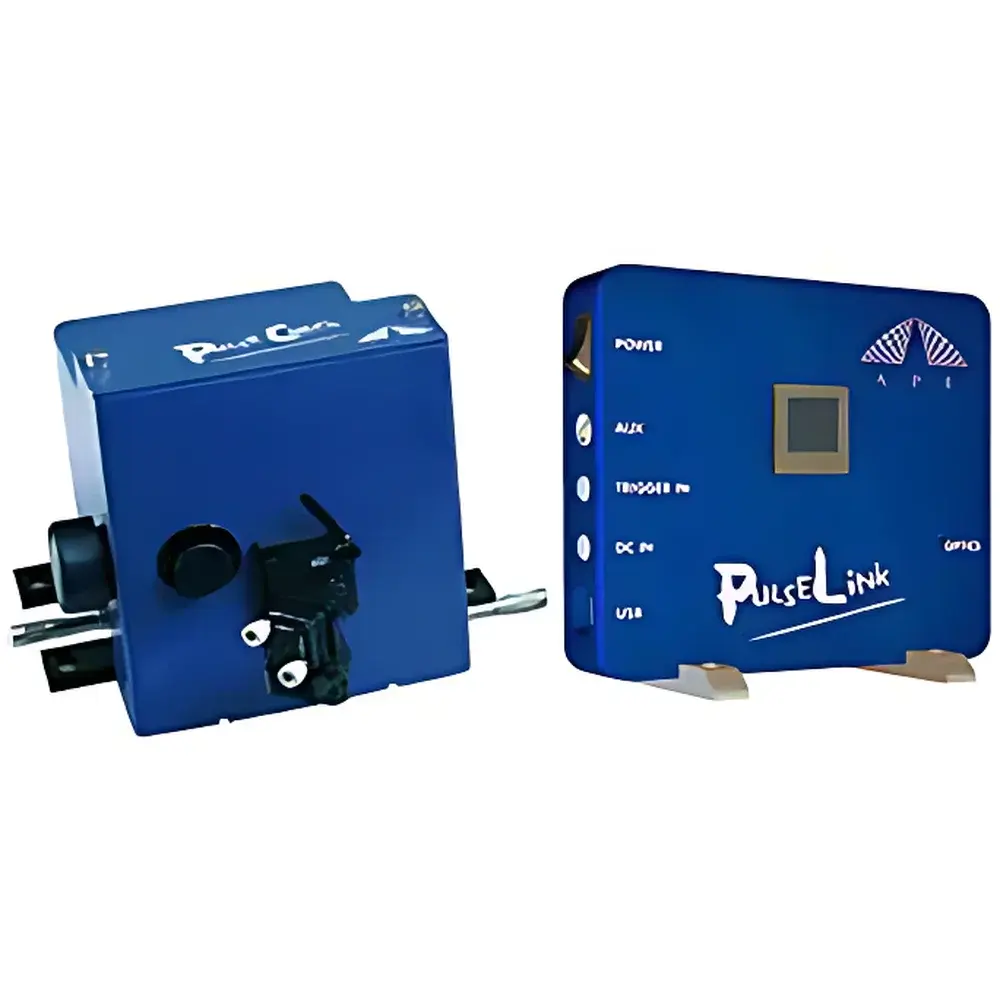

APE pulseCheck USB MIR Series Mid-Infrared Autocorrelator
| Brand | APE |
|---|---|
| Origin | Germany |
| Manufacturer Type | Authorized Distributor |
| Origin Category | Imported |
| Model | pulseCheck USB MIR |
| Price Range | USD 6,800 – 13,600 |
| Wavelength Coverage | 2.0–12.0 µm (via interchangeable MIR photodetector modules) |
| Pulse Duration Measurement Range | 50 fs – 35 ps |
| Temporal Resolution | < 0.5 fs (MIR1), < 1 fs (MIR2–MIR4) |
| Scan Ranges | <15 ps, <50 ps, <150 ps |
| Data Acquisition | 16-bit resolution, hardware-triggered synchronization |
| Interface | USB 2.0, TCP/IP-compatible control protocol |
| Compliance | CE-marked, RoHS-compliant, designed for laboratory-grade metrology environments |
Overview
The APE pulseCheck USB MIR Series is a precision mid-infrared (MIR) autocorrelator engineered for the direct, single-shot measurement of ultrashort laser pulse durations in the 2.0–12.0 µm spectral range. Unlike conventional near-infrared or visible autocorrelators, the pulseCheck USB MIR employs a dedicated optical architecture optimized for low-photon-energy MIR photons—utilizing non-linear crystals and photoconductive detectors specifically selected for phase-matching and responsivity across four discrete MIR bands (MIR1: 2.0–3.2 µm; MIR2: 3.0–5.2 µm; MIR3: 5.0–8.0 µm; MIR4: 7.0–12.0 µm). The instrument operates on the principle of second-harmonic generation (SHG)-based intensity autocorrelation in a collinear, interferometric configuration. A motorized delay line with integrated high-resolution position encoder ensures sub-femtosecond step accuracy and linear temporal mapping. Combined with real-time digitization at 16-bit depth and programmable external trigger support, the system delivers repeatable, traceable pulse width measurements for femtosecond to picosecond-class MIR sources—including OPOs, QCLs, DFG systems, and synchrotron-based broadband MIR pulses.
Key Features
- Dedicated MIR-optimized optical path—mechanically and thermally isolated from standard pulseCheck platforms; MIR optical modules are not cross-compatible with NIR/visible variants
- Four interchangeable photodetector modules enabling seamless coverage across 2.0–12.0 µm without recalibration or alignment rework
- High-precision galvanometric scanner with closed-loop position feedback, delivering <0.5 fs temporal resolution (MIR1) and <1 fs resolution (MIR2–MIR4)
- Three calibrated scan ranges: <15 ps, <50 ps, and <150 ps—user-selectable via software with automatic scaling of time-per-step calibration
- USB 2.0 interface with deterministic latency and full TCP/IP protocol support for integration into automated test benches or networked lab environments
- Hardware-synchronized acquisition with external trigger input (TTL/LVDS), supporting repetition rates down to single-shot or kHz-level MIR sources
- Real-time autocorrelation function reconstruction and FWHM/Gaussian deconvolution—displayed with statistical uncertainty estimation per measurement cycle
Sample Compatibility & Compliance
The pulseCheck USB MIR accommodates free-space MIR beam inputs with diameters up to 8 mm and divergence ≤ ±2 mrad. Input polarization sensitivity is minimized through optimized crystal orientation and broadband anti-reflection coatings. All optical components comply with ISO 10110 surface quality standards (scratch-dig 20–10), and detector modules meet IEC 61000-4 electromagnetic immunity requirements. The system is CE-marked and conforms to EU Directive 2014/30/EU (EMC) and 2011/65/EU (RoHS). While not FDA-cleared (as it is a metrology tool, not a medical device), its measurement traceability supports GLP-aligned calibration workflows when used with NIST-traceable reference pulses or certified MIR pulse standards.
Software & Data Management
Control and analysis are performed via the native pulseCheck Control Suite—a platform-independent application built on Qt framework with native USB and TCP/IP drivers. The GUI provides live waveform visualization, multi-curve overlay, baseline correction, noise gating, and export of raw autocorrelation traces in HDF5 and ASCII formats. All measurement metadata—including detector ID, scan parameters, trigger status, and environmental timestamps—is embedded in exported files. Audit trail functionality logs user actions, parameter changes, and software version history—supporting internal QA documentation and ISO/IEC 17025 laboratory accreditation requirements. Remote operation via SSH or REST API endpoints is available upon request for integration into Python- or LabVIEW-driven automation pipelines.
Applications
- Characterization of ultrafast mid-infrared optical parametric oscillators (OPOs) and amplifiers
- Pulse duration validation for quantum cascade lasers (QCLs) operating in mode-locked or gain-switched regimes
- Time-domain spectroscopy (TDS) source calibration in 2–12 µm fingerprint region
- Development and qualification of difference-frequency generation (DFG) setups targeting molecular vibrational resonances
- Beamline diagnostics at free-electron laser (FEL) facilities requiring MIR pulse metrology
- Academic and industrial R&D labs engaged in nonlinear optics, attosecond science, and ultrafast molecular dynamics
FAQ
Can the MIR optical modules be used with standard pulseCheck USB units?
No. The pulseCheck USB MIR features a fundamentally redesigned optical layout—including modified beam paths, crystal mounts, and detector interfaces—that is incompatible with standard pulseCheck hardware.
Is calibration required before each measurement?
No. Each MIR module is factory-calibrated with wavelength-specific dispersion compensation and time-zero alignment. Recalibration is only necessary after physical module replacement or mechanical shock.
Does the system support averaging over multiple shots?
Yes—software-controlled shot averaging (1–10,000 shots) is supported, with real-time SNR monitoring and automatic rejection of outlier scans based on RMS deviation thresholds.
What is the minimum detectable pulse energy?
Depends on the MIR module and pulse duration; typical thresholds range from 10 nJ (MIR1, 100 fs) to 50 nJ (MIR4, 1 ps) at optimal alignment and repetition rate.
Is firmware update capability included?
Yes—field-upgradable firmware is delivered via secure HTTPS download and installed through the Control Suite with rollback support and version checksum verification.






