
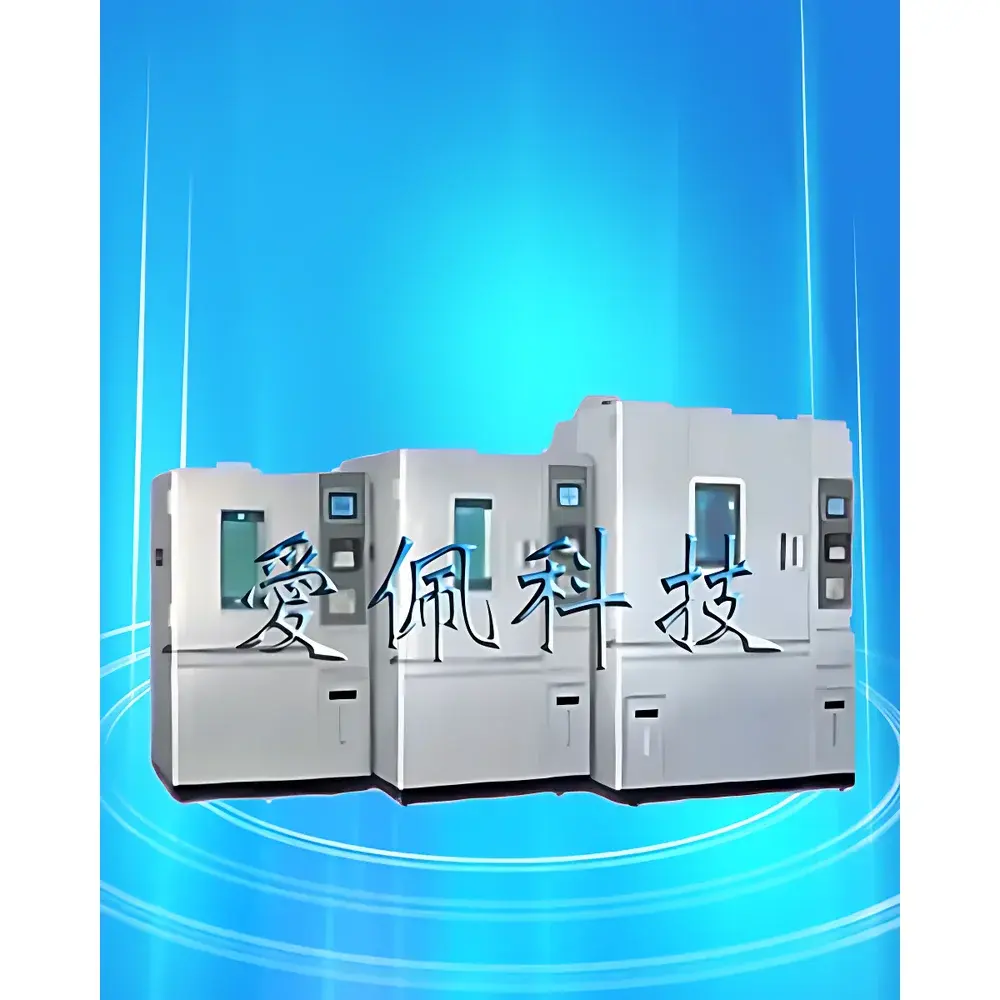
APEKJ AP-HX-408 Programmable Temperature and Humidity Environmental Test Chamber
| Brand | APEKJ |
|---|---|
| Origin | Guangdong, China |
| Manufacturer Type | OEM/ODM Manufacturer |
| Country of Origin | China |
| Model | AP-HX-408 |
| Pricing | Upon Request |
| Internal Volume | 408 L |
| Internal Dimensions (W×D×H) | 60 × 85 × 80 cm |
| External Dimensions (W×D×H) | 105 × 165 × 125 cm |
| Weight | 300 kg |
| Temperature Range | RT+10°C to 100°C |
| Humidity Range | 20–98% RH |
| Temperature Uniformity | ±2°C |
| Temperature Fluctuation | ±0.5°C |
| Humidity Deviation | +2% / −3% RH |
| Heating Rate | ~20 min (from ambient to 100°C) |
| Control System | Imported microcomputer-based integrated temperature & humidity controller with PT100 sensors |
| Heating Method | Independent nickel-chromium alloy electric heaters |
| Humidification Method | External stainless-steel boiler-type shallow-surface evaporation system |
| Air Circulation | Low-noise, high-efficiency centrifugal blower with multi-blade impeller |
| Compliance Standards | GB/T 2423.1–2023 (IEC 60068-2-1), GB/T 2423.2–2023 (IEC 60068-2-2), GB/T 2423.3–2016 (IEC 60068-2-78), GB/T 2423.4–2016 (IEC 60068-2-30), GJB 150.3A–2009, GJB 150.4A–2009, GJB 150.9A–2009 |
Overview
The APEKJ AP-HX-408 Programmable Temperature and Humidity Environmental Test Chamber is an engineered solution for accelerated environmental stress testing in product development, quality assurance, and reliability validation workflows. Designed around the principles of thermodynamic equilibrium and controlled vapor-phase mass transfer, the chamber precisely replicates static and dynamic climatic conditions—including constant high/low temperature, steady-state humidity, and cyclic temperature-humidity profiles—to evaluate material stability, dimensional integrity, electrical performance, and long-term functional resilience. Its architecture supports both IEC 60068-2 series and MIL-STD-810G-compliant test protocols, making it suitable for qualification testing across electronics, automotive components, medical devices, polymer composites, and aerospace subsystems where thermal expansion mismatch, condensation-induced corrosion, or hygroscopic swelling must be quantified under repeatable laboratory conditions.
Key Features
- Robust structural design featuring seamless arc-shaped exterior casing with electrostatic powder coating for enhanced corrosion resistance and ergonomic flat-panel door handles with non-reactive sealing mechanism.
- Triple-layer vacuum-coated observation window with embedded Philips energy-efficient fluorescent lighting—eliminates fogging without mechanical wipers and ensures uninterrupted visual monitoring of test specimens under all operational humidity conditions.
- Physically isolated humidification circuitry: stainless-steel boiler-type evaporative humidifier mounted externally; all water-carrying piping separated from control boards, power distribution units, and sensor signal lines to prevent moisture ingress-related short circuits or insulation degradation.
- Cryogenic-grade refrigeration system incorporating hermetically sealed compressors (imported from Europe/North America), eco-friendly R404A/R134a blended refrigerants, and precision-engineered expansion valves and heat exchangers for stable low-temperature hold capability down to RT+10°C.
- Independent heating module using high-stability nickel-chromium alloy resistive elements with PID-controlled power modulation—ensures rapid, overshoot-free ramping to 100°C within approximately 20 minutes from ambient start conditions.
Sample Compatibility & Compliance
The AP-HX-408 accommodates a broad spectrum of sample geometries and thermal masses—from PCB assemblies and handheld consumer electronics to automotive ECUs, lithium-ion battery modules, and composite structural panels—within its 408-liter working volume. All internal surfaces are constructed from SUS304 stainless steel with rounded corners to minimize condensate pooling and facilitate cleaning per ISO 14644 cleanroom maintenance guidelines. The unit complies with national and international environmental testing standards including GB/T 2423 (equivalent to IEC 60068-2), GJB 150 (military standard equivalent to MIL-STD-810), and supports traceable calibration per ISO/IEC 17025 requirements when used with accredited third-party verification services. Optional data logging modules can be configured to meet FDA 21 CFR Part 11 audit trail requirements for regulated pharmaceutical or medical device applications.
Software & Data Management
The integrated microcomputer controller features dual-channel real-time display of temperature (°C) and relative humidity (%RH), with programmable setpoint resolution of ±0.1°C and ±0.1%RH. Users define multi-step test profiles—including ramp-soak cycles, linear gradients, and dwell periods—with up to 120 segments stored in non-volatile memory. Data acquisition occurs at configurable intervals (1–60 sec), and logged parameters (actual vs. target values, alarm status, compressor runtime, heater duty cycle) are exportable via USB or RS485 interface in CSV format. Optional PC-based software enables remote supervision, statistical process control charting (X̄-R, Cpk), and automated report generation aligned with GLP/GMP documentation frameworks.
Applications
This chamber serves as a core tool in environmental simulation laboratories conducting: thermal cycling endurance tests on surface-mount solder joints; humidity-induced leakage current evaluation in insulated gate devices; condensation resistance validation for outdoor-rated enclosures; accelerated aging of elastomeric seals and adhesives; shelf-life prediction for moisture-sensitive active pharmaceutical ingredients (APIs); and qualification of conformal coatings under combined thermal-hygric stress. It is routinely deployed by QC labs in Tier-1 automotive suppliers, R&D centers developing 5G RF modules, and academic institutions studying polymer degradation kinetics under variable RH exposure.
FAQ
What is the maximum allowable load weight inside the chamber during operation?
The chamber is rated for uniform static loading up to 30 kg distributed across the standard stainless-steel perforated shelf; heavier or asymmetrically placed loads require custom support fixture validation.
Can the controller store multiple test programs simultaneously?
Yes—the internal memory retains up to 100 user-defined profiles, each supporting up to 120 programmable steps with independent ramp rates, soak durations, and alarm thresholds.
Is third-party calibration certification available?
APEKJ provides factory calibration certificates traceable to NIM (National Institute of Metrology, China); optional UKAS- or A2LA-accredited calibration with uncertainty budgets is available upon request.
Does the system support Ethernet connectivity for networked lab integration?
Standard configuration includes RS485; optional Ethernet-to-RS485 gateway modules enable integration into centralized LabVantage or Siemens Desigo CC platforms.
What maintenance intervals are recommended for optimal long-term stability?
Compressor oil inspection every 12 months; humidifier tank descaling every 3 months (or per water hardness level); air filter replacement every 6 months; annual verification of PT100 sensor drift against reference standards.



