
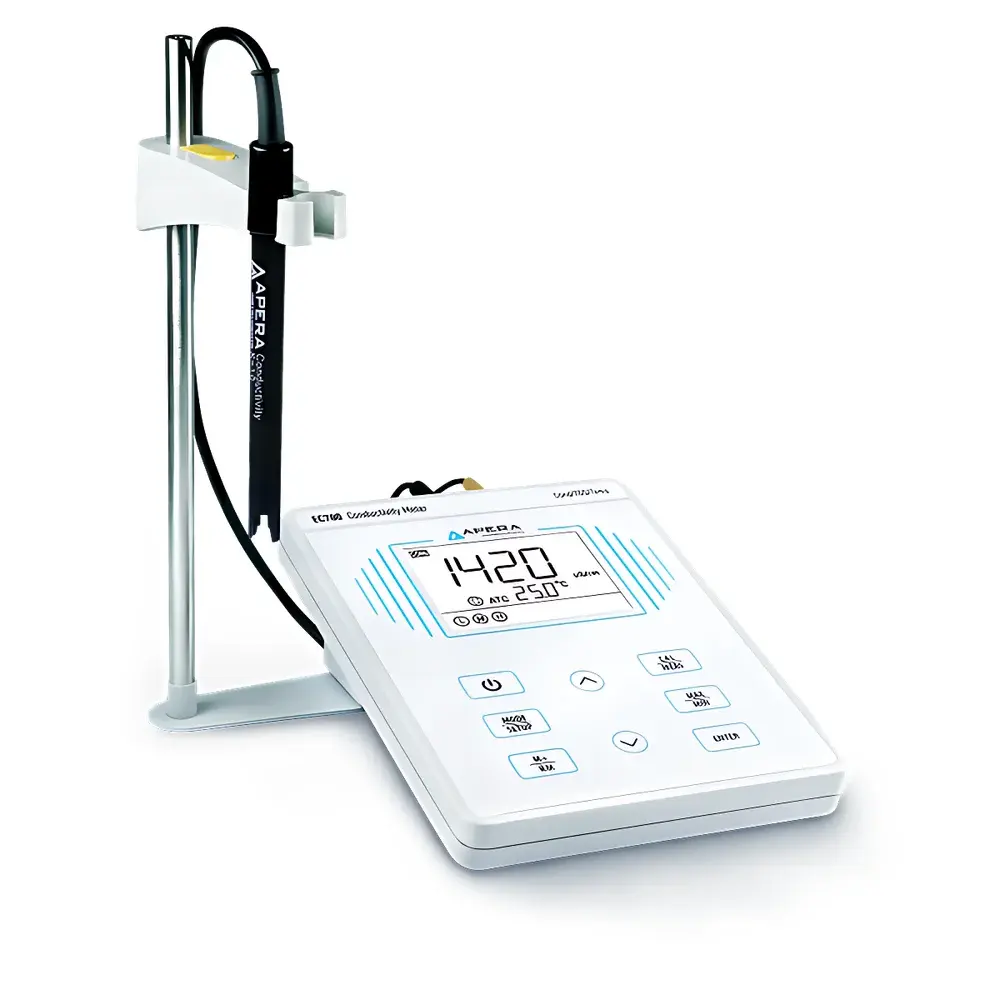
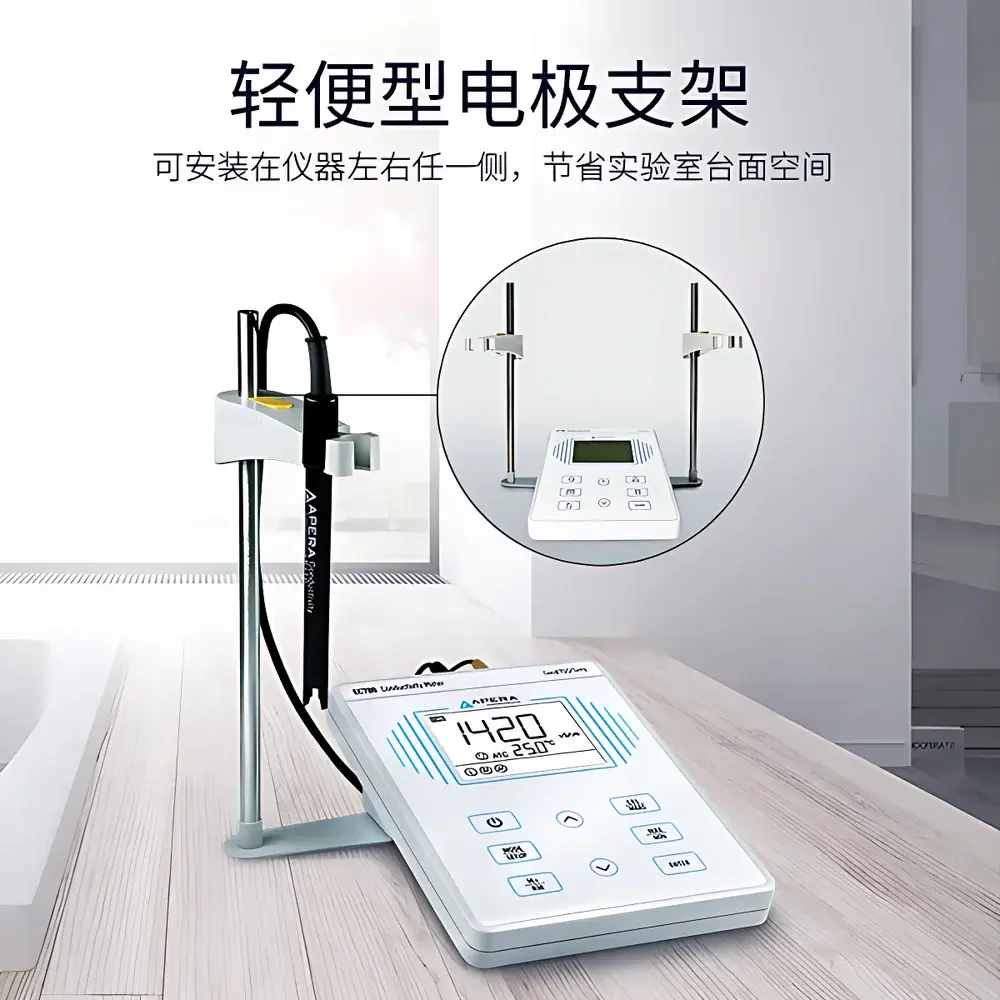
Apera Instruments EC700 Benchtop Conductivity Meter
| Brand | Apera |
|---|---|
| Origin | Shanghai, China |
| Model | EC700 |
| Form Factor | Benchtop |
| Application Environment | Laboratory |
| Conductivity Range | 0–200.0 mS/cm (4 auto-ranging segments: 0–199.9 µS/cm |
| TDS Range | 0–100 g/L (4 segments: 0.0–99.9 mg/L |
| Resistivity Range | 0–100 MΩ·cm (derived from conductivity) |
| Salinity Range | 0–200.0 mS/cm (equivalent to 0–125 ppt NaCl, calculated per ISO 80000-9) |
| Temperature Range | 0–50 °C (auto/manual compensation) |
| Accuracy | ±1.0% FS ±1 digit |
| Resolution | 0.1/1 µS/cm |
| Electrode Constant Options | 0.1 / 1 / 10 cm⁻¹ |
| Temp. Coefficient | 0.00–9.99 %/°C (default 2.00 %/°C) |
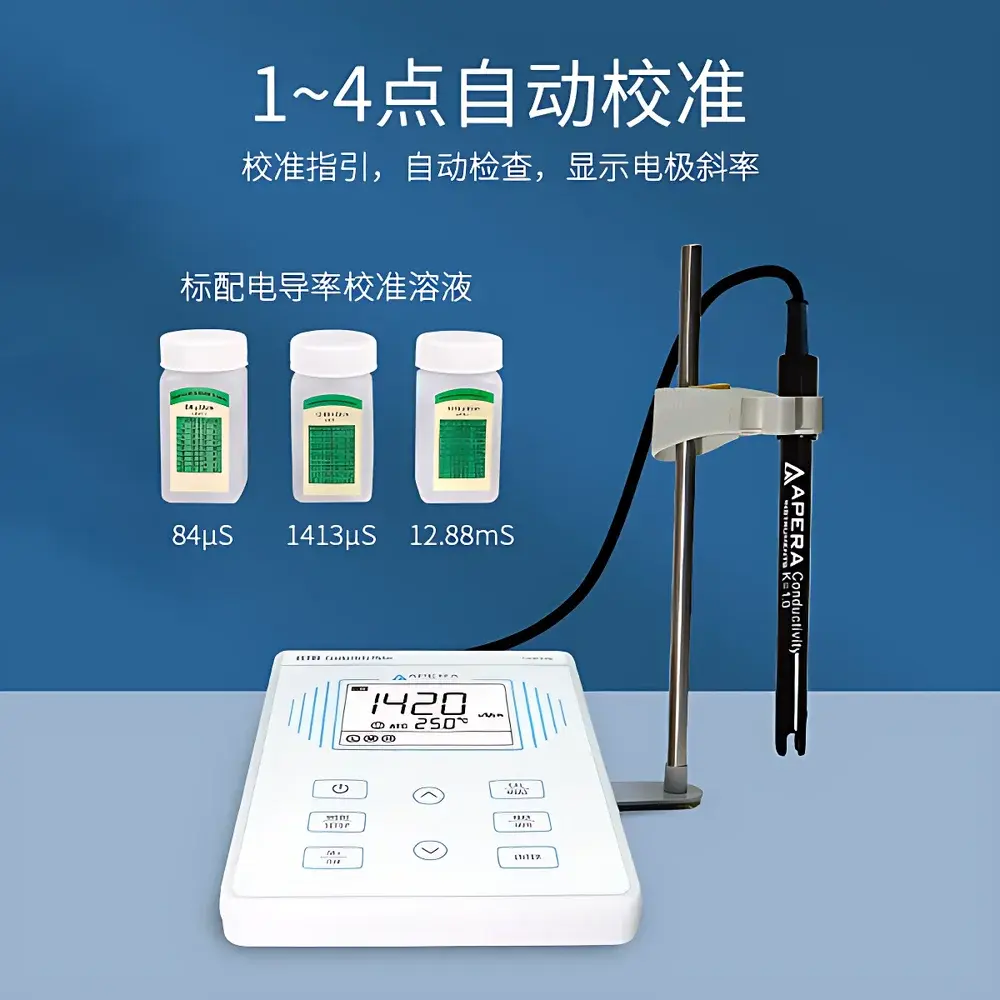
| Calibration | 1–4-point automatic with solution recognition |
| Data Storage | 50 sets (ID, value, unit, temp, TC status) |
| IP Rating | IP54 |
| Dimensions | 240 × 235 × 103 mm |
| Weight | 1.0 kg |
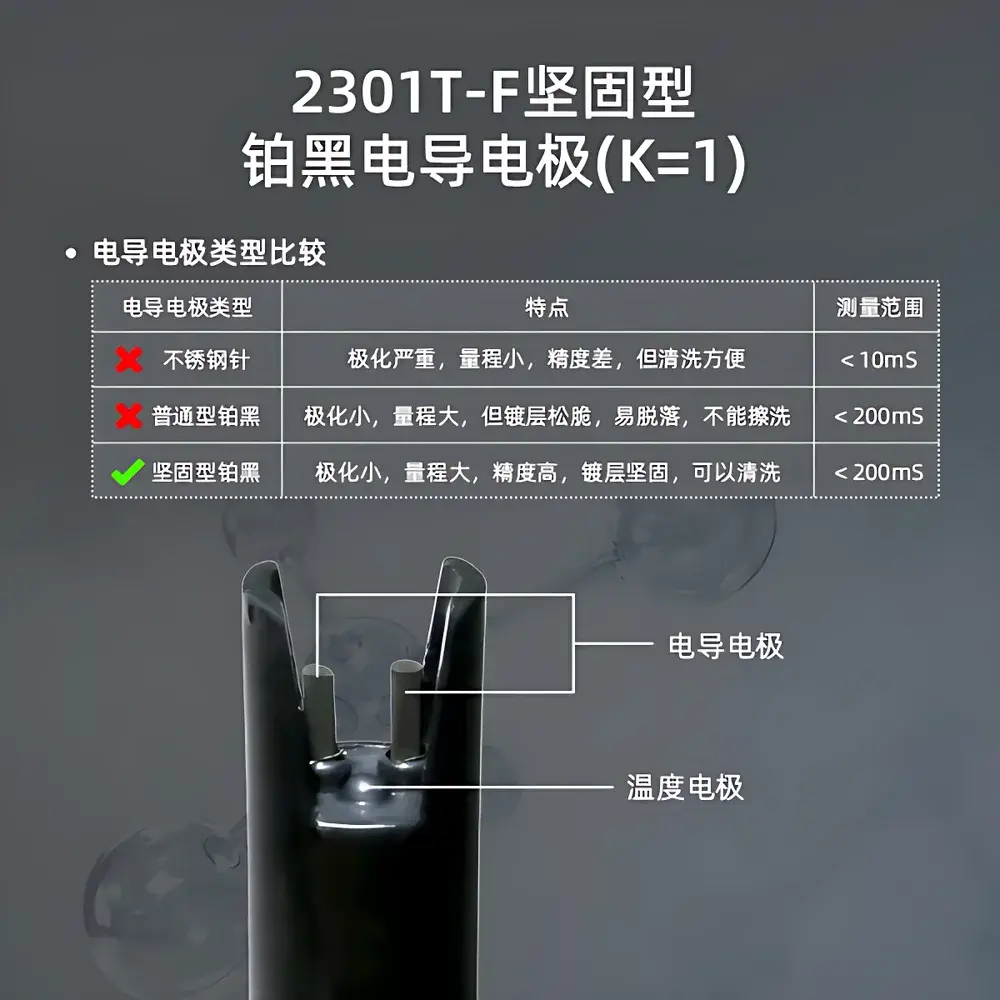
| Included Sensor | 2301T-F Pt-black conductivity cell (K = 1.0 cm⁻¹), POM body, integrated 30 kΩ thermistor |
Overview
The Apera Instruments EC700 Benchtop Conductivity Meter is a precision-engineered, entry-level laboratory instrument designed for reliable, repeatable measurement of electrical conductivity, total dissolved solids (TDS), resistivity, and salinity in aqueous solutions. Based on the fundamental principle of conductometric analysis—measuring the ability of a solution to conduct electric current via ion mobility—the EC700 employs a four-electrode AC excitation method to minimize polarization errors and electrode fouling. Its dual-range digital signal processing architecture enables seamless auto-ranging across four decades of conductivity (from ultra-pure water at <1 µS/cm to concentrated brines up to 200 mS/cm), ensuring high linearity and stability without manual range switching. The instrument complies with core metrological requirements outlined in ASTM D1125 (Standard Test Methods for Electrical Conductivity and Resistivity of Water) and supports traceable calibration protocols aligned with ISO/IEC 17025 quality management systems.
Key Features
- Four-segment auto-ranging conductivity measurement (0–199.9 µS/cm, 200–1999 µS/cm, 2.00–19.99 mS/cm, 20.0–199.9 mS/cm) with selectable electrode constants (0.1, 1.0, or 10 cm⁻¹) for optimal sensitivity across sample types.
- Integrated 2301T-F platinum black conductivity cell (K = 1.0 cm⁻¹) featuring electrochemically deposited Pt-black coating on 316 stainless steel electrodes—enhancing effective surface area, reducing polarization impedance, and improving mechanical adhesion for long-term durability and cleanability with soft-bristled brushes.
- Embedded 30 kΩ NTC thermistor for real-time temperature monitoring and automatic temperature compensation (ATC) across 0–50 °C, with user-adjustable temperature coefficient (0.00–9.99 %/°C) and reference temperature selection (15–30 °C).
- Intelligent digital slip-compensation algorithm that dynamically filters noise and stabilizes readings under variable ionic strength or flow conditions—critical for low-conductivity samples such as deionized water, distilled water, and surface runoff.
- Full-featured microprocessor control enabling 1–4 point conductivity calibration with automatic standard recognition (84 µS/cm, 1413 µS/cm, 12.88 mS/cm), self-diagnostic routines, and on-screen calibration guidance.
- IP54-rated enclosure with rubber-sealed sensor ports and robust ABS/POM housing—designed for sustained operation in teaching labs, QC environments, and routine water quality testing stations where dust and incidental splashes are present.
Sample Compatibility & Compliance
The EC700 is validated for use with a broad spectrum of aqueous matrices, including ultrapure water (UPW), pharmaceutical process water (PW/WFI per USP ), environmental surface waters, wastewater effluents, nutrient solutions, and saline calibration standards. Its Pt-black electrode demonstrates low drift (<±0.5% over 8 h) and high reproducibility (RSD <0.3% for repeated 1413 µS/cm measurements), satisfying GLP documentation requirements for educational and non-regulated QA workflows. While not certified for FDA 21 CFR Part 11 compliance out-of-the-box, audit-ready data logging—including timestamped ID, measured value, unit, temperature, and TC mode—is stored locally in non-volatile memory and exportable via manual transcription for inclusion in laboratory notebooks or LIMS records.
Software & Data Management
Data handling is optimized for efficiency in resource-constrained lab settings: 50 measurement records are retained onboard with full metadata (sequence ID, conductivity/TDS/resistivity/salinity value, unit, temperature reading, and temperature compensation status). Each entry supports recall, review, and selective deletion—no external software or USB interface required. All parameters—including electrode constant, reference temperature, TDS conversion factor (0.4–1.0, default 0.5), and linear temperature coefficient—are fully configurable via intuitive menu navigation. The instrument supports both manual and automatic temperature input modes, allowing integration with external calibrated thermometers when ambient thermal gradients exceed ±0.5 °C across the cell path.
Applications
- Undergraduate and graduate teaching laboratories for fundamental electrochemistry experiments, including Kohlrausch’s law verification and ion mobility studies.
- Environmental monitoring programs assessing freshwater conductivity trends in rivers, lakes, and groundwater wells per EPA Method 120.1.
- Pharmaceutical water system validation (PQ phase) for purified water conductivity checks against pharmacopoeial limits (e.g., USP Stage 1–3).
- Agricultural labs evaluating irrigation water salinity (ECₑ) and nutrient solution concentration in hydroponic systems.
- Food & beverage quality control for monitoring rinse water conductivity during CIP cycle verification.
- Academic research requiring stable, low-drift baseline measurements for colloidal stability or membrane filtration studies.
FAQ
Does the EC700 support GLP-compliant data recording?
Yes—each of the 50 stored measurements includes unique sequence ID, parameter value, unit, temperature, and temperature compensation status, enabling traceable manual transcription into lab notebooks or electronic records.
Can the 2301T-F electrode be used for low-conductivity measurements below 10 µS/cm?
Yes—the Pt-black surface and K=1.0 geometry provide optimal sensitivity and reduced polarization error down to 0.1 µS/cm, making it suitable for UPW and distilled water testing.
Is temperature compensation mandatory during measurement?
No—temperature compensation can be disabled for manual correction or comparative studies; however, ASTM D1125 recommends ATC for reporting standardized values at 25 °C.
What calibration standards are included in the standard kit?
One 50 mL vial each of certified 84 µS/cm (KCl), 1413 µS/cm (KCl), and 12.88 mS/cm (KCl) conductivity standards, traceable to NIST SRMs.
How is electrode maintenance performed?
The 2301T-F cell may be gently cleaned with deionized water and a soft nylon brush; avoid abrasive pads or organic solvents. Store immersed in deionized water or 3 M KCl solution to prevent drying of the Pt-black layer.




