
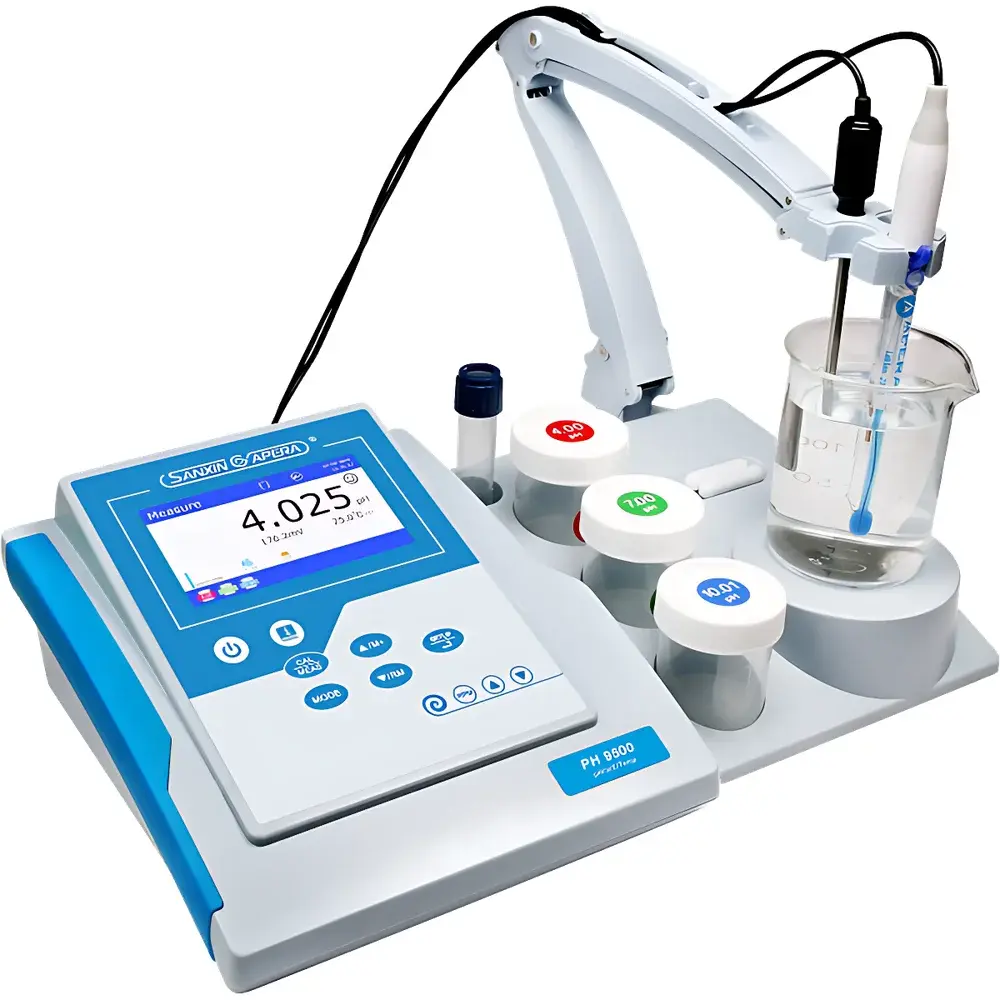
APERA PH9500 Benchtop pH Meter
| Brand | APERA (SANXIN PEIRUI) |
|---|---|
| Origin | Shanghai, China |
| Manufacturer Type | Direct Manufacturer |
| Instrument Type | Benchtop |
| Parameter Type | Single-Parameter (pH) |
| Measurement Range | −2.000 to 20.000 pH |
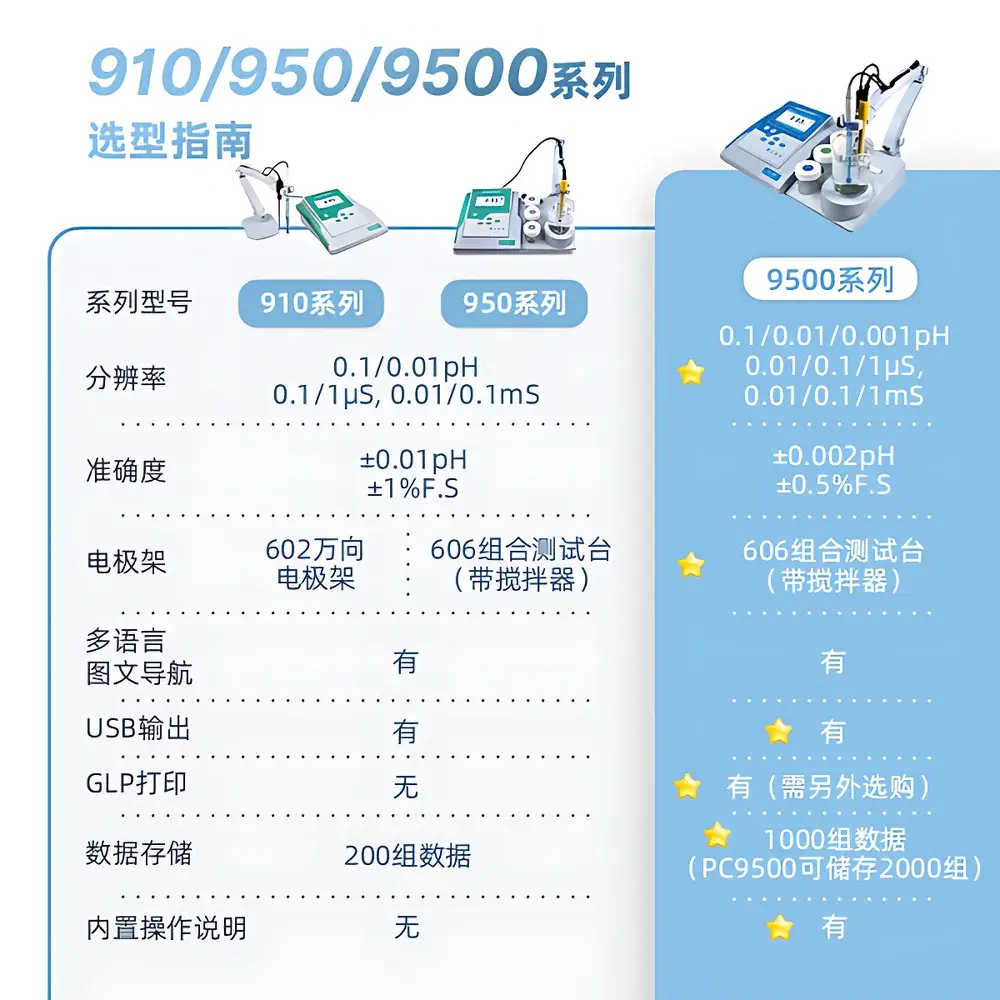
| Resolution | 0.1 / 0.01 / 0.001 pH |
| Accuracy | ±0.002 pH |
| Calibration Precision | 0.001 pH |
| Calibration Standards Supported | USA, NIST, and CH series certified buffer solutions |
| Calibration Points | 1–5-point automatic calibration with slope & offset validation |
| Data Storage | 1000 GLP-compliant records with operator ID, sample ID, electrode ID, calibration password, and institution name |
| Display | 4.3″ TFT color touchscreen with 8-language UI (English, Chinese, Japanese, French, German, Italian, Spanish, Russian) |
| Connectivity | USB port for data export to PC and optional thermal/impact printer (GLP/GMP-compliant printout) |
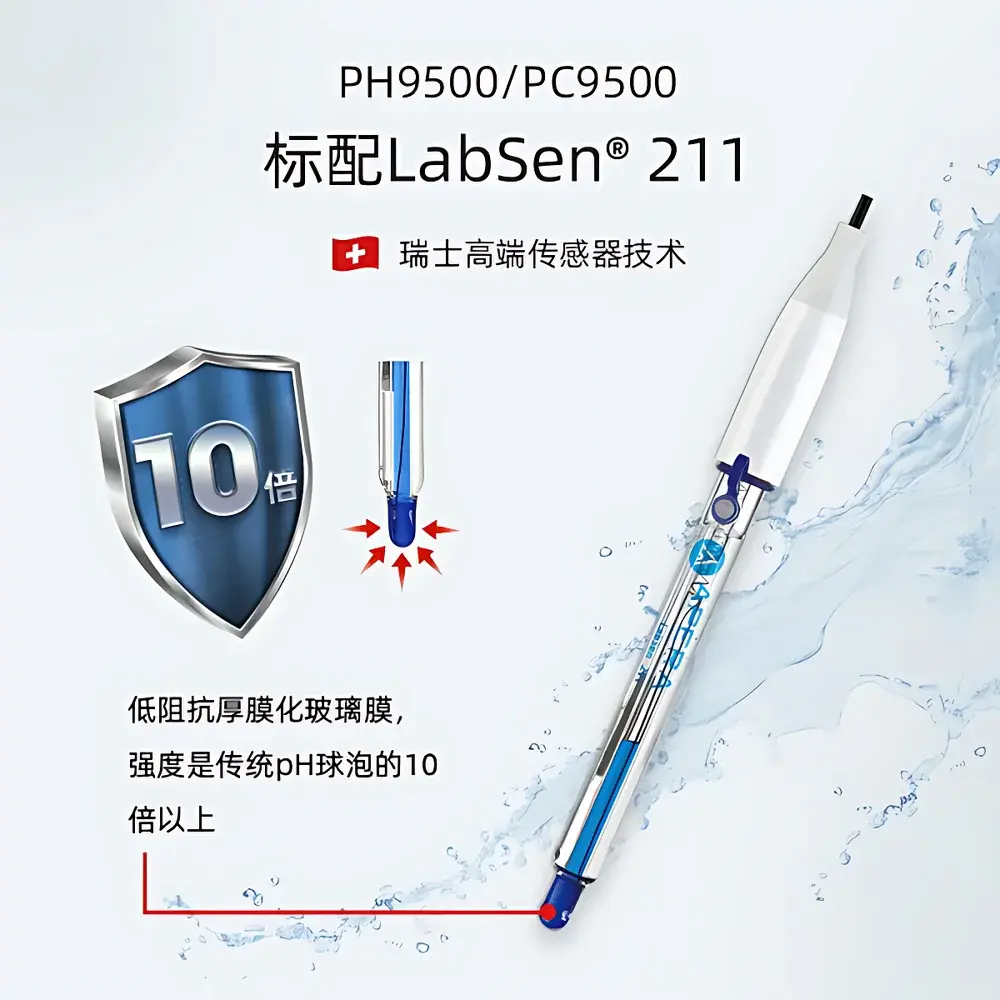
| Electrode | Included LabSen®211 rechargeable glass pH electrode (ISO 3696 Grade 1 compliant) |
| Accessories | 606 Smart Multi-Function Stand (integrated variable-speed stirrer with memory, universal electrode holder, reagent bottle cradle) |
| Input Method | On-screen soft keyboard |
| Onboard Help | Interactive “i” key with context-sensitive operation guides |
| Standard Kit | Three 50 mL certified buffer vials (pH 4.00, 7.00, 10.01), three calibration cups, electrode storage solution |
Overview
The APERA PH9500 Benchtop pH Meter is a high-precision electrochemical measurement system engineered for rigorous laboratory environments where trace-level pH accuracy, regulatory compliance, and long-term operational reliability are non-negotiable. Built upon potentiometric measurement principles—detecting the voltage difference between a pH-sensitive glass electrode and a stable reference electrode—the PH9500 delivers metrologically traceable results across an extended range of −2.000 to 20.000 pH. Its design adheres to fundamental electrochemical standards including ISO 7888 (water quality — determination of pH), ASTM D1293 (standard test method for pH of water), and USP (pH measurement in pharmaceutical preparations). The instrument’s core architecture integrates a low-noise, high-impedance analog front-end (>10¹² Ω input impedance), real-time temperature compensation (via integrated ATC probe or manual entry), and adaptive signal filtering to suppress electromagnetic interference common in shared lab spaces.
Key Features
- Triple-resolution display (0.1 / 0.01 / 0.001 pH) with automatic resolution switching based on calibration mode and measurement stability.
- Automatic 1–5 point calibration with real-time slope calculation, offset verification, and pass/fail assessment against IUPAC-recommended tolerance thresholds (e.g., ≥95% theoretical slope for new electrodes).
- Smart calibration recognition: auto-detection of USA (e.g., pH 4.01, 7.00, 10.01), NIST (e.g., pH 4.005, 6.865, 9.180), and CH-series buffers; supports user-defined multi-point calibration tables with editable nominal values and uncertainties.
- LabSen®211 electrode: Rechargeable, gel-filled Ag/AgCl reference system eliminates liquid junction drift; thick-film glass membrane (Swiss-manufactured) ensures mechanical resilience and rapid hydration kinetics—validated for ≥5,000 measurements under GLP conditions.
- 606 Smart Stand: Motorized stirrer with 0–1200 rpm continuous adjustment and speed memory; articulating electrode arm with 360° rotation and micro-positioning lock; integrated slots for buffer vials, rinse beakers, and spare electrodes.
- On-device GLP data governance: Timestamped records include operator ID, sample ID, electrode serial number, calibration history, ambient temperature, and measured mV value—exportable via USB as CSV or XML with embedded metadata.
Sample Compatibility & Compliance
The PH9500 is validated for aqueous and low-ionic-strength samples typical in environmental monitoring (e.g., rainwater, wastewater effluents), pharmaceutical QC (buffer preparation, dissolution media), academic research (enzyme kinetics, titration endpoints), and food safety testing (acidified products, dairy pH profiling). It complies with GLP (21 CFR Part 58) and GMP (21 CFR Part 211) data integrity requirements when used with audit-trail-enabled software (e.g., APERA DataLink Pro). All calibration buffers meet ISO/IEC 17025-accredited certification criteria. The LabSen®211 electrode is compatible with ISO 3696 Grade 1 water and withstands repeated immersion in aggressive matrices such as 0.1 M HCl, 0.1 M NaOH, and 10% ethanol—without measurable drift over 72-hour continuous operation.
Software & Data Management
Data capture and reporting follow ALCOA+ principles (Attributable, Legible, Contemporaneous, Original, Accurate, Complete, Consistent, Enduring, Available). Each measurement record includes digital signatures (operator ID + password-protected login), electronic calibration logs with slope/offset history, and automatic timestamping synchronized to UTC via host PC. USB exports generate machine-readable files containing raw mV, temperature, calculated pH, electrode impedance, and calibration diagnostics—compatible with LIMS integration (e.g., Thermo Fisher SampleManager, LabVantage). Optional GLP printers produce tamper-evident reports featuring header/footer metadata, QR-coded record IDs, and 21 CFR Part 11–compliant electronic signatures when paired with validated firmware (v3.2+).
Applications
- Pharmaceutical manufacturing: Final product pH verification per USP monographs; cleaning validation rinse water analysis.
- Environmental labs: EPA Method 150.1 (pH of surface waters); ISO 10523 (water quality — pH determination).
- Academic teaching: Quantitative acid-base titration endpoint detection; pKa determination via Gran plot analysis.
- Food & beverage QA: Fermentation process control (yogurt, kombucha); shelf-life stability testing of acidic beverages.
- Materials science: Electrolyte characterization for battery R&D; corrosion inhibitor efficacy screening.
FAQ
What calibration standards are pre-programmed into the PH9500?
The instrument ships with built-in tables for USA (NIST-traceable), NIST (certified reference materials), and CH-series buffers—including pH 1.678, 4.005, 6.865, 9.180, and 12.454—with uncertainty values aligned to NIST SRM certificates.
Can the LabSen®211 electrode be used in non-aqueous solvents?
It is optimized for aqueous systems. For >20% organic content (e.g., methanol, acetonitrile), use the optional LabSen®511 non-aqueous electrode with specialized liquid junction design.
Does the PH9500 support audit trail functionality?
Yes—when connected to APERA DataLink Pro (v2.4+) with enabled audit logging, all user actions (calibration, measurement, configuration changes) are recorded with immutable timestamps, IP addresses (if networked), and operator credentials.
Is the 606 stand compatible with third-party electrodes?
Yes—the universal electrode clamp accepts standard 12 mm OD shafts (DIN/ISO 17025-compliant dimensions) and accommodates both BNC and DIN connectors via included adapters.
How is data integrity ensured during USB transfer?
All exported files include SHA-256 checksums and embedded digital signatures verified by APERA’s public key infrastructure—meeting FDA 21 CFR Part 11 Subpart B requirements for electronic records.



