

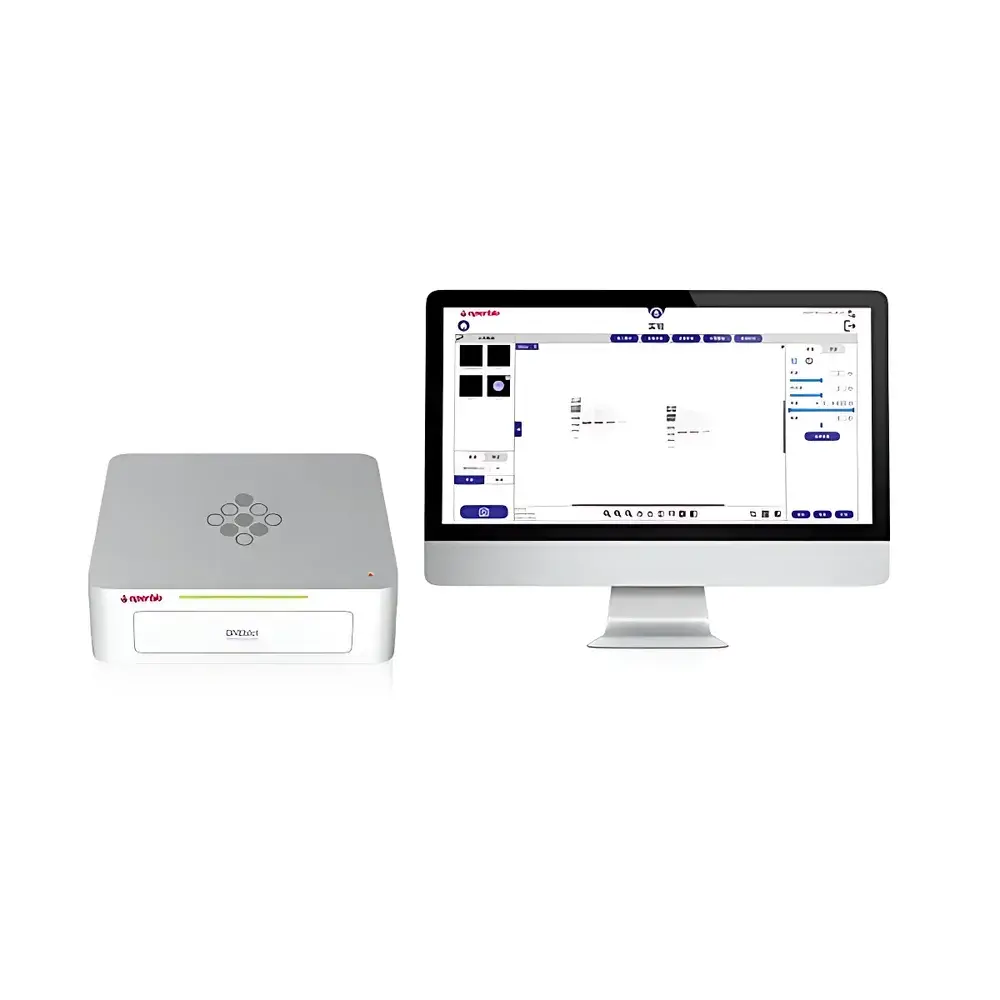
Aperbio ONEblot Near-Field High-Sensitivity Chemiluminescence Imaging System
| Brand | Aperbio |
|---|---|
| Origin | Jiangsu, China |
| Manufacturer Type | Original Equipment Manufacturer (OEM) |
| Instrument Category | Domestic |
| Model | ONEblot |
| Pricing | Upon Request |
| Instrument Type | Chemiluminescence Gel Imaging System |
| Dynamic Range | 6 OD |
| Sensor Area | 170 cm² |
| Detection Sensitivity | fg-level |
Overview
The Aperbio ONEblot Near-Field High-Sensitivity Chemiluminescence Imaging System is a purpose-built digital detection platform engineered for quantitative chemiluminescent signal acquisition from blot membranes and stained gels. Unlike conventional lens-based CCD or CMOS gel imagers, the ONEblot employs a lens-free near-field optical architecture—leveraging direct sensor–sample proximity to maximize photon capture efficiency and minimize signal loss from optical aberration or light path attenuation. This design enables high-fidelity imaging of low-abundance targets without signal amplification bias, supporting reproducible quantification across Western blot, Northern blot, Southern blot, and dot blot workflows. The system integrates a large-area (170 cm²), back-illuminated scientific CMOS sensor with 96 µm × 96 µm pixel pitch, optimized for high quantum efficiency in the visible-to-near-IR spectrum (400–750 nm), where most horseradish peroxidase (HRP) and alkaline phosphatase (AP) chemiluminescent substrates emit.
Key Features
- Lens-free near-field imaging architecture eliminates optical distortion and transmission losses, enhancing effective sensitivity by two orders of magnitude versus conventional CCD-based systems
- Sub-second image acquisition: >95% of standard chemiluminescent blots imaged within 1 second at full sensor resolution, enabled by high full-well capacity (>6 million electrons) and low-noise readout electronics
- 6-log dynamic range (6 OD) ensures linear response across weak and strong bands without saturation or manual exposure bracketing
- Motorized sample tray with precision Z-axis positioning enables repeatable sensor–membrane distance control (±0.1 mm), critical for consistent near-field signal coupling
- OTA-enabled firmware and software updates ensure long-term compliance with evolving data integrity requirements and analytical functionality enhancements
- Cross-platform remote operation via secure Wi-Fi or Ethernet: compatible with Windows/macOS laptops, iOS/Android tablets and smartphones, and HDMI-connected displays
Sample Compatibility & Compliance
The ONEblot supports standard nitrocellulose and PVDF membranes (up to 20 × 20 cm), as well as pre-cast and hand-cast SDS-PAGE, native PAGE, and agarose gels stained with Coomassie Brilliant Blue, silver stain, or SYPRO Ruby. Its lens-free geometry accommodates uneven or warped membranes without focus recalibration. From a regulatory standpoint, the system supports ALCOA+ data integrity principles: audit trails for user actions, electronic signatures (via role-based authentication), and timestamped raw image export (TIFF/FITS format) compliant with GLP and GMP environments. Data files include embedded metadata (exposure time, gain, sensor temperature, user ID), satisfying traceability requirements under FDA 21 CFR Part 11 when deployed with validated IT infrastructure.
Software & Data Management
The ONEblot Control Suite provides an intuitive, guided workflow interface—reducing operator training time while maintaining analytical rigor. Key modules include: (1) Auto-exposure wizard with real-time preview histogram; (2) Band quantification engine using background-subtracted integrated density (ID) with lane normalization and molecular weight calibration; (3) Album-style data repository with tag-based filtering, version-controlled editing history, and encrypted cloud sync (optional); (4) Multi-user account management with customizable permissions (e.g., “Analyst”, “Reviewer”, “Admin”) and isolated workspace allocation; (5) Batch processing pipeline for replicate blots with automated alignment and ratio-based differential expression reporting. All software updates are delivered via authenticated OTA channels with SHA-256 signature verification.
Applications
The system delivers validated performance in core life science applications requiring precise chemiluminescent detection: quantitative Western blotting for post-translational modification analysis and low-abundance biomarker validation; nucleic acid hybridization assays (Northern/Southern blot) with radiolabel-free sensitivity; high-throughput dot/slot blot screening for antibody specificity profiling; and comparative protein gel analysis following electrophoretic separation. Its fg-level detection limit enables reliable visualization of sub-picomolar target levels—particularly advantageous in phosphoproteomics, cytokine signaling studies, and CRISPR-edited cell line characterization where endogenous expression is inherently low.
FAQ
What types of chemiluminescent substrates are compatible with the ONEblot?
Standard HRP- and AP-conjugated substrates—including luminol/peroxide, CSPD, and CDP-Star—are fully supported. No substrate-specific hardware modifications are required.
Does the system support fluorescence or UV transillumination modes?
No. The ONEblot is dedicated exclusively to chemiluminescence and visible-light-stained gel imaging. It does not integrate excitation light sources or emission filters for fluorescence applications.
Can raw image data be exported in machine-readable formats for third-party analysis?
Yes. TIFF (16-bit grayscale) and FITS formats are natively supported, preserving linear intensity scaling and metadata. Export includes EXIF-compliant tags for exposure parameters, sensor temperature, and user-defined annotations.
Is the motorized sample tray serviceable in the field?
The tray actuator assembly is modular and replaceable under warranty. Preventive maintenance intervals are specified at 12 months or 5,000 cycles, whichever occurs first.
How is data security enforced during remote operation?
All network communications use TLS 1.2+ encryption. Device authentication is certificate-based, and session tokens expire after 15 minutes of inactivity. Local storage encryption (AES-256) is enabled by default.
Related Products




