
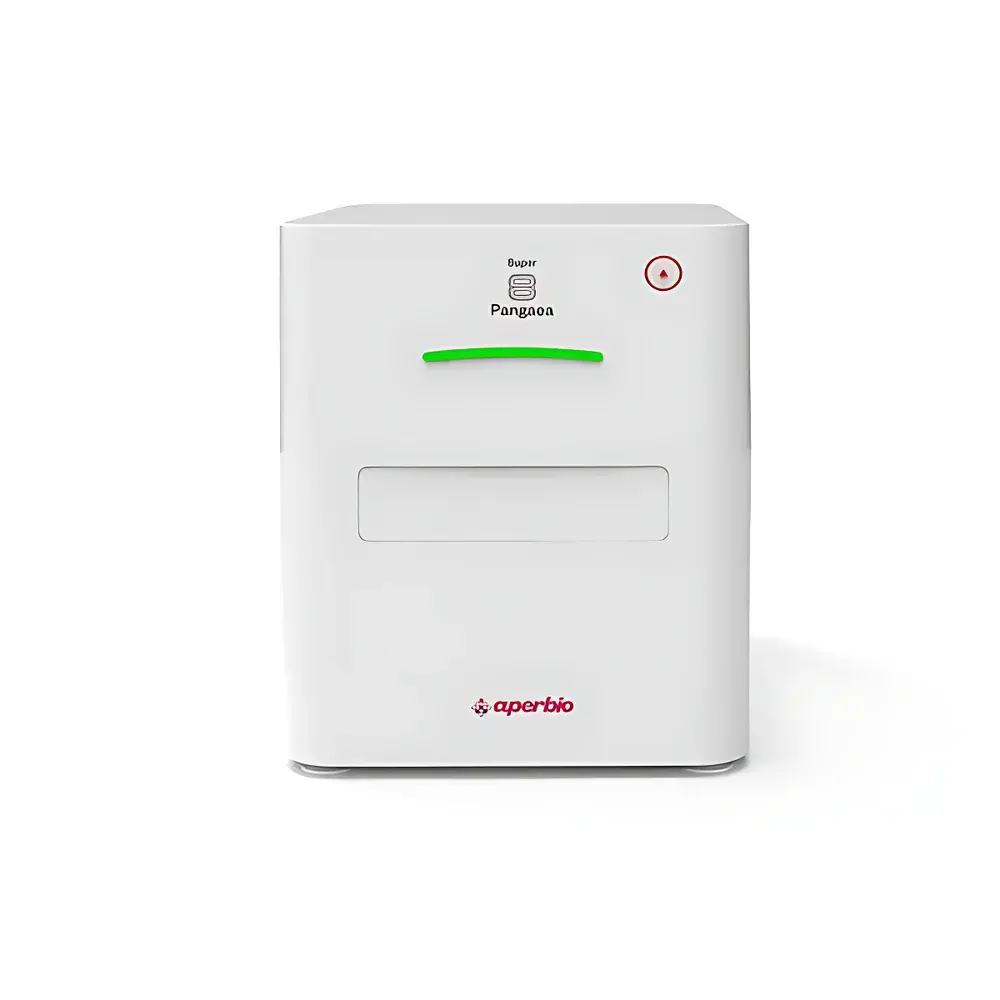
Aperbio Pangaea Super 8 Ultra-Fast Real-Time Fluorescent Quantitative PCR System
| Brand | Aperbio |
|---|---|
| Origin | Jiangsu, China |
| Manufacturer Type | Original Equipment Manufacturer (OEM) |
| Product Category | Domestic Instrument |
| Model | Pangaea Super 8 |
| Instrument Type | Real-Time Fluorescent Quantitative PCR System |
| Sample Throughput | 8 samples |
| Heating Rate | 12 °C/s |
| Temperature Accuracy | ±0.1 °C |
| Inter-Well Temperature Uniformity | ±0.15 °C |
| Detection Channels | 4 (FAM, VIC, ROX, CY5) |
| Reaction Volume | 10–50 µL |
| Optical Detection System | Waveguide-CMOS Integrated Optical Module |
| Dimensions (L×W×H) | 280 × 200 × 230 mm |
| Sample Loading | Motorized Auto-Loading Carousel |
| Operating System | Windows 10 (optimized for Microsoft Surface Go) |
| Multi-Unit Networking | ≥4 units via Ethernet (Wi-Fi adapter optional) |
| Connectivity | RJ45 Ethernet port |
Overview
The Aperbio Pangaea Super 8 is an ultra-fast, portable real-time fluorescent quantitative PCR system engineered for point-of-need molecular diagnostics. It employs a precisely controlled thermal cycling architecture based on Peltier-driven rapid heating and cooling, coupled with a waveguide-integrated CMOS optical detection module to enable high-fidelity fluorescence signal acquisition across four spectral channels (FAM, VIC, ROX, CY5). Unlike conventional benchtop qPCR instruments requiring 60–90 minutes per run, the Pangaea Super 8 achieves full amplification and quantification in ≤20 minutes—enabling actionable results within a single clinical or field-deployment workflow cycle. Its compact footprint, motorized auto-loading sample chamber, and embedded thermal calibration logic eliminate the need for post-movement recalibration, making it suitable for mobile laboratories, border health screening, veterinary field clinics, and decentralized public health surveillance programs.
Key Features
- Ultra-Rapid Thermal Cycling: Achieves heating rates up to 12 °C/s and precise temperature control (±0.1 °C accuracy; ±0.15 °C inter-well uniformity), enabling accelerated two-step or three-step protocols without compromising amplification efficiency or specificity.
- Integrated Waveguide-CMOS Optics: Eliminates traditional filter wheels and PMT-based detection; instead utilizes solid-state waveguide optics coupled directly to a high-sensitivity CMOS sensor for stable, low-noise fluorescence measurement across all four channels—reducing photobleaching artifacts and improving long-term signal reproducibility.
- True Plug-and-Play Portability: Self-contained design (280 × 200 × 230 mm; <4.2 kg) with internal power management supports operation from standard AC input or external 12 V DC sources (e.g., vehicle battery or portable power station), ideal for off-grid deployment.
- Multi-Unit Synchronization: Supports networked operation of ≥4 units via standard Ethernet infrastructure; centralized monitoring and batch result aggregation are managed through the native Windows 10 application—facilitating parallel testing in outbreak response or high-volume screening scenarios.
- Maintenance-Free Calibration Architecture: Embedded reference thermistors and factory-traceable optical alignment eliminate routine user calibration; thermal and optical performance remains validated across transport, ambient temperature shifts (10–35 °C operating range), and repeated power cycles.
Sample Compatibility & Compliance
The Pangaea Super 8 accepts standard 0.2 mL PCR tubes and 8-tube strips with reaction volumes between 10–50 µL. Its thermal block geometry and optical path are optimized for common master mixes and probe chemistries—including hydrolysis (TaqMan), hybridization (Molecular Beacon), and intercalating dye (SYBR Green I) assays. The system complies with ISO 13485:2016 requirements for in vitro diagnostic (IVD) manufacturing quality systems. While not pre-certified as an IVD device, its hardware and software architecture support integration into GLP/GMP-compliant workflows: audit trails, user access controls, electronic signatures, and raw data export (CSV, FAM/VIC/CY5 intensity time-series) align with FDA 21 CFR Part 11 readiness principles. All firmware and analysis algorithms are version-controlled and documented per IEC 62304 Class B software safety standards.
Software & Data Management
Controlled via a dedicated Windows 10 application optimized for touch-enabled devices such as the Microsoft Surface Go, the software provides intuitive protocol setup, real-time amplification curve visualization, automatic Ct determination using second-derivative maximum algorithms, and multi-channel baseline correction. Raw fluorescence intensity data (per well, per cycle, per channel) is stored in vendor-neutral CSV format with metadata (timestamp, instrument ID, operator ID, protocol parameters). Batch export supports LIMS integration via configurable API endpoints. Software updates are delivered via signed firmware packages with SHA-256 integrity verification. No cloud storage or telemetry is enabled by default; all data remains local unless explicitly exported by the user.
Applications
- Rapid pathogen identification (e.g., SARS-CoV-2, influenza A/B, RSV, Mycoplasma pneumoniae) in emergency departments and urgent care settings
- Foodborne pathogen screening (Salmonella, Listeria monocytogenes, E. coli O157:H7) at processing facilities and port-of-entry inspection points
- Veterinary point-of-care testing for avian influenza, canine parvovirus, and bovine viral diarrhea virus
- Environmental monitoring of waterborne pathogens (Legionella pneumophila, Cryptosporidium) in municipal systems
- Academic and industrial research requiring rapid genotyping, gene expression screening, or CRISPR editing validation under time-constrained conditions
FAQ
What is the minimum and maximum reaction volume supported?
The system is validated for 10–50 µL reaction volumes in standard 0.2 mL thin-wall PCR tubes or 8-tube strips.
Does the instrument require daily calibration or maintenance?
No. The embedded thermal and optical reference systems maintain traceable performance without scheduled recalibration or consumable replacement.
Can the Pangaea Super 8 be used in regulated environments (e.g., CLIA labs)?
Yes—its data integrity features (audit trail, user roles, electronic signatures) and documentation package support validation under CLIA, CAP, and ISO 15189 frameworks when deployed with validated assays.
Is Wi-Fi connectivity built-in?
Ethernet (RJ45) is standard; Wi-Fi operation is supported via optional USB-to-Wi-Fi adapters certified for Windows 10 compatibility.
How is thermal uniformity verified across the 8-well block?
Inter-well temperature uniformity (±0.15 °C) was confirmed using NIST-traceable micro-thermocouples placed simultaneously in all positions during accelerated life-cycle testing per ASTM E2234-20.
Related Products




