
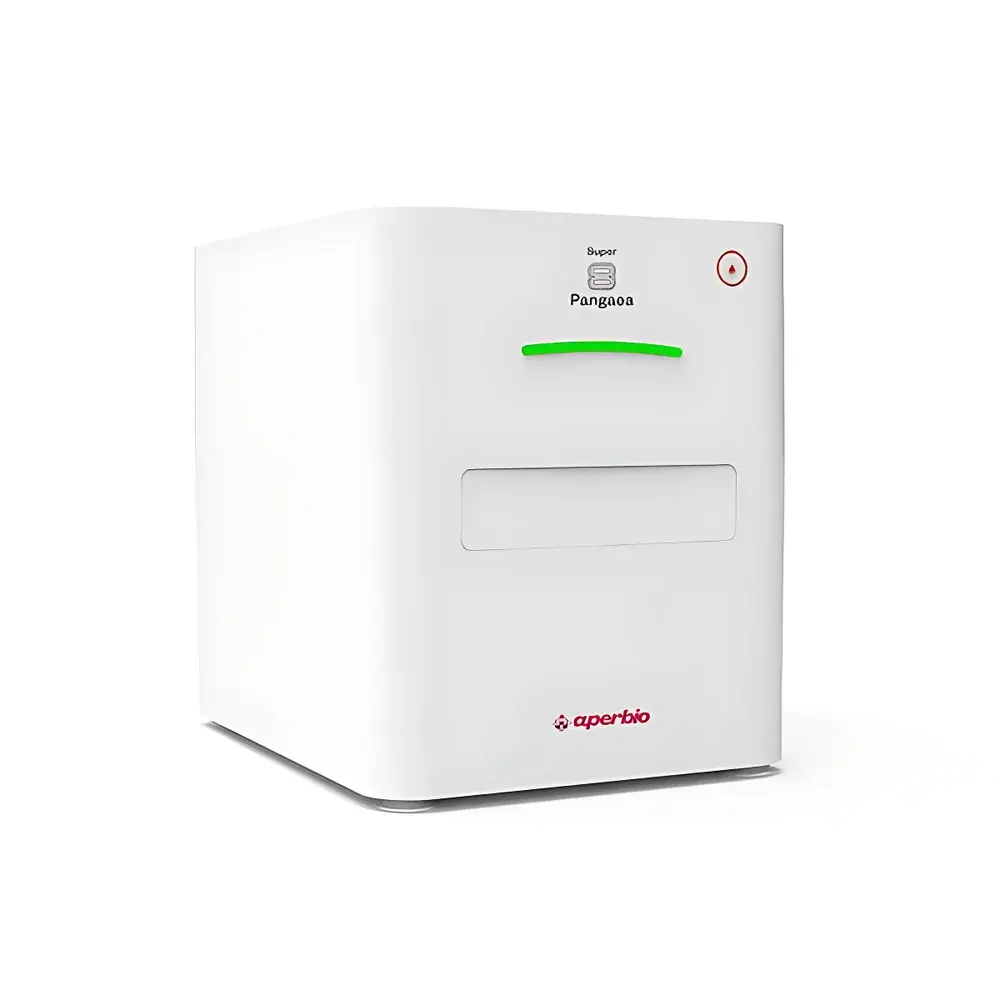
Aperbio Pangaea Super8 Portable Real-Time Fluorescent Quantitative PCR System
| Brand | Aperbio |
|---|---|
| Origin | Jiangsu, China |
| Manufacturer Type | Manufacturer |
| Product Category | Domestic |
| Model | Pangaea Super8 |
| Instrument Type | Real-Time Fluorescent Quantitative PCR System |
| Sample Throughput | 8 samples |
| Heating Rate | 12 °C/s |
| Temperature Accuracy | ±0.1 °C |
| Inter-Well Temperature Uniformity | ±0.15 °C |
| Detection Channels | 4 (FAM/VIC/ROX/Cy5) |
| Reaction Volume | 10–50 µL |
| Optical System | Waveguide-CMOS Integrated Optical Detection |
| Dimensions | 280 × 200 × 230 mm (L×W×H) |
| Sample Loading | Motorized Auto-Loading Tray |
| Operating System | Windows 10 (optimized for Microsoft Surface Go) |
| Multi-Unit Networking | ≥4 units via Ethernet (Wi-Fi adapter optional) |
Overview
The Aperbio Pangaea Super8 Portable Real-Time Fluorescent Quantitative PCR System is an engineered molecular diagnostics platform designed for point-of-need nucleic acid amplification and quantification. Based on real-time fluorescence detection via SYBR Green or probe-based chemistries (e.g., hydrolysis probes), the system employs precise thermal cycling driven by Peltier elements and high-fidelity optical monitoring using a waveguide-coupled CMOS sensor array. Its architecture supports rapid thermocycling kinetics—achieving full qPCR amplification and quantification in as little as 20 minutes—without compromising analytical robustness. Targeted at field-deployable applications including outbreak response, veterinary diagnostics, food safety screening, and decentralized clinical testing, the Super8 meets the operational demands of low-infrastructure environments while maintaining compliance with core performance benchmarks expected of Class II IVD instruments under ISO 13485-aligned manufacturing controls.
Key Features
- Ultra-Rapid Thermal Cycling: Maximum heating rate of 12 °C/s enables accelerated ramping between denaturation, annealing, and extension phases—reducing total assay time without sacrificing amplification efficiency or specificity.
- High Thermal Precision: Temperature accuracy of ±0.1 °C and inter-well uniformity of ±0.15 °C ensure reproducible Cq values across all eight reaction wells, critical for relative quantification and multiplex assay consistency.
- Integrated Optical Architecture: A solid-state waveguide-CMOS optical detection system eliminates moving parts and alignment drift, delivering stable fluorescence signal acquisition across four independent channels (FAM, VIC, ROX, Cy5) with minimal cross-talk.
- True Portability & Operational Autonomy: Compact footprint (280 × 200 × 230 mm), integrated motorized sample tray, and battery-compatible power input allow deployment in mobile labs, biosafety level 2 (BSL-2) field stations, or remote clinics without external calibration or routine service intervention.
- Network-Ready Scalability: Supports Ethernet-based daisy-chaining of up to four units under centralized software control—enabling parallel processing of up to 32 samples per session while preserving individual instrument traceability and audit-ready data logs.
Sample Compatibility & Compliance
The Pangaea Super8 accommodates standard 0.2 mL thin-wall PCR tubes and 8-well strips within its fixed-block configuration. Reaction volumes range from 10 to 50 µL, compatible with common master mixes and lyophilized reagent formats used in WHO-recommended diagnostic assays (e.g., SARS-CoV-2 N-gene targeting, influenza A/B differentiation, or Mycobacterium tuberculosis IS6110 detection). The system operates in accordance with ISO 20387:2018 (biobanking) and aligns with essential principles of CLIA-waived test design per FDA guidance. While not pre-certified for IVD use in EU or US markets, its hardware architecture and firmware logging structure support validation pathways compliant with ISO 15189, ISO 17025, and GLP/GMP documentation requirements—including electronic signature readiness and user-access-level permissions.
Software & Data Management
Controlled via a dedicated Windows 10 application optimized for touch-enabled devices such as the Microsoft Surface Go, the software provides intuitive workflow navigation, real-time amplification curve visualization, automatic baseline and threshold assignment, and ΔΔCt-based relative quantification. All raw fluorescence intensity data, thermal profiles, and user actions are timestamped and stored locally in encrypted SQLite databases. Export options include CSV, PDF reports, and MIQE-compliant metadata files. Audit trails capture operator ID, session start/end times, parameter modifications, and result exports—supporting regulatory readiness for 21 CFR Part 11 compliance when deployed with validated identity management infrastructure.
Applications
- Rapid pathogen identification in resource-limited settings (e.g., malaria parasite detection in endemic regions)
- Veterinary point-of-care testing for avian influenza, foot-and-mouth disease virus, or African swine fever virus
- Foodborne pathogen screening (Salmonella spp., Listeria monocytogenes) during farm-to-fork inspections
- Environmental monitoring of waterborne viruses (e.g., norovirus, adenovirus) in municipal wastewater surveillance programs
- Academic and biotech lab use for gene expression profiling, genotyping, and CRISPR editing validation where throughput prioritization outweighs ultra-high sensitivity needs
FAQ
Does the Pangaea Super8 require regular optical recalibration after transportation?
No. The waveguide-CMOS optical path is factory-aligned and mechanically stabilized; no field recalibration is needed following relocation or vibration exposure.
Can the system perform melt curve analysis?
Yes—software-supported high-resolution melting (HRM) mode is available for post-amplification discrimination of SNP variants and amplicon verification.
Is remote monitoring supported?
Local network access enables remote desktop control and live data streaming via secure RDP or VNC protocols when configured within institutional IT policies.
What reagent kits are validated for use with this instrument?
Aperbio provides a list of third-party and in-house validated master mixes optimized for fast-cycling protocols; users may also validate proprietary chemistries following ISO/IEC 17025 method verification guidelines.
How is data integrity ensured during multi-unit network operation?
Each unit maintains independent local storage with SHA-256 hashed file integrity checks; synchronized timestamps and unique instrument IDs prevent data collision during centralized aggregation.



