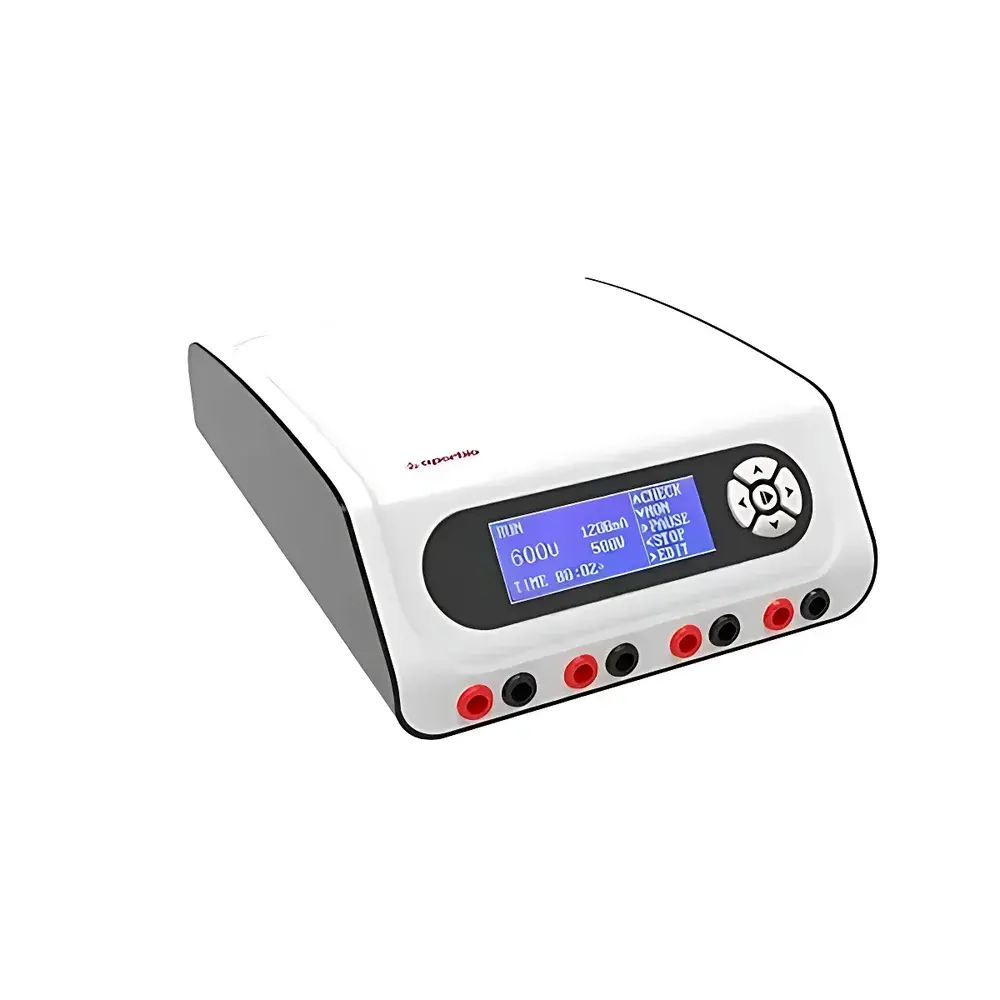
Aperbio PowerBasic 300 Electrophoresis Power Supply
| Brand | Aperbio |
|---|---|
| Model | PowerBasic 300 |
| Output Modes | Constant Voltage, Constant Current, Constant Power |
| Voltage Range | 5–300 V |
| Current Range | 1–400 mA |
| Dimensions (L×W×H) | 308 × 242 × 100 mm |
| Display | LCD showing real-time voltage, current, power, and timer |
| Programmable Methods | 10 stored protocols, up to 10 steps per method |
| Parallel Outputs | 4 independent output channels |
| Safety Features | Overvoltage, arc detection, open-circuit alarm, short-circuit/overload protection, leakage current protection, auto-recovery after power interruption, pause/resume function |
| Gel Compatibility | Optimized for SDS-PAGE, native PAGE, agarose gel electrophoresis, and isoelectric focusing (IEF) applications |
Overview
The Aperbio PowerBasic 300 Electrophoresis Power Supply is an engineered solution for reproducible, high-fidelity nucleic acid and protein separation in academic, clinical, and industrial laboratories. Designed around the fundamental principles of controlled direct-current (DC) power delivery, it supports standard electrophoretic techniques including vertical slab gel electrophoresis (e.g., SDS-PAGE), horizontal agarose gel systems, and discontinuous buffer systems requiring precise voltage or current regulation. Its triple-mode output architecture—constant voltage, constant current, and constant power—enables optimal run conditions across diverse gel matrices, buffer compositions, and sample loads. The unit operates without internal fans, minimizing electromagnetic interference and mechanical vibration that could compromise resolution in sensitive separations. All electrical pathways comply with IEC 61010-1 safety standards for laboratory equipment, ensuring operational integrity under variable ambient humidity and temperature conditions typical of shared core facilities.
Key Features
- Triple-output mode selection (constant voltage, constant current, constant power) for adaptive control across gel types and run phases
- Real-time LCD display showing concurrent voltage (V), current (mA), power (W), and countdown timer (hh:mm:ss)
- Four independent parallel output channels—each electrically isolated—to drive multiple electrophoresis tanks simultaneously without cross-talk or load imbalance
- Programmable protocol storage: 10 user-defined methods, each supporting up to 10 sequential steps with individually set parameters and timing
- Automated transition logic for discontinuous gel systems: automatic shift from stacking-gel (low-voltage) to resolving-gel (high-voltage) conditions upon completion of the first phase
- Transparent polycarbonate housing enabling visual verification of internal status indicators and component integrity during operation
- Comprehensive electronic protection suite: overvoltage cutoff, arc detection, open-circuit alarm, short-circuit response (<10 ms), leakage current monitoring (<0.5 mA threshold), and auto-restart after transient power loss
Sample Compatibility & Compliance
The PowerBasic 300 is validated for use with standard commercial electrophoresis chambers—including mini-PROTEAN®, Bio-Rad Sub-Cell GT™, and Thermo Fisher Owl E1 series—as well as custom-built vertical and horizontal rigs. It meets ISO 9001 manufacturing quality requirements and conforms to CE marking directives (2014/30/EU EMC Directive and 2014/35/EU Low Voltage Directive). For regulated environments, its deterministic output behavior and non-volatile method storage support GLP-compliant documentation workflows. While not FDA 21 CFR Part 11 certified out-of-the-box, audit trails can be generated via external logging when paired with time-stamped digital cameras or networked lab information management systems (LIMS).
Software & Data Management
No proprietary software installation is required; all configuration and execution are performed locally via front-panel controls and the integrated LCD interface. Method files are retained in non-volatile memory with write-protection against accidental overwrite. Each stored protocol includes step-wise voltage/current targets, ramp rates (where applicable), duration, and end-condition triggers (e.g., “stop on current drop”). Export of runtime logs requires manual transcription or third-party serial-to-USB capture using standard RS-232 or TTL-level UART interfaces (available via optional adapter). The unit supports timestamp-synchronized operation when triggered externally via TTL pulse input.
Applications
- SDS-PAGE and native PAGE for molecular weight estimation and oligomeric state analysis
- Agarose gel electrophoresis of PCR products, plasmid DNA, and restriction fragments (0.1–20 kb range)
- Two-dimensional electrophoresis (2-DE) first-dimension IEF runs under constant voltage mode
- Western blot transfer optimization using semi-dry or tank blotting systems
- Preparative electrophoresis for protein purification and fraction collection
- Teaching laboratories requiring intuitive, fail-safe power control for undergraduate instruction
FAQ
Can the PowerBasic 300 be used with high-percentage polyacrylamide gels requiring >200 V?
Yes—its 300 V maximum output supports high-resolution Tris-Tricine or Bis-Tris gels up to 20% T, provided appropriate buffer conductivity and cooling are maintained.
Does it support gradient elution or voltage ramping during a single run?
Yes—multi-step programmable protocols allow linear or stepwise voltage/current transitions between defined intervals.
Is remote computer control possible?
Not natively; however, external microcontroller-based automation (e.g., Arduino or Raspberry Pi) can interface via TTL trigger and serial feedback lines.
What maintenance is required?
None beyond periodic cleaning of ventilation slots and visual inspection of output terminals for corrosion or pitting.
How does the open-circuit alarm behave during gel loading pauses?
It activates within 3 seconds of detecting no load impedance (<1 kΩ); pressing “Pause” suppresses the alarm while retaining all active settings.