
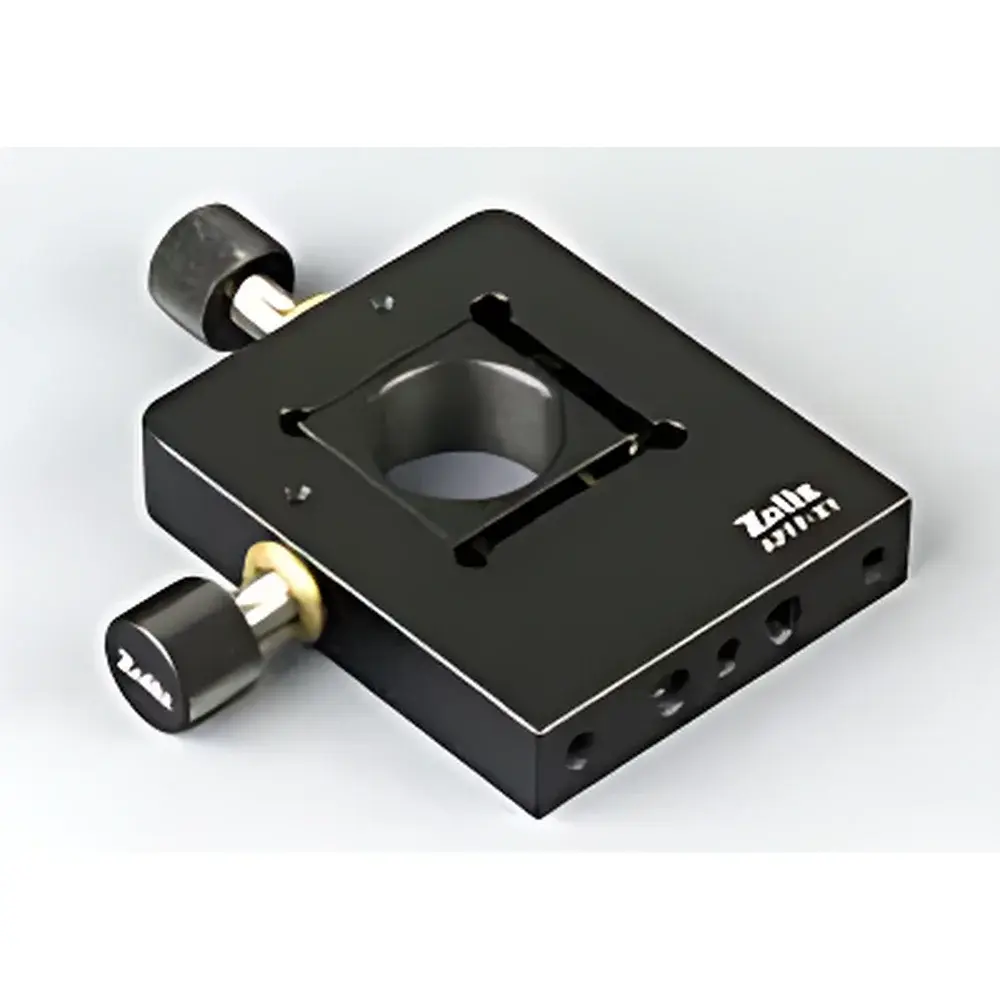
APFP-XY Two-Axis Fiber Optic Alignment Stage
| Brand | ZOLIX |
|---|---|
| Origin | Beijing, China |
| Manufacturer | ZOLIX (OEM/ODM Capable) |
| Type | Precision Manual Translation Stage |
| Model | APFP-XY |
| Travel Range (X/Y) | 3 mm each axis |
| Mounting Thread | M20×1 (ISO Metric) |
| Construction Material | Stainless Steel (AISI 420 or equivalent, thermally stable grade) |
| Guidance Mechanism | Crossed Roller Bearings |
| Load Capacity | ≤2 kg (centered, static) |
| Repeatability | ±0.5 µm (typical, under controlled lab conditions) |
| Angular Deviation | <5 arcsec per mm travel (pitch/yaw) |
Overview
The APFP-XY Two-Axis Fiber Optic Alignment Stage is a high-stability, manually operated precision translation stage engineered for demanding optical coupling, fiber positioning, and free-space beam alignment applications in research laboratories and photonics manufacturing environments. Designed around fundamental principles of mechanical metrology and thermal drift mitigation, the stage employs a monolithic stainless steel structural frame combined with crossed roller bearing guidance to deliver sub-micron repeatability and long-term positional fidelity. Its operation relies on orthogonal micrometer-driven linear motion along X and Y axes—each independently actuated via calibrated 10-µm resolution vernier thumbscrews—enabling deterministic, backlash-free displacement without elastic deformation or hysteresis. The absence of flexure elements or polymer components ensures consistent performance across ambient temperature fluctuations (15–30 °C), making it suitable for interferometric setups, fiber-to-waveguide coupling, and cavity alignment where thermal-induced drift must remain below 100 nm/h.
Key Features
- Thermally stable stainless steel construction (AISI 420-equivalent grade) minimizes coefficient of thermal expansion (CTE ≈ 10.2 × 10⁻⁶ /°C), reducing positional drift during extended experiments.
- Crossed roller bearing guidance system provides low-friction, high-rigidity motion with angular deviation <5 arcsec/mm—critical for maintaining collimation integrity during multi-axis alignment.
- Independent X- and Y-axis micrometer drives with 10-µm graduation and locking thumbscrews ensure repeatable, tactile positioning without tool dependency.
- M20×1 external thread interface enables direct integration with standard lens tubes, kinematic mounts, and OEM optical housings compliant with ISO 8178-1 dimensional standards.
- Zero-backlash mechanical design eliminates compliance-related uncertainty; all load paths are fully constrained within the base plate and carriage assembly.
- Compact footprint (82 mm × 82 mm base) supports dense optical breadboard layouts while maintaining ≥2 kg static load capacity at center of travel.
Sample Compatibility & Compliance
The APFP-XY stage is compatible with single-mode and multimode optical fibers (Ø125 µm to Ø900 µm jacketed), bare fiber pigtails, fiber arrays, and micro-optic subassemblies mounted via standard SM1 (1.035″-40) or M20×1 adapters. It meets mechanical interface requirements defined in ISO 10110-7 (optical component mounting) and aligns with general laboratory equipment safety guidelines per IEC 61000-6-2 (immunity) and IEC 61000-6-3 (emission). While not certified for medical or aerospace-grade qualification, its material traceability (mill test reports available upon request), RoHS-compliant surface finishing, and absence of outgassing elastomers make it appropriate for Class 1000 cleanroom-adjacent optical assembly workflows.
Software & Data Management
As a purely manual, non-motorized stage, the APFP-XY requires no firmware, drivers, or software integration. All positioning data is recorded manually via micrometer scale reading or integrated into third-party motion control ecosystems using optional encoder-equipped retrofit kits (e.g., Thorlabs KDC101 + APA101 adapter bracket). For GLP/GMP-aligned labs, users may log adjustment sequences in electronic lab notebooks (ELN) with timestamped entries referencing stage serial number (engraved on baseplate), operator ID, and environmental conditions (temperature/humidity)—supporting audit readiness per ISO/IEC 17025 clause 7.7.
Applications
- Precision alignment of single-mode fiber pigtails to laser diodes, photonic integrated circuits (PICs), or silicon photonics chips.
- Active/passive coupling optimization in telecom transceiver module assembly (SFP+, QSFP-DD).
- Stabilized reference arm positioning in fiber-based Mach-Zehnder or Michelson interferometers.
- Co-alignment of quantum dot emitters with collection optics in confocal microscopy setups.
- Calibration fixture integration for optical power meter sensor heads requiring XY repeatability verification per IEC 61223-3-3.
- Education: Undergraduate photonics labs demonstrating Gaussian beam propagation, mode matching, and polarization-dependent loss characterization.
FAQ
Is the APFP-XY compatible with vacuum environments?
No—standard units are not vacuum-rated due to lubricant presence in crossed roller assemblies and lack of venting provisions. Vacuum-compatible variants (with dry-film MoS₂ coating and vented bearing seals) are available under custom order (lead time: 12 weeks).
What is the maximum recommended payload for dynamic operation?
For vibrational stability during scanning (e.g., raster alignment), payloads should not exceed 1.2 kg. Static loading up to 2 kg is permissible when position is held for >10 minutes.
Can the micrometer screws be replaced with motorized actuators?
Yes—ZOLIX offers APFP-XY-M variant with integrated 0.9° stepper motor interfaces (NEMA 8 footprint) and optional closed-loop encoders (±0.2 µm resolution). Retrofit kits require factory recalibration.
Does the stage include mounting hardware?
Standard delivery includes four M3 × 8 mm socket-head cap screws for breadboard mounting and one Allen key (1.5 mm). Optical adapter rings (e.g., SM1-to-M20) are sold separately.
Is calibration documentation provided?
A factory-verified repeatability report (per ISO 230-2 Annex B) is included with each unit, listing measured bidirectional repeatability across full travel range at 22 °C ±1 °C. NIST-traceable calibration is available as an add-on service.




