
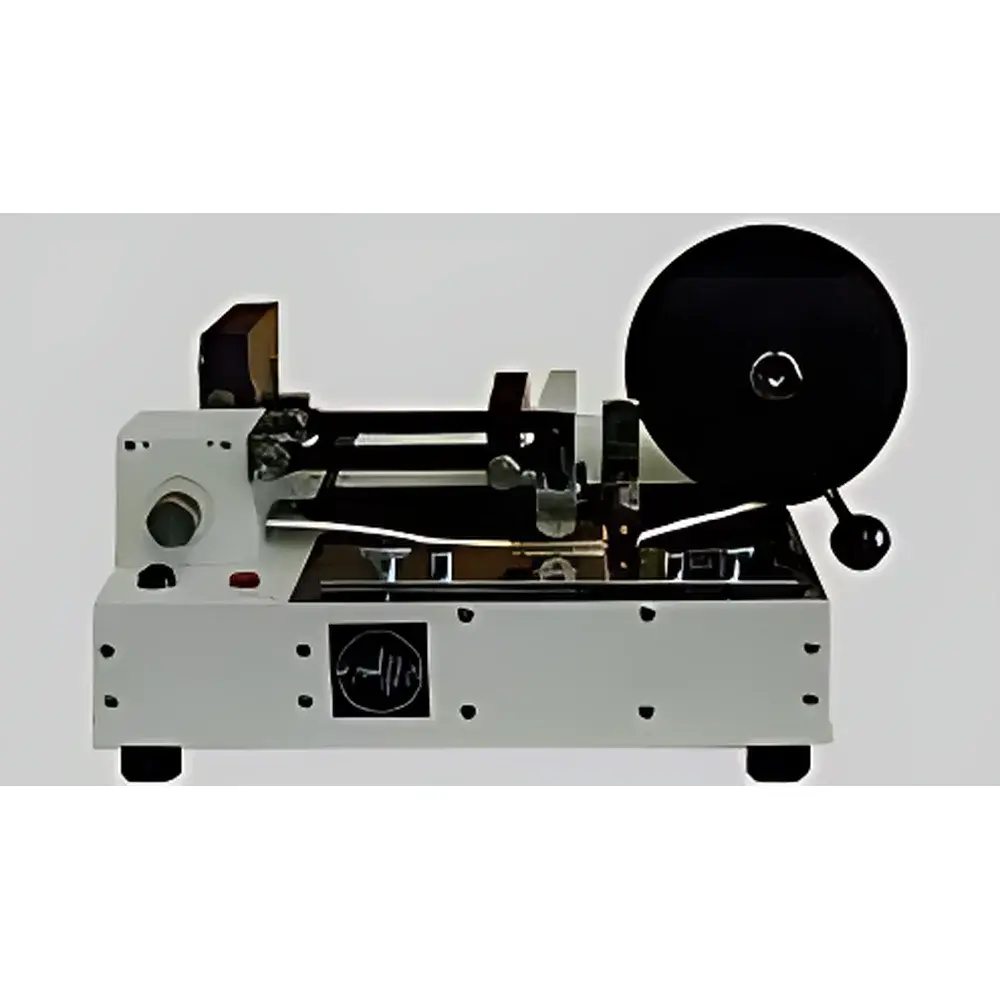
APG Abrasion Tester D2-APG
| Origin | Germany |
|---|---|
| Manufacturer Type | Authorized Distributor |
| Origin Category | Imported |
| Model | D2-APG |
| Pricing | Upon Request |
| Test Load | 5 N or 2.5 N |
Overview
The APG Abrasion Tester D2-APG is a precision-engineered tribological testing instrument designed to quantitatively evaluate the resistance of coated surfaces—particularly paints, varnishes, and printing inks—to mechanical wear under controlled, reproducible conditions. Based on the standardized oscillating abrasion principle, the D2-APG applies a defined normal force (selectable at 2.5 N or 5 N) via a calibrated load arm onto a standardized abrasive medium (typically SAE J400-grade or ISO 1518-1 compliant abrasive paper), which reciprocates linearly across the test specimen surface. This motion simulates real-world mechanical degradation mechanisms such as scuffing, rubbing, and surface particle removal. The instrument operates in strict accordance with internationally recognized test standards including ISO 1518-1 (Paints and varnishes — Determination of resistance to abrasion — Part 1: Oscillating abrasion tester), ASTM D4060 (Standard Test Method for Abrasion Resistance of Organic Coatings by the Taber Abraser), and DIN 53778 (Testing of paints and varnishes — Determination of abrasion resistance using an oscillating abrasion tester). Its German-engineered mechanical architecture ensures high repeatability, minimal hysteresis, and long-term dimensional stability—critical attributes for QC laboratories operating under GLP or ISO/IEC 17025-accredited frameworks.
Key Features
- Electromechanically synchronized oscillating drive system delivering precise stroke length (typically 50 mm ± 0.5 mm) and frequency (60 cycles/min nominal) per ISO 1518-1 requirements
- Dual-load configuration: Interchangeable weight sets enabling rapid switching between 2.5 N and 5 N test loads without recalibration
- Integrated specimen clamping mechanism with micrometer-adjustable parallelism control to ensure uniform contact pressure distribution across the test area
- Stainless steel abrasive holder compatible with standard 100 × 100 mm abrasive papers (e.g., SAE J400 P120, P180, or ISO 12103-1 A2 alumina)
- Robust cast-aluminum base plate with vibration-damping elastomeric feet for stable operation on standard laboratory benches
- No external power supply required: purely mechanical operation ensures intrinsic safety, zero electromagnetic interference, and compliance with explosion-proof environments where electrical instrumentation is restricted
Sample Compatibility & Compliance
The D2-APG accommodates flat, rigid substrates up to 150 × 150 mm and thicknesses ranging from 0.5 mm to 25 mm—including metal panels (steel, aluminum), plastic sheets (PVC, PET, ABS), glass slides, and laminated composites. Specimen mounting follows ISO 1518-1 Annex A guidelines for surface preparation, drying time verification, and conditioning (23 °C ± 2 °C / 50 % RH ± 5 % RH, minimum 24 h). All test reports generated—whether manually recorded or exported via optional digital interface—support traceability to ISO/IEC 17025 Clause 7.8 (Reporting of Results) and are suitable for inclusion in regulatory submissions under FDA 21 CFR Part 11 when paired with validated electronic lab notebook (ELN) integration. The device itself bears CE marking and conforms to EN 61000-6-2 (EMC immunity) and EN 61000-6-3 (EMC emissions) directives.
Software & Data Management
While the core D2-APG operates as a stand-alone mechanical tester, an optional USB-connected digital cycle counter module (D2-APG-DCM) provides real-time cycle logging, automatic stop triggering at user-defined thresholds (e.g., 100, 500, or 1000 cycles), and CSV-exportable timestamped datasets. When integrated with laboratory information management systems (LIMS) or ELNs, raw cycle counts and operator IDs can be embedded into structured audit trails satisfying ALCOA+ principles (Attributable, Legible, Contemporaneous, Original, Accurate, Complete, Consistent, Enduring, Available). No proprietary software installation is required; data export is OS-agnostic and compatible with Windows, macOS, and Linux platforms.
Applications
- Quality control of automotive OEM and refinish coatings for scratch resistance validation prior to body shop deployment
- Formulation screening of UV-curable inkjet inks used in industrial packaging printing
- Comparative assessment of anti-graffiti topcoats under accelerated wear protocols
- Accelerated aging studies of architectural façade coatings exposed to pedestrian traffic simulation
- Supplier qualification testing per OEM-specific material specifications (e.g., Ford WSS-M2P175-B1, BMW GS 97033)
- Research into nanocomposite reinforcement effects on polymer coating durability
FAQ
Is calibration certification included with the D2-APG?
Yes—each unit ships with a factory-issued calibration certificate traceable to PTB (Physikalisch-Technische Bundesanstalt), Germany’s national metrology institute, covering load application accuracy and stroke geometry verification.
Can the D2-APG be used for wet-abrasion testing?
No—the standard configuration is designed for dry-abrasion evaluation only. For wet-abrasion protocols (e.g., ISO 1518-2), a separate fluid delivery and containment accessory kit must be specified at time of order.
What abrasive media are recommended for routine use?
SAE J400 P120 silicon carbide paper is the default reference medium for general-purpose paint testing; P180 is used for high-gloss finishes requiring finer wear resolution.
Does the instrument comply with Good Manufacturing Practice (GMP) documentation requirements?
Yes—when operated with documented SOPs, maintenance logs, and the optional D2-APG-DCM module, it supports full GMP-compliant record retention per EU Annex 11 and FDA guidance on computerized systems.



