API Propeller Pitch Measuring Machine Model A
| Brand | API |
|---|---|
| Origin | Sichuan, China |
| Manufacturer Type | Authorized Distributor |
| Country of Origin | China |
| Model | Propeller Pitch Measuring Machine Model A |
| Pricing | Available Upon Request |
Overview
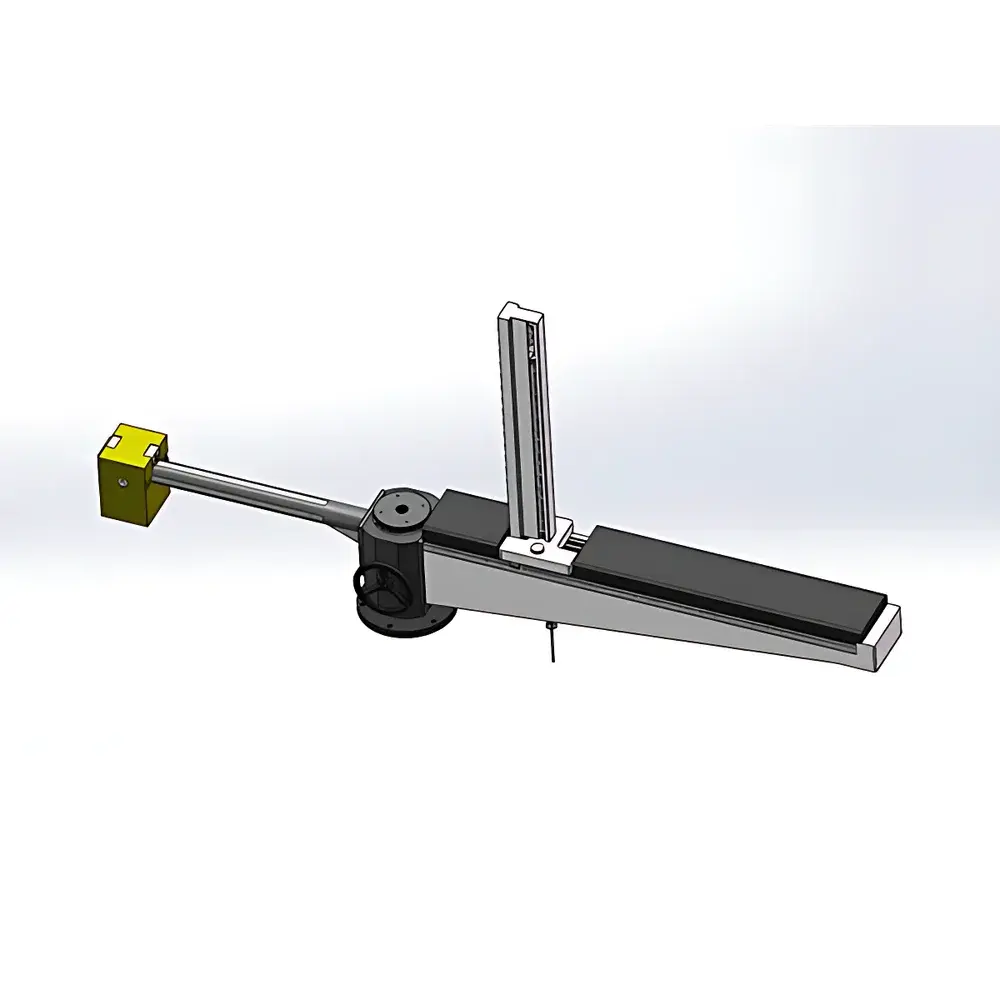
The API Propeller Pitch Measuring Machine Model A is a precision metrological instrument engineered for the non-contact, high-repeatability measurement of propeller blade pitch angles across marine, aerospace, and unmanned aerial vehicle (UAV) propulsion systems. It operates on the principle of multi-axis angular displacement metrology, integrating calibrated rotary encoders, linear displacement sensors, and a rigid kinematic base to determine local pitch angle at discrete radial stations along each blade surface. Unlike optical profilometers or coordinate measuring machines (CMMs), this system is purpose-built for large-diameter, asymmetric, curved-blade geometries—enabling traceable pitch evaluation per ISO 484-3 (Marine Propellers) and ASTM F2529 (Standard Practice for Propeller Blade Inspection). The machine supports both fixed-mount and portable deployment configurations, with mechanical stability optimized to minimize thermal drift and vibration-induced uncertainty during extended measurement cycles.
Key Features
- Modular kinematic fixture system accommodating propellers up to 3.2 m in diameter and blade chord lengths exceeding 600 mm
- Dual-axis angular encoder array with resolution ≤ 0.01° and repeatability ±0.03° (2σ) under controlled environmental conditions (20 ± 1°C, RH < 60%)
- Motorized radial positioning carriage with micrometer-grade lead screw drive (pitch accuracy ±2 µm over 500 mm travel)
- Integrated reference calibration sphere and master pitch gauge for on-site verification prior to measurement campaigns
- Stainless steel structural frame with granite base plate to ensure long-term geometric stability and minimal creep
- Compliance-ready design supporting audit trails, user access levels, and electronic signature capability per FDA 21 CFR Part 11 requirements when paired with optional software modules
Sample Compatibility & Compliance
The Model A accommodates fixed-pitch, controllable-pitch, and ducted fan propellers fabricated from aluminum alloys, stainless steel, composite laminates (e.g., carbon fiber/epoxy), and titanium. Blade thickness ranges from 8 mm to 75 mm; root-to-tip sweep angles up to 45° are fully supported. All mechanical interfaces conform to ISO 1101 (Geometrical Product Specifications) for datum establishment and GD&T referencing. Measurement procedures align with ISO 484-3 Annex B (Pitch deviation assessment) and support traceability to NIM (National Institute of Metrology, China) certified standards. Calibration certificates include uncertainty budgets calculated per ISO/IEC 17025:2017 requirements, covering contributions from encoder linearity, thermal expansion of fixtures, and sensor hysteresis.
Software & Data Management
The proprietary API PitchView™ software (v3.2+) provides real-time angular feedback, automated radial station indexing, and deviation mapping against nominal CAD profiles. Raw sensor data—including encoder counts, linear transducer voltages, and temperature-compensated offset values—are logged in ASCII CSV format with timestamps synchronized to UTC. Software modules support GLP-compliant reporting: automatic generation of pitch deviation charts (±0.5° tolerance bands), statistical summaries (mean, standard deviation, Cp/Cpk), and PDF reports embeddable with digital signatures. Audit logs record all operator actions, parameter changes, and calibration events—retained for ≥36 months unless purged under documented data retention policy. Optional integration with enterprise LIMS platforms via OPC UA or RESTful API enables direct ingestion into quality management workflows.
Applications
- Final inspection of newly manufactured marine propellers prior to vessel commissioning
- In-service condition monitoring of UAV propellers following impact events or fatigue cycling
- Reverse engineering of legacy propeller designs where original tooling data is unavailable
- Validation of CNC milling and robotic polishing processes in aerospace component manufacturing
- Research-grade pitch distribution analysis for hydrodynamic efficiency optimization in R&D laboratories
- Third-party certification testing for classification societies (e.g., DNV, ABS, CCS) requiring ISO 484-3 compliance evidence
FAQ
What standards does the Model A comply with for marine propeller certification?
It supports full implementation of ISO 484-3:2015 (Class I and Class II tolerances) and includes documentation templates aligned with DNV-RP-0510 and ABS Guide for Propulsion Systems.
Can the system measure variable-pitch propellers in situ without disassembly?
No—blades must be mounted on the dedicated kinematic chuck; however, the modular fixture allows rapid setup for multi-blade configurations without re-truing between measurements.
Is NIST-traceable calibration included with delivery?
A factory calibration certificate with expanded uncertainty (k=2) is provided; NIST-traceable recalibration services are available through API’s authorized metrology centers in Shanghai and Chengdu.
Does the system support automated pass/fail judgment based on user-defined tolerances?
Yes—PitchView™ allows configurable tolerance zones per radial station and auto-generates red/amber/green status indicators in reports and dashboards.
What environmental conditions are required for optimal measurement accuracy?
Recommended operating range: 18–22°C ambient temperature, <60% relative humidity, and vibration isolation compliant with ISO 230-2:2014 (Class 3).