API R2000 Parallel Flexure Ballbar System
| Key | Brand: API |
|---|---|
| Origin | USA |
| Manufacturer Type | Authorized Distributor |
| Origin Category | Imported |
| Pricing | Upon Request |
| Resolution | 0.25 µm |
| Accuracy | 0.5 µm |
| Max Measuring Radius | 1500 mm |
| Sensor Type | High-Precision Inductive Transducer |
| Calibration | NIST-Traceable Laser Interferometer Calibration |
Overview
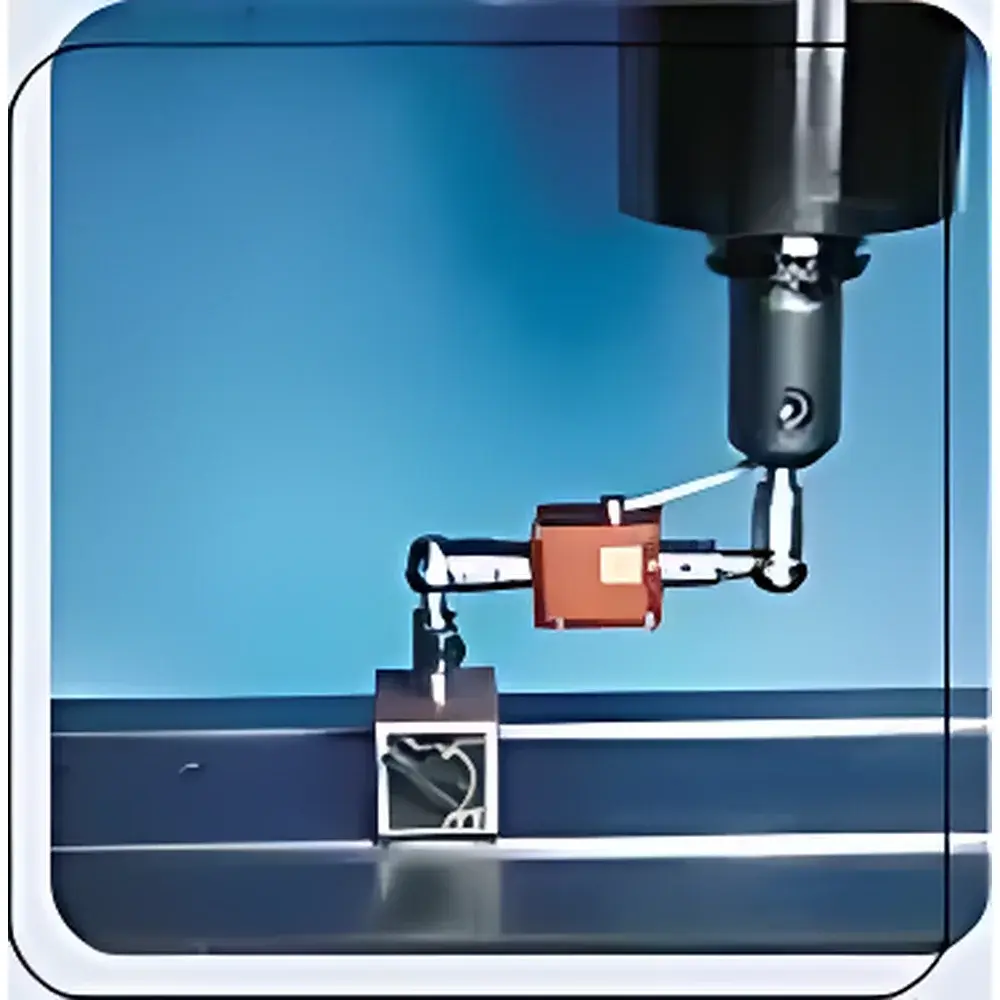
The API R2000 Parallel Flexure Ballbar System is a metrology-grade diagnostic instrument engineered for quantitative evaluation of dynamic contouring performance in CNC machine tools. It operates on the principle of two-axis simultaneous interpolation error measurement—capturing deviations between commanded circular motion (G02/G03) and actual toolpath geometry by rigidly coupling a precision ballbar between the machine spindle and worktable (or turret in turning centers). Unlike traditional articulated or hinge-based ballbars, the R2000 employs a monolithic parallel flexure mechanism that constrains relative motion strictly to a single translational degree of freedom, eliminating parasitic rotation, mechanical hysteresis, and stick-slip phenomena. This architecture ensures traceable, repeatable measurements across the full operational radius (up to 1500 mm), with no degradation in resolution or stiffness at extended lengths—a critical advantage for large-format machining centers and multi-axis gantry systems.
Key Features
- Parallel flexure kinematic design: Provides pure linear displacement sensing without torsional compliance or angular misalignment, enabling sub-micron repeatability over full travel range.
- NIST-traceable calibration: Each integrated inductive displacement transducer is individually calibrated using a laser interferometer certified to ISO/IEC 17025 standards by the National Institute of Standards and Technology (NIST).
- High-stability inductive sensing technology: Delivers 0.25 µm system resolution and ≤0.5 µm total measurement uncertainty (k=2) under controlled environmental conditions (20 ±1 °C, <50% RH).
- Modular mechanical interface: Includes ISO 30/40/50 and CAT/BT taper adapters for rapid mounting on milling spindles, lathe turrets, and rotary tables without disassembly or alignment fixtures.
- Thermally compensated electronics: Onboard signal conditioning compensates for ambient temperature drift (±0.02 µm/°C) to maintain measurement integrity during extended thermal soak periods.
Sample Compatibility & Compliance
The R2000 is compatible with all ISO-standard CNC machine tools capable of executing G-code circular interpolation—including vertical/horizontal machining centers, 5-axis mill-turn systems, CNC lathes, and gear hobbing machines. Its non-contact, wear-free operation conforms to ISO 230-4:2022 (Test Code for Machine Tools — Part 4: Circular Tests for Numerically Controlled Machine Tools) and supports compliance verification per ASME B5.54-2021 (Methods for Performance Evaluation of Computer Numerically Controlled Machining Centers). Data acquisition and reporting workflows are structured to meet GLP and GMP documentation requirements, including audit-trail-enabled timestamping, user authentication, and electronic signature support per FDA 21 CFR Part 11 when integrated with API’s optional Metrology Software Suite.
Software & Data Management
The R2000 interfaces exclusively with API’s proprietary Metrology Analysis Software (v8.2+), which provides real-time trajectory visualization, harmonic decomposition (up to 12th order), and automated ISO 230-4 error mapping (radial deviation, circularity, center shift, and axis coupling errors). All raw sensor data are stored in vendor-neutral HDF5 format with embedded metadata (machine ID, operator, date/time, environmental logs). The software supports export to CSV, XML, and STEP AP242 for integration into enterprise quality management systems (QMS) and statistical process control (SPC) platforms. Firmware updates and calibration certificate archives are managed via secure HTTPS-based cloud synchronization, ensuring version control and regulatory traceability.
Applications
- Pre-acceptance testing of new CNC machine tools against OEM specifications and contractual tolerance clauses.
- Routine preventive maintenance diagnostics—identifying backlash, servo mismatch, scale misalignment, and thermal growth asymmetries before they impact part conformance.
- Post-repair validation following linear axis reconditioning, ball screw replacement, or CNC controller upgrades.
- Process capability studies for high-precision aerospace components (e.g., turbine blade blisks, structural airframe fittings) requiring GD&T-controlled circular features.
- Root-cause analysis of geometric errors contributing to surface finish anomalies or positional stack-up in multi-operation setups.
FAQ
Is the R2000 suitable for use on 5-axis machines with tilting rotary tables?
Yes—the system supports synchronized measurement across any two interpolated axes, including A/C, B/C, or X/Y configurations. Dedicated mounting kits and kinematic compensation algorithms account for rotary table eccentricity and tilt-induced lever-arm effects.
Does the R2000 require periodic recalibration by the end user?
No—factory calibration is permanent and NIST-traceable. Users perform only daily verification using the included reference sphere and ISO 230-4-compliant check routine.
Can measurement data be integrated into our existing MES or SAP QM module?
Yes—via API’s RESTful API and ODBC-compliant database connector, enabling direct ingestion of pass/fail status, error magnitude, and harmonic spectra into enterprise manufacturing execution systems.
What environmental conditions must be maintained during measurement?
ISO 230-4 specifies 20 ±1 °C ambient temperature, ≤1 °C/hour gradient, and stable humidity (<50% RH non-condensing). The R2000’s onboard thermal compensation extends usable range to ±2 °C deviation with <10% uncertainty increase.
Is operator training required prior to deployment?
API provides certified Level I (application) and Level II (calibration & audit) training programs aligned with ISO/IEC 17025 competency requirements. Training includes hands-on test planning, uncertainty budgeting, and report generation per ISO 17025 Annex A.2.