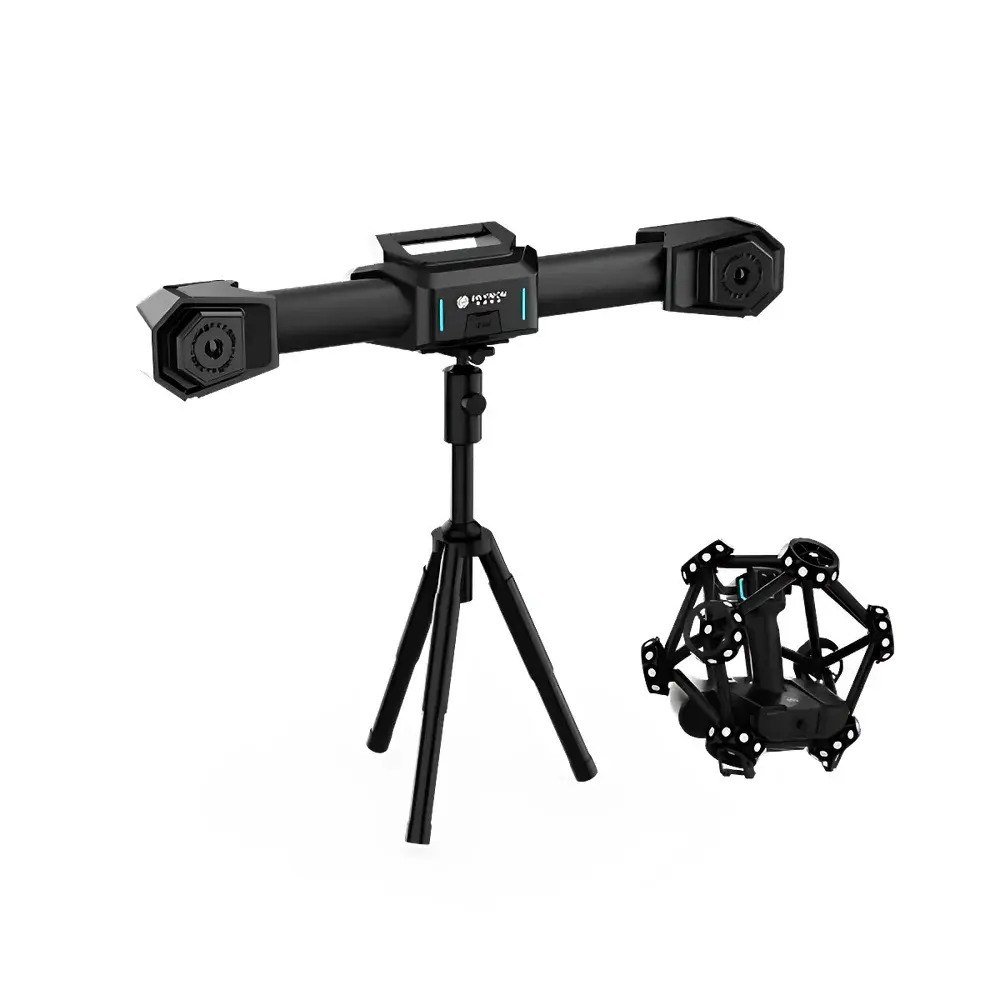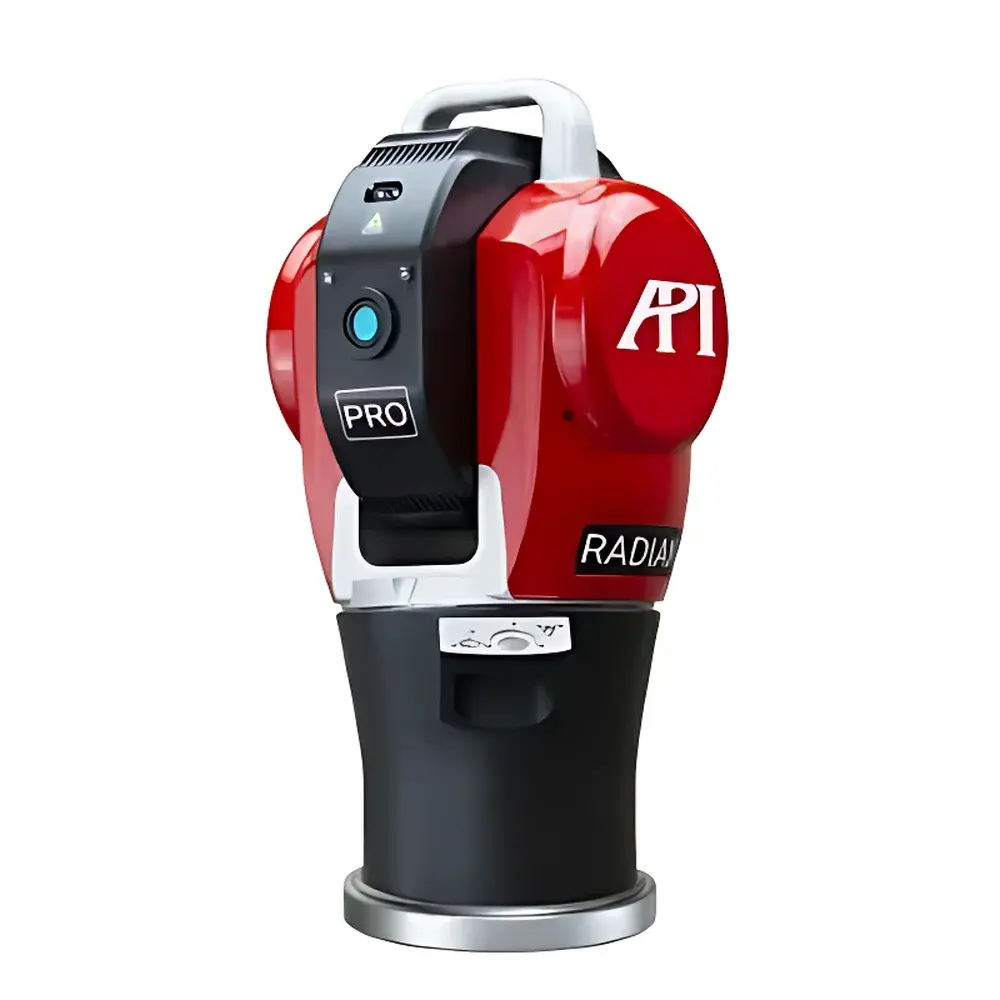
API Radian Pro Laser Tracker
| Origin | USA |
|---|---|
| Manufacturer Type | Authorized Distributor |
| Product Origin | Imported |
| Model | Radian Pro |
| Price Range | USD 135,000 – 270,000 (FOB) |
| Maximum Measurement Range | 160 m |
| Positional Resolution | 0.08 µm |
| Volumetric Accuracy | 10 µm + 5 µm/m |
| Horizontal Rotation | ±320° |
| Vertical Pitch | −59° to +79° |
| Roll Tilt Capability | Unlimited (Motorized Gimbal Architecture) |
Overview
The API Radian Pro Laser Tracker is a high-precision, portable coordinate measuring instrument engineered for large-volume metrology in industrial manufacturing, aerospace assembly, automotive body-in-white verification, and precision alignment of heavy machinery. It operates on the principle of interferometric and absolute distance measurement (ADM), combined with high-speed angular encoders and real-time kinematic feedback control. The system emits a collimated HeNe laser beam toward a retroreflective spherically mounted retroreflector (SMR), measures the round-trip time-of-flight or interference fringe count for distance, and simultaneously resolves horizontal and vertical angular positions with sub-arcsecond encoder resolution. This dual-mode (IFM/ADM) architecture enables traceable, NIST-calibrated 3D coordinate acquisition across volumetric workspaces up to 160 meters in diameter — supporting both static point capture and dynamic continuous-path tracking at rates exceeding 1,000 points per second.
Key Features
- I-Vision Intelligent Target Acquisition: Integrated wide-field CMOS imaging system with 30° field-of-view automatically detects, identifies, and reacquires SMRs after beam interruption — eliminating manual reacquisition and enabling uninterrupted measurement during complex part manipulation.
- ADM-Maxx Absolute Distance Module: Next-generation ADM subsystem delivering enhanced stability, extended effective range (>160 m), and improved thermal drift compensation versus prior-generation systems — critical for long-duration production-floor deployments.
- Self-Diagnostics Real-Time Health Monitoring: Continuous onboard assessment of laser power, encoder thermal drift, environmental vibration spectra, air temperature/pressure gradients, and optical path integrity — reported via INNOVO platform interface with actionable alerts.
- Activity Advisor Intelligent Workflow Guidance: Context-aware system advisor monitors warm-up status, atmospheric conditions (per ISO 10360-8 and VDI/VDE 2617 Part 10), and calibration validity — prompting user intervention only when metrologically necessary.
- Smart Check SMR Authentication: Automatic validation of SMR geometry, reflectivity, and mounting integrity prior to measurement initiation — ensuring compliance with ISO 10360-12 requirements for artifact-based uncertainty propagation.
- Multi-SMR Concurrent Tracking: Supports simultaneous acquisition from up to four independently positioned SMRs without signal loss — enabling multi-point deformation analysis, robotic arm kinematic calibration, and real-time relative motion monitoring.
Sample Compatibility & Compliance
The Radian Pro is compatible with standard 0.5″, 1″, and 1.5″ stainless-steel SMRs (including API’s certified Class 0 and Class 1 artifacts), as well as active targets (e.g., T-Cam, T-Scan) for dynamic scanning applications. All measurement data adhere to ISO 10360 series standards for coordinate measuring machines (CMMs), including ISO 10360-2 (MPE testing), ISO 10360-8 (volumetric performance), and ISO 10360-12 (SMR-based uncertainty modeling). System firmware supports audit-ready logging compliant with FDA 21 CFR Part 11 (electronic records/signatures) and GLP/GMP documentation workflows when integrated with INNOVO software.
Software & Data Management
Controlled exclusively through the INNOVO Smart Metrology Platform, the Radian Pro provides unified access to measurement planning, real-time visualization, GD&T evaluation (per ASME Y14.5–2018 and ISO 1101), and statistical process control (SPC) reporting. INNOVO includes native support for STEP AP242 model-based definition (MBD) import, automated report generation (PDF/Excel/XML), and secure cloud synchronization via optional API SecureLink gateway. Raw trajectory data is stored in vendor-neutral HDF5 format, ensuring long-term archival integrity and third-party interoperability with MATLAB, Python (NumPy/Pandas), and metrology post-processing tools such as PolyWorks or SpatialAnalyzer.
Applications
- Aerospace: Wing spar alignment, fuselage section mating verification, tooling calibration for composite layup molds
- Automotive: Body-in-white dimensional validation, robotic weld cell certification, powertrain subassembly tolerance stack-up analysis
- Energy: Wind turbine blade geometry verification, nuclear containment vessel distortion mapping, hydroelectric turbine runner alignment
- Heavy Machinery: Large gear train positioning, gantry crane rail straightness assessment, ship hull panel flatness inspection
- Research & Standards Labs: Primary calibration of large-scale CMMs, validation of photogrammetric networks, development of ISO-compliant volumetric error models
FAQ
What environmental conditions affect volumetric accuracy?
Temperature gradients >0.5°C/m, barometric pressure fluctuations >1 hPa/min, and relative humidity >85% may exceed built-in compensation limits; use of API’s Environmental Sensor Package (ESP) is recommended for ISO 10360-8 conformance.
Is the Radian Pro suitable for outdoor use?
Yes — IP54-rated enclosure and active thermal stabilization allow operation in controlled outdoor environments (shade, wind <10 km/h); direct sunlight exposure on the tracker head must be avoided to prevent encoder thermal drift.
How is traceability maintained across global installations?
Each unit ships with NIST-traceable calibration certificate (ISO/IEC 17025 accredited lab), and INNOVO software enforces digital chain-of-custody for all calibration events, firmware updates, and SMR certification records.
Can the system integrate with factory automation protocols?
Yes — native OPC UA server support enables bidirectional communication with MES/SCADA systems; Ethernet/IP and Modbus TCP adapters are available as optional modules.
What is the typical recalibration interval under GMP conditions?
Annual full volumetric recalibration is recommended; however, daily self-diagnostics and quarterly in-situ verification using certified reference artifacts satisfy most FDA and ISO 9001 audit requirements.