
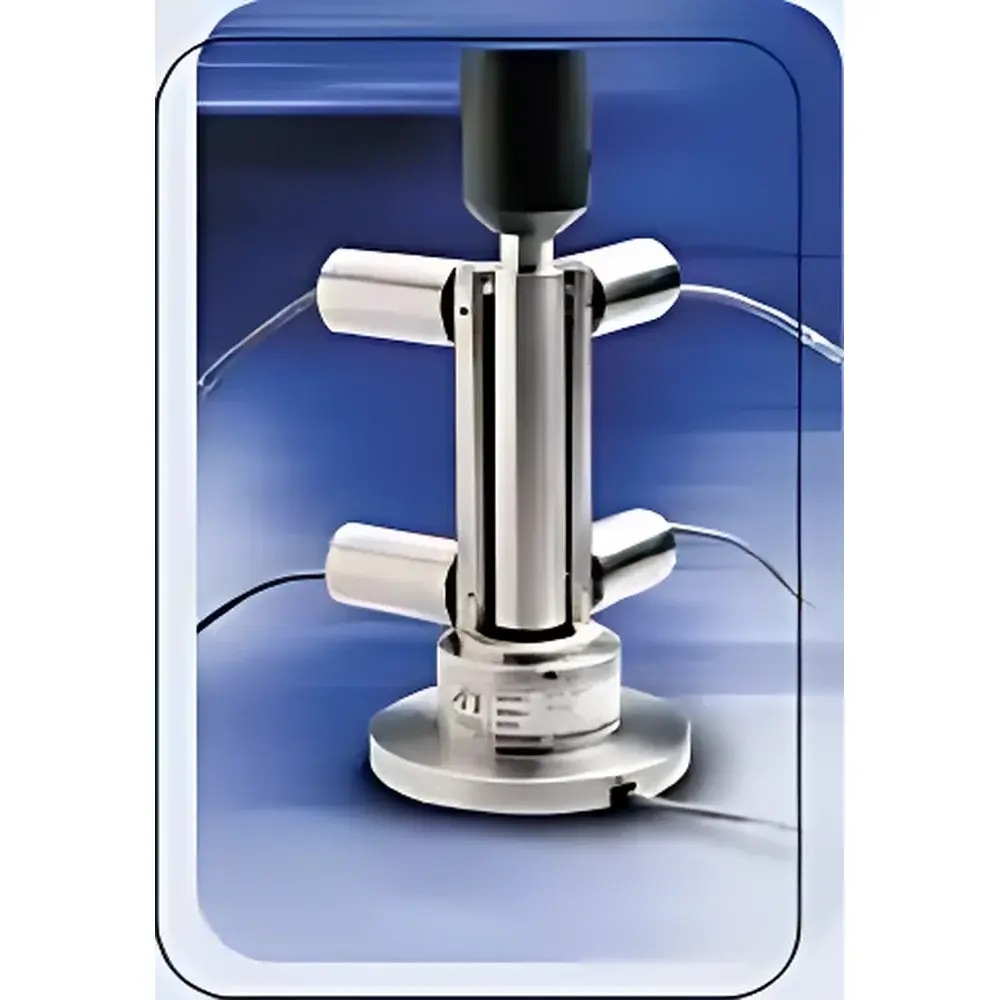
API Radian Pro Spindle Thermal Drift Analyzer
| Brand | API |
|---|---|
| Origin | USA |
| Manufacturer Type | Authorized Distributor |
| Origin Category | Imported |
| Pricing | Upon Request |
| Measurement Range | 0.1–0.8 mm (0.004–0.032 in) |
| Resolution | 0.1 µm |
| Precision | 0.5 µm |
Overview
The API Radian Pro Spindle Thermal Drift Analyzer is a precision metrology system engineered to quantify and characterize thermal-induced positional deviations in CNC machine tool spindles under operational load conditions. It operates on the principle of non-contact, multi-axis displacement monitoring using five synchronized high-stability optical or electromagnetic sensors—configured to capture real-time motion in all five critical degrees of freedom: axial (Z), radial (X, Y), tilt (pitch), and yaw (roll). Unlike static thermal modeling or post-process inspection, this system captures dynamic thermal drift behavior as it evolves during warm-up cycles, sustained cutting loads, and ambient fluctuations—enabling root-cause identification of thermally driven geometric errors that constitute 50–70% of total volumetric error in high-precision machining centers. Its architecture is purpose-built for shop-floor deployment, with ruggedized sensor housings, EMI-resistant signal conditioning, and environmental tolerance for both dry and coolant-lubricated (wet) machining environments.
Key Features
- Real-time, five-degree-of-freedom thermal drift measurement during active spindle operation—including under simulated or actual cutting loads
- High-resolution displacement sensing with 0.1 µm resolution and ≤0.5 µm repeatability across full 0.1–0.8 mm measurement range
- Configurable test duration from 1 minute to 48 hours, supporting short-term transient analysis and long-term thermal equilibrium studies
- Integrated sensor suite compatible with both optical interferometric and high-frequency electromagnetic (eddy-current) transduction—optimized for wet machining environments where >80% of production occurs
- Onboard data synchronization and time-stamped acquisition aligned to spindle RPM, coolant flow status, and ambient temperature logs
- Robust mechanical design certified for ISO 10791-6 and ANSI B5.54 environmental class 2 shop-floor operation
Sample Compatibility & Compliance
The Radian Pro analyzer is compatible with all standard ISO 30, ISO 40, ISO 50, CAT40, CAT50, BT40, and HSK-A/C/F spindle interfaces without mechanical modification. Sensor mounting fixtures are modular and adjustable to accommodate varying spindle nose geometries and clearance constraints. The system complies with IEC 61326-1 (EMC for industrial environments), UL 61010-1 (safety), and meets the functional requirements for thermal stability verification per ISO 230-3 (machine tool testing – thermal evaluation). When used in regulated manufacturing settings, data export supports audit-ready CSV and XML formats traceable to NIST-traceable calibration certificates. Full GLP/GMP-aligned metadata tagging—including operator ID, environmental log, and instrument firmware version—is embedded in every dataset.
Software & Data Management
The included RadianView™ 4.2 software provides synchronized visualization of thermal drift trajectories across all five axes, with overlay capability for spindle speed, coolant temperature, and ambient air temperature. Trend analysis tools include derivative-based rate-of-change detection, thermal time-constant estimation, and deviation threshold alerts configurable per axis. All raw sensor data is stored in HDF5 format with built-in checksum validation. Export options include ASTM E2928-compliant reports, MATLAB-compatible .mat files, and direct OPC UA integration for MES/SCADA systems. Audit trail functionality satisfies FDA 21 CFR Part 11 requirements, including electronic signatures, immutable session logs, and user-access-level permissions (admin/operator/viewer).
Applications
- Thermal error mapping for feedforward compensation model development in Siemens SINUMERIK, Heidenhain TNC, and FANUC CNC platforms
- Verification of thermal stabilization protocols prior to high-tolerance aerospace component machining (e.g., turbine blade blisks, structural airframe parts)
- Root-cause analysis of part-to-part dimensional drift in automotive powertrain production lines
- Validation of spindle cooling system efficacy and optimization of coolant flow rates and temperatures
- Baseline thermal performance qualification for machine acceptance testing (SAT) and periodic requalification per ISO 10791-6
- Research-grade thermal dynamics studies in university advanced manufacturing labs and national metrology institutes
FAQ
Can the system operate while the spindle is under actual cutting load?
Yes—the Radian Pro is explicitly designed for in-situ, load-conditioned thermal drift measurement, with sensor mounting configurations validated for vibration amplitudes up to 2.5 g RMS at frequencies up to 2 kHz.
Is electromagnetic interference (EMI) from VFDs or coolant pumps a concern?
No—sensors employ differential analog signal transmission and digital filtering compliant with IEC 61000-4-3 Level 3 radiated immunity; field-tested in facilities with multiple high-power CNC controls operating simultaneously.
Does the system support automated compensation integration with CNC controllers?
Yes—real-time thermal drift vectors can be output via Ethernet/IP or Modbus TCP to enable closed-loop thermal compensation when interfaced with compatible CNC OEM APIs.
What calibration documentation is provided?
Each unit ships with NIST-traceable calibration certificate covering linearity, resolution, and thermal coefficient of offset across the full operational temperature range (10–40 °C).
Can data be exported for statistical process control (SPC) analysis?
Yes—time-series datasets include timestamped XYZ + pitch + yaw values with sub-millisecond resolution, fully compatible with JMP, Minitab, and Python-based SPC frameworks.



