API SC100M Rotary Axis Angular Deviation Analyzer
| Brand | API |
|---|---|
| Origin | USA |
| Model | SC100M |
| Measurement Range | ±220° (440° total) |
| Accuracy | ±1 arcsecond |
| Resolution | 0.36 arcsecond |
| Shaft Interface Diameter | 1 in (25.4 mm), optional 25 mm |
| Weight | 4.1 kg |
| Dimensions | 130 × 185 × 220 mm |
| Interface | RS232 |
| Construction | Integrated servo motor, electrolytic tilt sensor (pendulum-type electronic level), and dual high-precision round glass gratings with angular encoders |
Overview
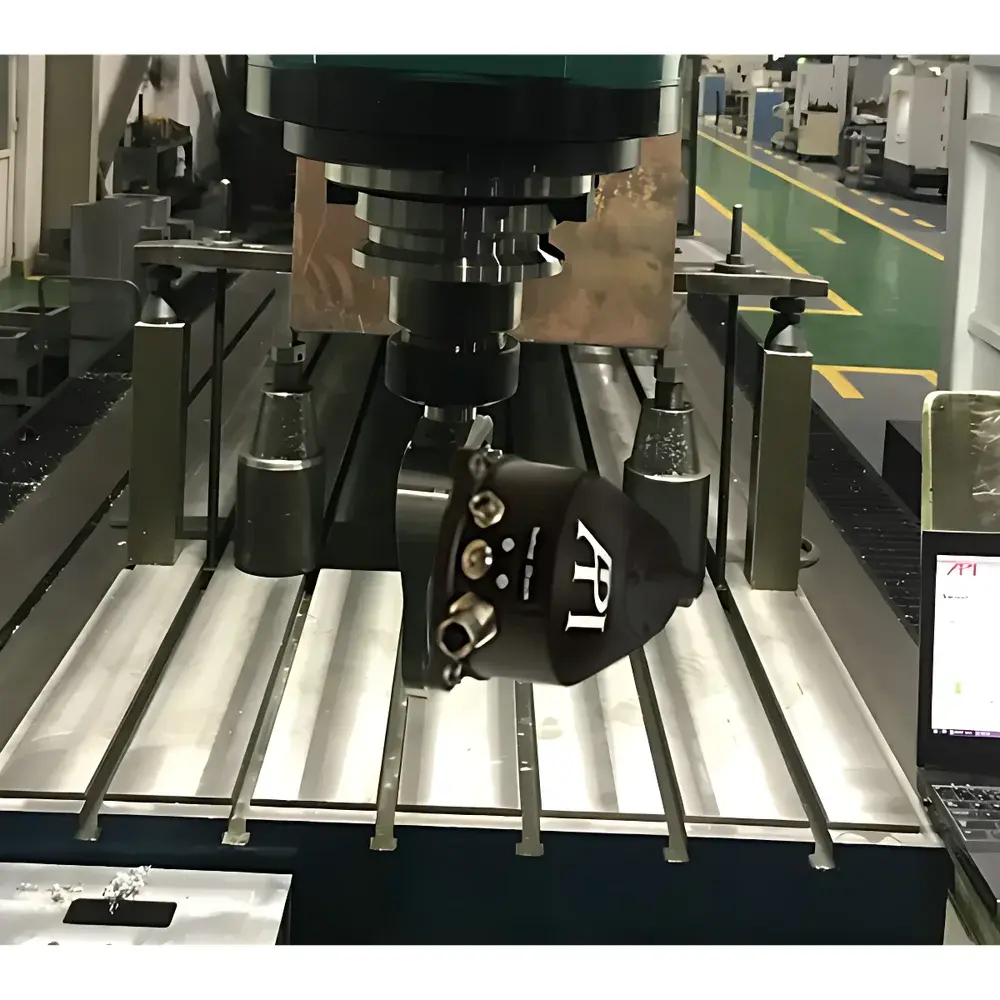
The API SC100M Rotary Axis Angular Deviation Analyzer is an engineered metrology solution designed for traceable, high-resolution calibration of angular positioning errors—specifically wobble (axial tilt) and inclination (radial tilt)—in the rotary axes of 4-axis and 5-axis vertical or horizontal machining centers. It operates on a closed-loop, real-time compensation principle rooted in precision angular metrology: a pendulum-based electrolytic electronic level serves as the inertial reference for true gravitational vertical; this sensor is rigidly mounted within a coaxial sleeve coupled to two co-located, high-stability optical round gratings and angular encoders. During measurement, the system software nulls the level output at a defined reference orientation. As the machine’s rotary axis (spindle or table) rotates under CNC command, the integrated servo motor drives the analyzer’s internal shaft in counter-rotation to maintain the level’s orientation relative to gravity. The angular displacement of the servo shaft—recorded by the dual glass gratings—is compared against the commanded motion from the CNC controller, yielding direct, differential angular deviation data (in arcseconds) across the full 440° range. This methodology eliminates reliance on mechanical centering or external alignment fixtures, enabling rapid, operator-safe, in-situ verification without interrupting machine setup workflows.
Key Features
- Self-contained, monolithic architecture integrating servo drive, electrolytic tilt sensor, and dual high-stability optical round gratings—minimizing thermal drift and mechanical hysteresis
- No requirement for precise coaxial alignment with the rotary axis centerline; accommodates off-center mounting via standardized interface
- Full 440° continuous angular measurement range (±220°), supporting full-circle evaluation of A-, B-, and C-axis kinematics
- RS232 serial interface for direct integration with host PC and compatibility with industry-standard metrology software environments
- Portable carrying case with shock-absorbing foam, designed for transport between production floors and calibration labs
- Modular accessory support: side-mount bracket for vertical table applications; precision flat retroreflector kit for hybrid use with API laser interferometers in horizontal rotary axis validation per ISO 230-4
Sample Compatibility & Compliance
The SC100M is compatible with all standard ISO 40, ISO 50, CAT40, CAT50, BT40, and HSK-A63 spindle tapers, as well as common rotary table mounting interfaces (e.g., ISO 15545, DIN 69871). Its mechanical interface supports both 1-inch (25.4 mm) and optional 25 mm shaft diameters, ensuring adaptability across OEM-specific configurations. The instrument complies with fundamental requirements of ISO 10360-1 (Geometrical Product Specifications — Acceptance and reverification tests for coordinate measuring machines) for angular metrology subsystems and aligns with the traceability framework outlined in ISO/IEC 17025:2017. While not a standalone certified calibration standard, its measurement uncertainty budget—derived from verified encoder linearity, level sensor repeatability, and thermal coefficient characterization—supports GUM-compliant uncertainty statements required for ISO 9001 and AS9100 quality systems.
Software & Data Management
The SC100M operates with API’s proprietary Metrology Control Suite (v5.2+), a Windows-based application delivering automated test sequencing, real-time deviation plotting, and export to CSV, XML, and PDF formats. Software features include configurable sampling intervals (1–100 ms), multi-point averaging, harmonic error separation (fundamental + 2nd/3rd harmonics), and pass/fail threshold mapping against user-defined tolerances. Audit trail functionality logs all operator actions, parameter changes, and calibration events in accordance with FDA 21 CFR Part 11 requirements when configured with digital signature and role-based access controls. Raw angular deviation datasets are timestamped and metadata-tagged (machine ID, axis label, environmental conditions), enabling integration into enterprise MES/QMS platforms via OPC UA or RESTful API adapters.
Applications
- Verification of A/B/C-axis angular positioning accuracy in multi-axis CNC machining centers prior to production ramp-up
- Root-cause analysis of geometric errors contributing to part taper, out-of-roundness, or surface form deviations in turbine blade or impeller milling
- Periodic in-house verification of rotary axis performance between third-party calibrations (per ISO 230-4 Annex D)
- Supporting dynamic thermal drift studies by capturing angular stability over extended runtime cycles
- Validation of CNC interpolation algorithms during machine rebuilds or control system upgrades
FAQ
Is the SC100M suitable for both vertical and horizontal machining centers?
Yes—the instrument supports vertical table measurement using the optional side-mount bracket, and horizontal axis evaluation when paired with API’s laser interferometer and flat retroreflector per ISO 230-4 methodology.
Does it require external power or only USB/serial bus power?
The SC100M requires an external 24 V DC power supply (included); RS232 communication is isolated and does not provide bus power.
Can measurement data be exported for statistical process control (SPC)?
Yes—CSV exports contain raw arcsecond values, timestamps, and metadata, fully compatible with Minitab, JMP, and custom SPC dashboards.
What environmental conditions affect measurement validity?
Operation is specified for 15–30 °C ambient temperature with ≤60% non-condensing humidity; thermal stabilization time is recommended at ≥30 minutes after transport.
Is NIST-traceable calibration documentation provided with shipment?
Each unit ships with a factory calibration certificate referencing NIST-traceable angular standards; annual recalibration is recommended and supported through API’s accredited service centers.