API Smart Probe by Automated Precision Inc.
| Brand | API |
|---|---|
| Origin | USA |
| Distributor Type | Authorized Distributor |
| Origin Category | Imported |
| Pricing | Available Upon Request |
| Measurement Range | Up to 60 m (diameter) |
| Pitch/Yaw/Roll Range | ±35° |
| Probe Stem Lengths | 50 mm, 100 mm, 200 mm (standard) |
| Absolute Accuracy | ±0.05 mm (2σ, ≤10 m with 100 mm stem) |
| Absolute Accuracy | ±0.05 mm + 10 ppm (2σ, >10 m with 100 mm stem) |
| Target Accessibility | Hidden features, deep cavities, reverse-engineering surfaces |
Overview
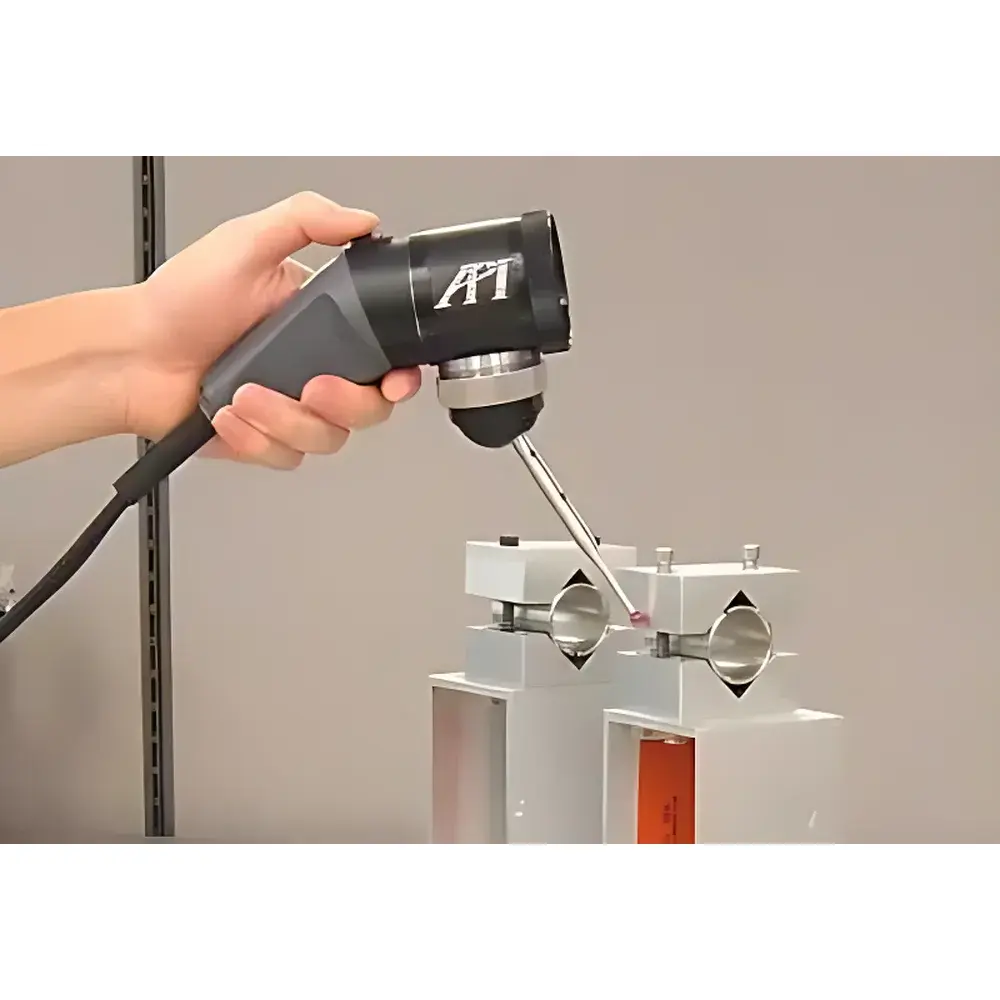
The API Smart Probe is a high-precision, six-degree-of-freedom (6-DOF) non-contact coordinate measurement accessory engineered for integration with API’s laser tracker systems—primarily the Radian series. It operates on the principle of interferometric distance measurement combined with angular position sensing via integrated encoders and real-time kinematic modeling. Unlike conventional touch probes or retroreflector-based measurement methods, the Smart Probe enables direct, unobstructed metrology of geometrically inaccessible features—including blind holes, recessed flanges, internal contours, and undercuts—without requiring line-of-sight to a spherical mirror (SMR). Its core functionality relies on the tracker’s simultaneous measurement of three spatial coordinates (X, Y, Z) and three orientation angles (pitch, yaw, roll), resolved from a single, compact optical target mounted at the probe tip. This architecture delivers traceable, NIST-aligned dimensional data in real time, supporting both static inspection and dynamic alignment tasks across large-volume industrial environments.
Key Features
- True 6-DOF real-time pose resolution: Measures tip position and orientation simultaneously, enabling accurate probing of hidden or occluded geometry without repositioning the tracker.
- Modular stem configuration: Standard interchangeable stems (50 mm, 100 mm, 200 mm) allow optimized reach-to-stiffness ratio for varying cavity depths and access constraints.
- Sub-50 µm absolute accuracy: Achieves ±0.05 mm (2σ) within 10 meters; maintains metrological integrity up to 60 m diameter envelope with linear compensation (±0.05 mm + 10 ppm).
- Wide angular articulation: ±35° pitch, yaw, and roll range permits adaptive orientation control for conformal surface contact and feature alignment.
- No SMR dependency: Eliminates need for manual placement or re-targeting of spherical mirrors during complex part inspections, reducing operator-induced error and cycle time.
- Ruggedized industrial design: Sealed optics, temperature-compensated encoders, and IP54-rated housing ensure stability in shop-floor conditions including thermal drift and vibration.
Sample Compatibility & Compliance
The API Smart Probe is compatible with all API Radian laser trackers equipped with ADM (Absolute Distance Meter) and IFM (Interferometric Distance Meter) dual-mode capability. It supports measurement of metallic, composite, and coated surfaces typical in aerospace structural assemblies, automotive body-in-white fixtures, wind turbine blade molds, and heavy machinery frames. The system complies with ISO 10360-12 (coordinate measuring machines—performance verification of optical distance sensors) and meets traceability requirements per ISO/IEC 17025 when operated within calibrated environmental conditions (20 ± 1 °C, humidity <65% RH). Data acquisition workflows support GLP/GMP audit trails when paired with Metrology Software Suite (MSS) v5.2+, fulfilling FDA 21 CFR Part 11 electronic record and signature requirements where applicable.
Software & Data Management
Integration occurs through API’s proprietary Metrology Software Suite (MSS), which provides native Smart Probe calibration routines, 6-DOF kinematic modeling, and real-time vector visualization of probe tip trajectory. MSS enables full GD&T evaluation—including true position, profile, and orientation tolerances—directly referenced to CAD models (STEP, IGES, or native CATIA/Creo formats). All measurement sessions generate timestamped, user-attributed datasets with embedded uncertainty budgets and environmental metadata. Export formats include CSV, XML (ISO 10303-238 AP242), and industry-standard DMIS 4.3 for interoperability with enterprise QMS platforms such as ETQ Reliance or Siemens Teamcenter.
Applications
- Hidden-feature inspection: Quantification of internal diameters, blind bolt patterns, and recessed datum features on large castings or welded structures.
- Tooling and fixture setup: Precise alignment of jigs, welding fixtures, and assembly mandrels relative to master datums.
- Reverse engineering of legacy components: Capture of complex organic surfaces and undercut geometries where traditional CMM access is impractical.
- Surface contour mapping: High-density point cloud generation for mold validation, turbine blade profiling, or aerodynamic surface analysis.
- Real-time guidance for robotic cell commissioning: Synchronization of robot end-effector pose with tracker-referenced world coordinates for path validation and collision avoidance.
FAQ
What is the maximum working distance for the Smart Probe when used with an API Radian tracker?
The probe operates within the full 60-meter spherical measurement envelope of the Radian tracker, though optimal accuracy (±0.05 mm) is specified for distances ≤10 meters using the 100 mm stem.
Can the Smart Probe be calibrated in-house, or does it require factory service?
Initial calibration must be performed by an API-certified metrology lab; however, field verification and stem-specific compensation updates can be executed using MSS built-in routines and traceable artifact sets.
Is the Smart Probe compatible with third-party laser trackers?
No—it is a proprietary API hardware-software ecosystem component, requiring native firmware and communication protocols exclusive to Radian-series trackers.
Does the system support automated scanning or only discrete point capture?
It supports both modes: discrete point acquisition for GD&T verification and continuous path-following for contour tracing, with user-defined sampling density and filtering options.
How is thermal drift compensated during extended measurements?
The probe incorporates dual-material thermal expansion compensation in its kinematic linkage, while MSS applies real-time air temperature and pressure corrections derived from integrated environmental sensors or external weather stations.