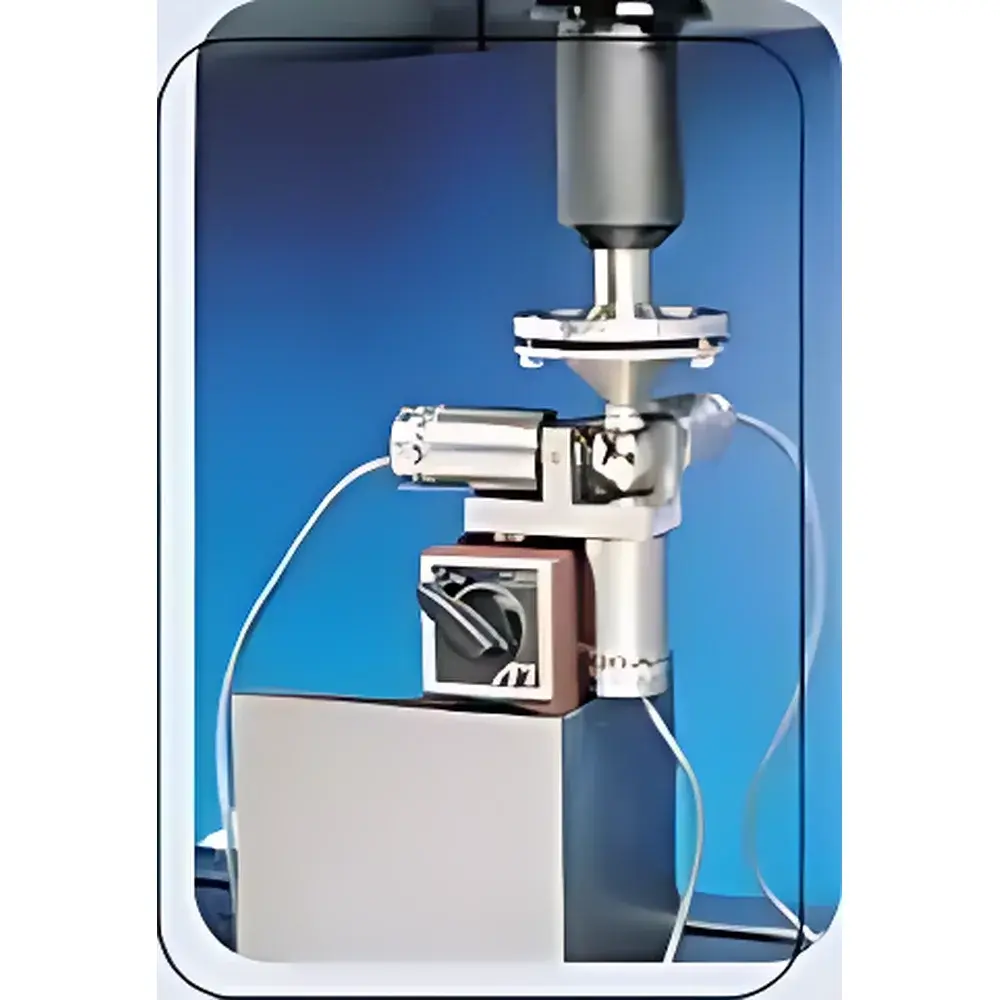
API SPN300 Spindle Dynamic Error Analyzer
| Brand | API |
|---|---|
| Origin | USA |
| Model | SPN300 |
| Sensor Type | Capacitive/Inductive |
| Resolution | 0.1 µm |
| Dynamic Response | 25 kHz |
| Measurement Range | 0.1–0.8 mm |
| Linearity | < 0.1% FS |
| Thermal Stability | < 0.1% / °C |
| Sensor Dimensions | 30.5 mm (Ø) × 53.3 mm (L) |
Overview
The API SPN300 Spindle Dynamic Error Analyzer is a high-precision metrology instrument engineered for real-time, non-contact measurement of rotational and positional errors in high-speed machine tool spindles. It operates on the principle of high-frequency capacitive or inductive displacement sensing—enabling sub-micron resolution under dynamic conditions. Designed for integration into precision manufacturing environments—including aerospace component machining, ultra-precision optics grinding, and semiconductor equipment qualification—the SPN300 captures radial, axial, and angular motion deviations during spindle rotation at speeds up to 60,000 RPM. Its architecture supports traceable error decomposition (e.g., synchronous vs. asynchronous components), facilitating root-cause analysis of bearing wear, thermal drift, imbalance, or mechanical preload anomalies. Unlike static alignment tools, the SPN300 delivers time-synchronized, multi-axis displacement data synchronized to spindle encoder signals—providing phase-resolved error maps essential for ISO 230-1 and ISO 230-4 compliance verification.
Key Features
- Sub-micron resolution (0.1 µm) maintained across full operational speed range (0–60,000 RPM), validated per ISO 230-2 Annex C protocols
- 25 kHz analog bandwidth ensures faithful capture of high-frequency vibration modes—including cage frequency, ball pass frequency (BPFO/BPFI), and resonance peaks associated with preloaded angular contact bearings
- Compact, ruggedized sensor head (30.5 mm Ø × 53.3 mm L) optimized for installation in confined spindle housings without compromising signal integrity
- Real-time condition monitoring algorithms embedded in firmware: automatic bearing health index calculation, trend-based anomaly detection, and predictive maintenance flagging aligned with ISO 13374-1 guidelines
- Integrated thermal compensation engine corrects for sensor drift across ambient temperature fluctuations (±0.1% / °C), critical for long-duration thermal stability testing per ASTM E2554
- Modular I/O interface supporting TTL encoder synchronization, analog voltage output (±10 V), and digital Ethernet (TCP/IP) for seamless integration into factory SCADA and MES platforms
Sample Compatibility & Compliance
The SPN300 is compatible with all rotating spindle configurations found in CNC milling centers, grinding machines, turning centers, and coordinate measuring machine (CMM) rotary tables. It accommodates both air-bearing and rolling-element spindles, including hybrid ceramic designs. Sensor mounting is standardized via M6 threaded inserts and kinematic dowel pins to ensure repeatable positioning per ASME B89.3.4M. The system complies with electromagnetic compatibility requirements per EN 61326-1 (industrial environment), safety standards per UL 61010-1, and supports audit-ready documentation for ISO 9001:2015 and AS9100D quality management systems. Data acquisition workflows are configurable to meet FDA 21 CFR Part 11 requirements when deployed in regulated medical device or pharmaceutical manufacturing settings.
Software & Data Management
The SPN300 is operated via API’s SpindleAnalyzer™ v4.x software suite—a Windows-based application offering real-time waveform visualization, FFT spectral analysis, orbit plot generation, and harmonic order tracking (up to 128th order). All raw time-series data is stored in HDF5 format with embedded metadata (timestamp, spindle speed, temperature, calibration ID) to support GLP/GMP traceability. Software includes automated report generation compliant with ISO 230-4 Annex D templates, export to CSV/PDF/PNG, and direct integration with MATLAB® and Python (via REST API) for custom algorithm development. Audit trails record user actions, parameter changes, and calibration events—enabling full revision control and regulatory inspection readiness.
Applications
- Quantification of radial runout, axial float, and tilt error in high-speed spindles during production validation and periodic certification
- Diagnostics of bearing degradation mechanisms—including raceway pitting, lubricant breakdown, and preload loss—using envelope spectrum analysis
- Verification of thermal growth compensation algorithms in closed-loop CNC controllers
- Characterization of machine tool volumetric accuracy per ISO 230-6 using multi-position spindle error mapping
- Support for spindle rebuild qualification and supplier acceptance testing per OEM technical specifications (e.g., DMG MORI, Makino, Haas)
- Research applications in tribology, rotor dynamics, and precision motion control system modeling
FAQ
What spindle speeds can the SPN300 measure?
The SPN300 supports continuous measurement from 0 to 60,000 RPM, with full resolution and linearity maintained across the entire range.
Is the system compatible with existing machine tool controllers?
Yes—it provides TTL-compatible encoder input, analog outputs for PLC interfacing, and Ethernet connectivity for OPC UA or Modbus TCP integration.
Does the SPN300 require annual recalibration?
Calibration is recommended every 12 months or after any mechanical shock event; NIST-traceable calibration certificates are provided with each service.
Can it distinguish between synchronous and asynchronous spindle errors?
Yes—phase-locked acquisition enables separation of once-per-revolution (synchronous) errors from random or process-induced (asynchronous) disturbances.
What environmental conditions affect measurement accuracy?
Ambient temperature must remain within 15–30 °C during operation; airflow >1 m/s across the sensor head may introduce convective cooling artifacts requiring empirical correction.
Related Products