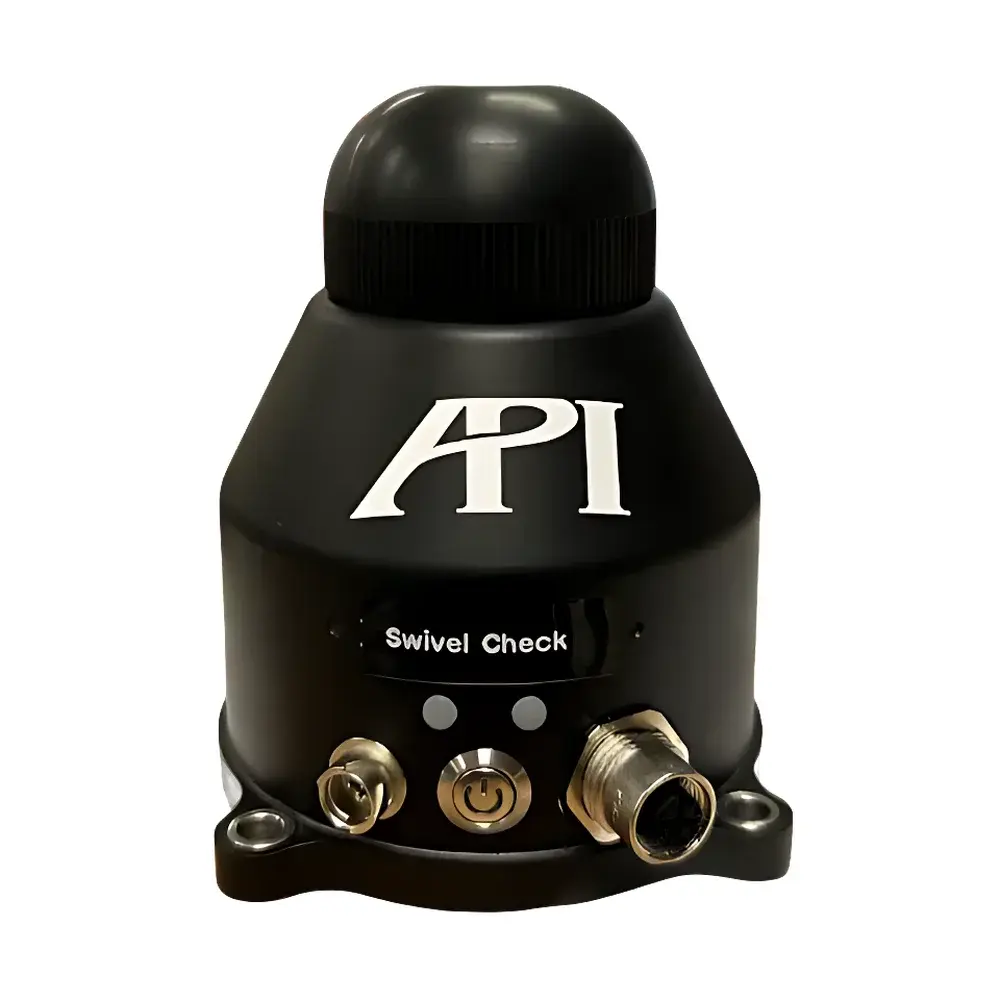
API Swivelcheck Angular Deviation Analyzer
| Brand | API |
|---|---|
| Origin | USA |
| Manufacturer Type | Authorized Distributor |
| Import Status | Imported |
| Model | Swivelcheck |
| Price Range | USD 14,000 – 70,000 |
Overview
The API Swivelcheck Angular Deviation Analyzer is a high-precision, portable metrology instrument engineered for quantitative evaluation of angular misalignment—specifically tilt, wobble, and axial runout—in rotating mechanical components. It operates on the principle of non-contact capacitive or inductive displacement sensing (configuration-dependent), delivering real-time angular deviation data with sub-arcsecond resolution under controlled environmental conditions. Designed explicitly for industrial metrology workflows, the Swivelcheck targets vertical spindles, rotary tables, indexing heads, and precision turntables used in CNC machining centers, coordinate measuring machine (CMM) calibration, and aerospace component verification. Its modular architecture enables both standalone operation and synchronized integration with API’s XD Laser Interferometer system—enabling comprehensive 3D motion error mapping (including horizontal rotary axis characterization when paired with linear displacement measurements). The device complies with foundational metrological traceability requirements aligned with ISO/IEC 17025–accredited calibration practices and supports uncertainty budgets consistent with ISO 230-2 (Test Code for Machine Tools — Part 2: Determination of Accuracy and Repeatability of Positioning Numerically Controlled Axes).
Key Features
- Compact, lightweight sensor head (≤1.2 kg) with integrated mounting interface for rapid installation on spindles, chuck faces, or fixture plates without requiring permanent modifications.
- Real-time angular deviation acquisition at up to 1 kHz sampling rate, supporting dynamic performance assessment during rotation under load.
- Intuitive, icon-driven GUI within API Swivelcheck software—designed for shop-floor usability with minimal operator training (typical proficiency achieved within 30 minutes).
- Automated measurement sequencing: auto-zeroing, multi-point sweep, harmonic analysis, and residual error reporting—all configurable via wizard-based setup.
- Full compatibility with API XD Laser Interferometer systems: enables combined angular + linear error decomposition per ISO 230-4, facilitating full volumetric error compensation modeling.
- Ruggedized enclosure rated IP54 for resistance to coolant mist, metal particulates, and ambient temperature fluctuations typical in production environments (operating range: 15–30 °C).
Sample Compatibility & Compliance
The Swivelcheck accommodates rotating elements with diameters from 50 mm to 1,200 mm and rotational speeds up to 3,000 rpm (dependent on mechanical stability and sensor mounting rigidity). It supports both air-bearing and mechanical bearing spindle configurations, provided radial and axial runout remain within ±25 µm peak-to-peak during measurement. Calibration certificates are issued per ANSI/NCSL Z540-1 and traceable to NIST standards. While not FDA-regulated, its data integrity features—including user-access logs, audit trail timestamps, and exportable .csv/.xml reports—meet baseline GLP documentation expectations for quality-critical manufacturing processes. Software-generated error maps comply with GD&T symbology per ASME Y14.5–2018 for direct comparison against geometric tolerance specifications.
Software & Data Management
API Swivelcheck software (v4.2+) runs on Windows 10/11 (64-bit) and provides native support for error separation algorithms including Fourier harmonic decomposition (up to 12th order), vectorial error summation, and ISO-defined “average line” referencing. All raw and processed datasets are stored with embedded metadata (operator ID, timestamp, environmental readings, calibration ID). Export formats include CSV (for statistical process control integration), PDF (annotated reports with pass/fail thresholds), and XML (compatible with MES and QMS platforms such as Siemens Opcenter Quality or ETQ Reliance). Audit trails record all configuration changes, report generation events, and user logins—satisfying foundational requirements of 21 CFR Part 11 for electronic records where applicable.
Applications
- Verification of vertical spindle squareness relative to machine bed (per ISO 230-1 Annex B).
- Performance qualification of high-precision rotary tables prior to CMM or multi-sensor inspection cell deployment.
- Root-cause analysis of part out-of-roundness attributable to workholding-induced angular instability.
- Preventive maintenance trending for machine tool rotary axes using longitudinal deviation baselines.
- Validation of thermal growth compensation models by capturing angular drift across warm-up cycles.
- Supporting ISO 10791-6 compliance testing for machining centers with B- or C-axis functionality.
FAQ
Can Swivelcheck measure horizontal rotary axes independently?
No—standalone Swivelcheck operation is optimized for vertical-axis geometry. Horizontal axis evaluation requires synchronized use with API XD Laser Interferometer for orthogonal linear displacement correlation.
Is calibration required before each use?
A full system calibration is recommended annually or after mechanical shock; however, daily verification via built-in reference target or zero-reference routine satisfies ISO 230-2 repeatability checks.
Does the system support automated pass/fail decision logic?
Yes—tolerance bands can be preloaded per feature, triggering visual alerts and auto-flagging nonconforming measurements in generated reports.
What environmental conditions affect measurement validity?
Air turbulence, localized thermal gradients (>0.5 °C/m), and vibration exceeding 2.5 µm RMS at 10–100 Hz may degrade angular resolution; use in climate-stabilized metrology labs or shielded shop-floor enclosures is advised for ≤1 arcsecond uncertainty.
Is remote operation supported?
Yes—software supports LAN-based client-server mode, enabling off-site monitoring and measurement initiation from engineering offices while retaining local data sovereignty.