
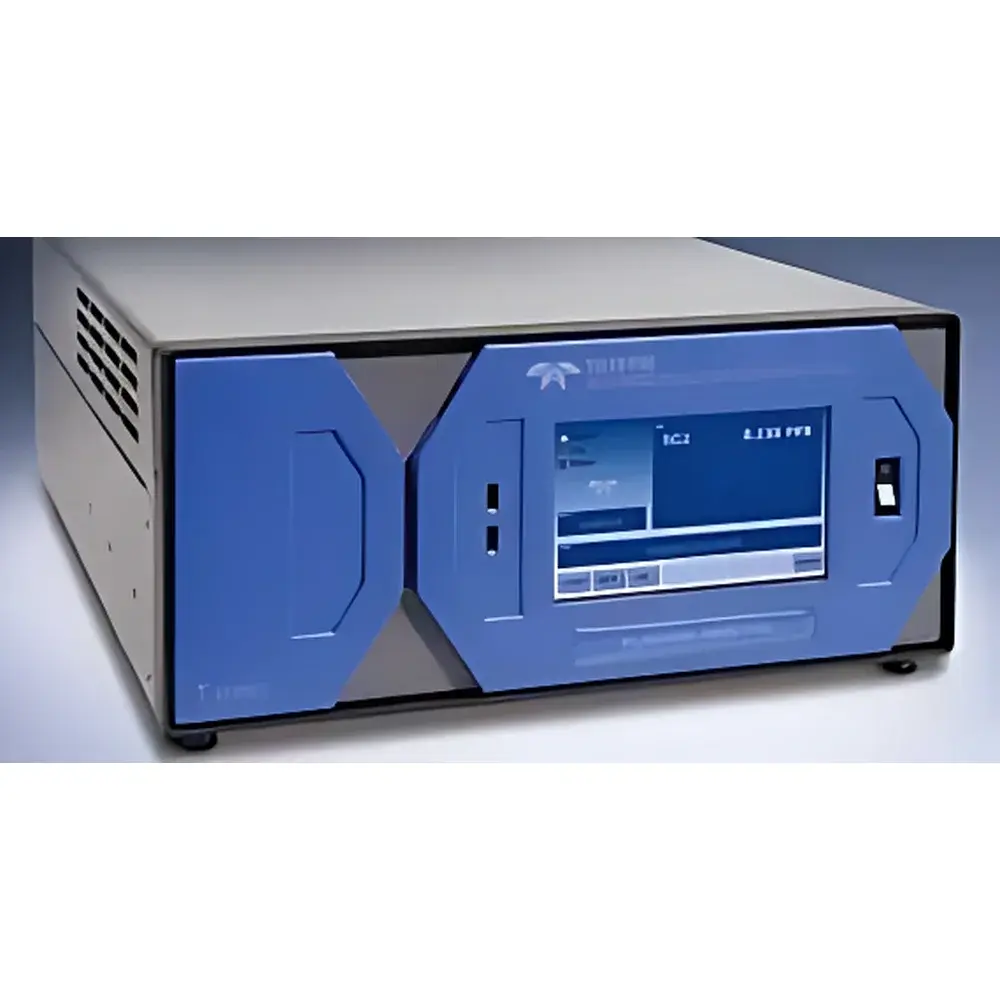
API T100 UV Fluorescence Sulfur Dioxide (SO₂) Analyzer
| Brand | API |
|---|---|
| Origin | USA |
| Model | T100 |
| Detection Principle | Ultraviolet Fluorescence |
| Measurement Range | 0–50 ppb or 0–20 ppm (selectable dual range) |
| Zero Noise | 0.2 ppb (RMS) |
| LOD | 0.4 ppb |
| Zero Drift | <0.5 ppb/24 h, <1 ppb/7 d |
| Span Drift | <0.5%/24 h, <1%/7 d |
| Response Time (T95) | <100 s |
| Sample Flow Rate | 700 cm³/min ±10% |
| Linearity | ±1% of full scale |
| Accuracy | ±0.5% of reading |
| Temperature Compensation | Yes |
| Pressure Compensation | Yes |
| Operating Temperature | 5–40 °C |
| Power Supply | 100–240 VAC, 50/60 Hz, 250 W |
| Dimensions (H×W×D) | 178 × 432 × 597 mm |
| Weight | 16 kg |
| Certifications | U.S. EPA EQPM Designated, Eignungsgeprüft, CE |
Overview
The API T100 UV Fluorescence Sulfur Dioxide (SO₂) Analyzer is a high-precision, continuous ambient air and stack emission monitoring instrument engineered for regulatory-grade compliance and long-term operational stability. It employs the ultraviolet fluorescence detection principle—where SO₂ molecules are excited by pulsed UV light at 214 nm and emit characteristic fluorescence at ~310–350 nm—which provides exceptional selectivity against common interferents (e.g., NO₂, O₃, hydrocarbons) and enables sub-part-per-trillion-level sensitivity in optimized configurations. Designed to meet U.S. Environmental Protection Agency (EPA) Performance Specification 2 (PS-2) and European EN 14211 requirements, the T100 delivers trace-level quantification across two user-selectable ranges (0–50 ppb and 0–20 ppm), making it suitable for both ambient air quality networks (e.g., NAAQS monitoring) and dilution-based source emission applications (e.g., CEMS pre-dilution or post-dilution verification).
Key Features
- UV fluorescence detection with photomultiplier tube (PMT) and optical interference filters for high signal-to-noise ratio and chemical specificity
- Integrated microprocessor control enabling automated zero/span calibration, self-diagnostics, and real-time fault logging
- Full-color touchscreen interface with intuitive navigation, configurable display layouts, and on-device data review
- Dual RS-232 serial ports supporting bidirectional communication for remote configuration, firmware updates, and integration into SCADA or DCS systems
- Temperature- and pressure-compensated measurement engine ensuring accuracy across variable environmental conditions without manual correction
- Critical orifice flow control system maintaining stable sample draw at 700 cm³/min ±10%, minimizing flow-induced drift and enhancing reproducibility
- Onboard data storage with programmable averaging intervals—from 1 minute to 365 days—and timestamped CSV export via front-panel USB port and removable SD card
- Multiple analog output options (10 V, 5 V, 1 V, 100 mV, 4–20 mA) compliant with industrial I/O standards and compatible with legacy data acquisition hardware
Sample Compatibility & Compliance
The T100 is validated for direct analysis of ambient air, diluted flue gas, and process streams with particulate filtration (recommended 2.5 µm or finer) and moisture removal (Nafion dryer or chilled mirror dew point control). It complies with U.S. EPA Equivalent Method (EQPM) designation under PS-2 for SO₂, satisfying federal reference method equivalency requirements for regulatory reporting. The analyzer also carries Eignungsgeprüft certification per German TA Luft Annex 3 and CE marking under the EU Measuring Instruments Directive (MID) and Electromagnetic Compatibility (EMC) Directive. Its design supports GLP/GMP-aligned audit trails when integrated with compliant data management platforms—full event logging (calibration, alarm, power cycle) meets FDA 21 CFR Part 11 expectations when paired with validated software.
Software & Data Management
API provides optional PC-based configuration and data visualization software (T100 Control Suite), supporting Windows OS environments. The software enables remote instrument setup, scheduled calibration sequences, spectral diagnostics, and export of time-stamped concentration records in ASCII or Excel-compatible formats. All internal memory operations include write-protection and cyclic buffer overwrite safeguards. Raw fluorescence intensity, temperature, pressure, flow rate, and diagnostic flags are recorded alongside concentration values—enabling retrospective root-cause analysis of drift events. Data integrity is preserved through non-volatile flash memory with battery-backed real-time clock and checksum-verified firmware updates.
Applications
- Ambient air quality monitoring stations (urban, rural, background sites) adhering to WHO, EU Air Quality Directive, or U.S. NAAQS standards
- Continuous Emission Monitoring Systems (CEMS) for coal-, oil-, or biomass-fired power plants and industrial boilers
- Regulatory verification of scrubber efficiency and desulfurization unit performance
- Mobile laboratory deployments and short-term field campaigns requiring EPA-compliant SO₂ data
- Research applications involving atmospheric chemistry modeling, plume dispersion studies, and intercomparison exercises
- Industrial hygiene assessments in sulfur-processing facilities, pulp & paper mills, and metal smelters
FAQ
What regulatory methods does the T100 comply with?
The T100 is designated as an EPA Equivalent Method (EQPM) under Performance Specification 2 (PS-2) for SO₂ and certified Eignungsgeprüft per TA Luft Annex 3. It also meets CE requirements under MID and EMC directives.
Can the T100 operate unattended for extended periods?
Yes—the analyzer features continuous self-diagnostics, automatic zero/span validation (with optional external gas standards), and robust thermal management, enabling >30-day unattended operation in climate-controlled enclosures.
Is pressure compensation mandatory for accurate readings?
Yes—barometric pressure variation directly affects SO₂ molecule density in the sample cell; the built-in pressure sensor and algorithmic compensation are active by default and essential for regulatory-grade accuracy.
How is data integrity ensured during power interruptions?
All critical parameters and events are logged to non-volatile memory prior to shutdown; the real-time clock maintains time stamp continuity using backup power, and no data is lost during brief outages (<5 s).
Does the T100 support MODBUS or Ethernet communication?
The standard configuration includes two RS-232 ports only; MODBUS RTU over RS-232 is supported via API’s protocol documentation, but native Ethernet or MODBUS TCP requires optional gateway hardware.
Related Products







