
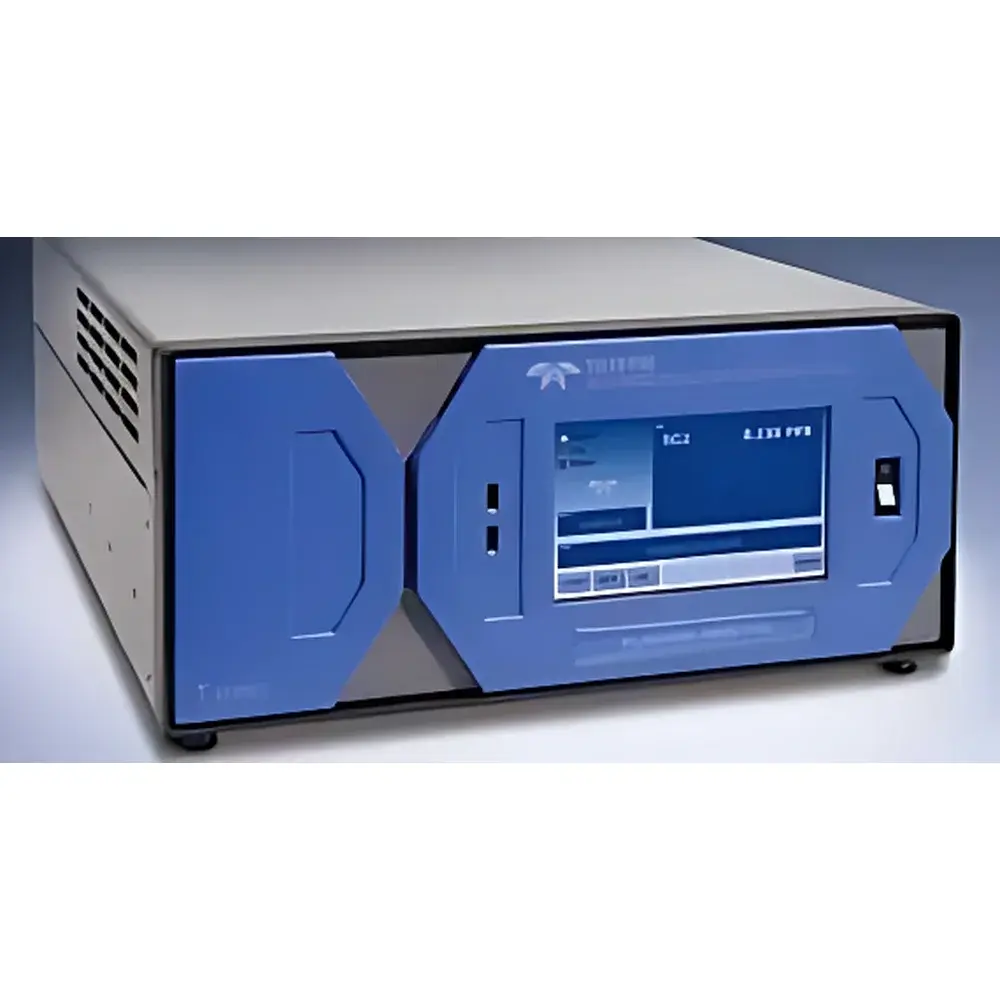
API T200 Chemiluminescence NO/NO₂/NOₓ Analyzer
| Brand | API |
|---|---|
| Origin | USA |
| Model | T200 |
| Type | Online Gas Analyzer |
| Measurement Principle | Chemiluminescence |
| Detection Targets | NO, NO₂, NOₓ (simultaneously independent) |
| Range Options | 0–50 ppb or 0–20 ppm (dual-range selectable) |
| Zero Noise | 0.2 ppb (RMS) |
| LOD | 0.4 ppb |
| Zero Drift | <0.5 ppb/24 h, <1 ppb/7 d |
| Span Drift | <0.5% of reading/24 h, <1% of reading/7 d |
| Response Time (T95) | <60 s |
| Lag Time | 20 s |
| Sample Flow Rate | 500 cm³/min ±10% |
| Linearity | ±1% of full scale |
| Accuracy | ±0.5% of reading |
| Temperature Range | 5–40 °C |
| Temp. Coefficient | <0.1%/°C |
| Humidity Range | 0–95% RH (non-condensing) |
| Voltage Coefficient | <0.1%/V |
| Dimensions (H×W×D) | 178 mm × 432 mm × 597 mm |
| Weight (Analyzer) | 18 kg |
| External Pump Weight | 7 kg |
| Power | 100–240 VAC, 50/60 Hz, 250 W |
| Output Signals | 10 V, 5 V, 1 V, 100 mV, isolated 4–20 mA, dual bidirectional RS-232 |
| Certifications | U.S. EPA EQPM Designated, CE, Eignungsgeprüft (German PTB Verification) |
Overview
The API T200 Chemiluminescence NO/NO₂/NOₓ Analyzer is an EPA-equivalent performance-certified, continuous online gas analyzer engineered for regulatory-grade ambient air quality monitoring and dilution-based stack emission compliance testing. It employs the well-established gas-phase chemiluminescence reaction between nitric oxide (NO) and ozone (O₃), generating light proportional to NO concentration; NO₂ is quantified via catalytic conversion to NO in a heated molybdenum converter, enabling simultaneous, independent measurement of NO, NO₂, and total NOₓ with high specificity and minimal cross-sensitivity. The instrument’s microprocessor-controlled architecture integrates real-time temperature and pressure compensation, digital signal processing, and automated diagnostics—ensuring trace-level stability and metrological integrity under field-deployed conditions. Designed to meet U.S. EPA Reference Method 7E and EU EN 14792 requirements, the T200 delivers sub-part-per-trillion detection capability at the system level and supports long-term unattended operation in fixed-site monitoring networks and industrial fence-line applications.
Key Features
- Independent, real-time quantification of NO, NO₂, and NOₓ using dual-channel chemiluminescence detection with integrated thermal converter
- Auto-zero calibration with programmable frequency (e.g., hourly, daily) and optional zero/span drift verification (1-min to 365-day averaging)
- High-resolution color touchscreen interface with intuitive navigation, status visualization, and on-device data review
- Dual bidirectional RS-232 ports for remote configuration, firmware updates, and integration into SCADA or EMS platforms
- Front-panel USB port supporting removable SD card logging (up to 32 GB) with timestamped, CSV-formatted raw and averaged data
- Onboard signal filtering algorithms to optimize response dynamics without compromising accuracy—adjustable time constants from 1 s to 120 s
- Comprehensive self-diagnostic suite including lamp intensity monitoring, O₃ generator health check, flow sensor validation, and alarm-triggered event logging
- Isolated analog outputs (10 V, 5 V, 1 V, 100 mV) and fully isolated 4–20 mA current loop compliant with IEC 61000-4 immunity standards
Sample Compatibility & Compliance
The T200 is validated for use with ambient air, flue gas (post-dilution), and clean process streams meeting ISO 8573-1 Class 3 particulate and oil-free specifications. Its sampling system accommodates inlet temperatures up to 50 °C and dew points below 5 °C to prevent condensation-induced interference. All wetted materials—including stainless steel reaction chamber, PTFE-lined sample lines, and ozone-resistant elastomers—are selected per ASTM D5502 and EPA Method 7E material compatibility guidelines. Regulatory conformance includes U.S. EPA Environmental Technology Verification (ETV) Program designation as an Equivalent Method (EQPM), German PTB Eignungsgeprüft certification for official air quality reporting, and CE marking under the EU Measuring Instruments Directive (MID) and Electromagnetic Compatibility (EMC) Directive. Data integrity meets GLP/GMP-aligned audit trail requirements through embedded timestamping, user-access logging, and non-volatile memory retention of calibration history.
Software & Data Management
The T200 operates with API’s proprietary multi-tasking firmware, enabling concurrent execution of measurement, calibration, diagnostics, and communications without latency. Its embedded data logger stores second-by-second raw photomultiplier tube (PMT) counts, converted concentrations, environmental parameters (T, P, RH), and diagnostic flags—retained for up to one year depending on averaging interval. Exported datasets include ISO/IEC 17025-compliant metadata headers specifying instrument ID, calibration dates, operator credentials, and uncertainty contributors. Optional API DataLink™ software provides secure HTTPS-based remote access, configurable alarm thresholds (email/SMS via gateway), trend visualization with statistical overlays (min/max/mean/std dev), and automated report generation aligned with EPA 40 CFR Part 60 Appendix B QA/QC templates.
Applications
- Ambient air quality monitoring networks (AQS, NCore, EEA AirBase)
- Continuous emissions monitoring systems (CEMS) for power plants, cement kilns, and waste incinerators
- Mobile laboratory platforms for urban pollution mapping and hotspot identification
- Research-grade studies on atmospheric chemistry, NOₓ photochemical cycling, and ozone formation potential
- Industrial hygiene assessments in semiconductor fabrication, metal plating, and chemical synthesis facilities
- Calibration transfer standard for field portable analyzers requiring traceable reference values
FAQ
Does the T200 require external ozone generation?
Yes—the analyzer incorporates an internal UV-based ozone generator with closed-loop concentration control and real-time ozone output monitoring to ensure stoichiometric excess and reaction consistency.
Can the molybdenum converter be replaced in the field?
Yes—converter cartridges are user-replaceable with tool-free access; typical service life exceeds 12 months under continuous operation with clean, filtered sample gas.
Is the 4–20 mA output intrinsically safe for hazardous area installation?
No—the standard output is not IS-rated; however, API offers an optional ATEX/IECEx-certified signal isolator module for Zone 1/2 deployment when paired with appropriate barrier systems.
How is traceability maintained for calibration gases?
The T200 supports NIST-traceable span gas certificates; its firmware logs gas lot numbers, expiration dates, and certified concentrations during each manual or automated calibration event.
What maintenance intervals are recommended?
Routine tasks include quarterly PMT gain verification, semiannual ozone generator cleaning, annual converter replacement (if used continuously), and biannual full-system leak check per EPA Method 7E Section 8.2.







