
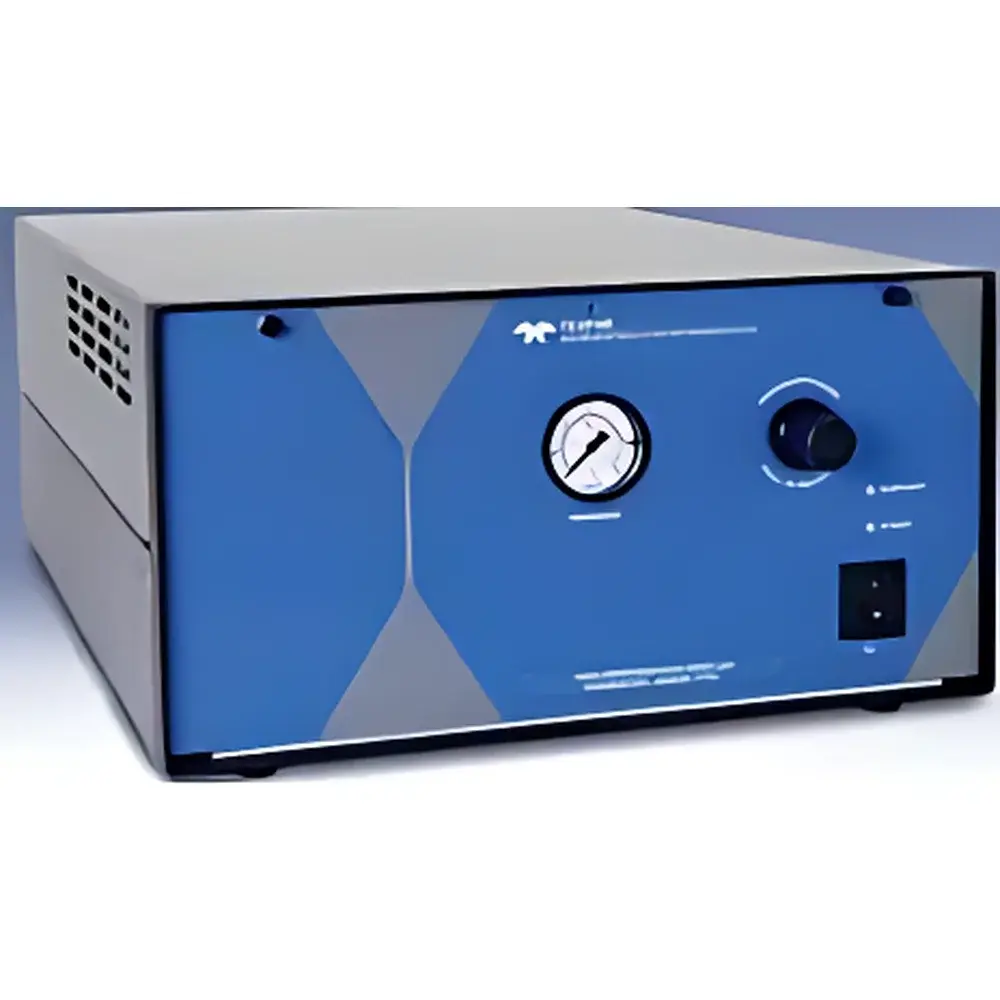
API T700 Multi-Parameter Gas Mass Flow Calibrator
| Brand | API |
|---|---|
| Origin | USA |
| Manufacturer Type | Authorized Distributor |
| Origin Category | Imported |
| Model | T700 |
| Pricing | Upon Request |
Overview
The API T700 Multi-Parameter Gas Mass Flow Calibrator is a microprocessor-controlled, laboratory-grade calibration system engineered for high-accuracy span and zero-point verification of ambient air quality analyzers and continuous emission monitoring systems (CEMS). It operates on the principle of dynamic dilution using precision thermal mass flow controllers (MFCs) to blend certified standard gases with purified zero air, generating traceable, stable, and reproducible calibration gas mixtures across multiple target species—including O₃, NO, NO₂, CO, H₂S, and SO₂. The system supports up to four independent gas source inputs and integrates an optional programmable ozone generator coupled with a built-in gas-phase titration (GPT) chamber for primary-standard-grade NO₂ generation via the reaction NO + O₃ → NO₂ + O₂. When equipped with the optional UV photometer module, the T700 achieves photometric feedback control of ozone output, enabling real-time concentration validation prior to GPT—critical for meeting EPA Method 214, ISO 13964, and EN 14625 compliance requirements in regulatory-grade calibration workflows.
Key Features
- Four independently controlled gas inlet ports supporting single-gas or multi-component mixture calibration
- Integrated, programmable UV ozone generator with output range of 100 ppb to 6 ppm (at 1 LPM), T98 < 180 s
- Dual-mode NO₂ generation: direct cylinder delivery or traceable GPT synthesis using NIST-traceable NO and photometrically verified O₃
- Optional NIST-traceable UV photometer (100 ppb–10 ppm range, ±1.0 ppb absolute accuracy, ±1.0% of reading linearity) for closed-loop ozone control and GPT validation
- High-stability thermal mass flow control: ±1% FS flow measurement accuracy, ±0.2% FS repeatability, ±0.5% FS linearity
- Dilution airflow range: 0–10 SLPM (standard options); extended ranges available (0–5 or 0–20 SLPM)
- Standard zero air supply requirement: 10 SLPM @ 30 psig (20 SLPM option available)
- Front-panel color touchscreen interface with intuitive menu navigation and real-time parameter visualization
- Digital output of all operational parameters (flow rates, concentrations, temperatures, status flags) via Ethernet (standard), RS-232 (standard), USB (optional), or RS-485 (optional)
- Glass-walled gas-phase titration chamber designed for chemical inertness, minimal wall loss, and rapid mixing kinetics
- Compact benchtop footprint (178 × 432 × 609 mm) and lightweight construction (27 kg) for lab mobility and field-deployable calibration setups
Sample Compatibility & Compliance
The T700 is compatible with EPA-certified gas analyzers used in ambient monitoring networks (e.g., Thermo Fisher 42i, 43i, 48i; Teledyne API 400 series; Horiba APNA-370) and industrial CEMS platforms requiring multi-gas calibration traceable to NIST SRMs. Its architecture supports GLP- and GMP-aligned calibration recordkeeping when paired with compliant data acquisition software. The photometer-equipped configuration satisfies the instrumental uncertainty requirements of US EPA Performance Specification 2 (PS-2) for ozone analyzers and Method 205 for NOx calibration. All flow paths are constructed from electropolished stainless steel and PFA-lined components to prevent adsorption or catalytic decomposition of reactive species (e.g., NO₂, O₃). The system carries CE marking and conforms to IEC 61000-6-3 (EMC) and IEC 61010-1 (safety) standards.
Software & Data Management
The T700 communicates natively via Modbus TCP over Ethernet or ASCII protocol over RS-232, enabling seamless integration into SCADA, LIMS, or custom calibration management platforms. Optional API-provided calibration software supports automated sequence execution (e.g., multi-point linearity checks, drift assessments), audit-trail logging per FDA 21 CFR Part 11 (with electronic signatures and user access controls), and export of CSV/Excel-formatted calibration reports. All flow, concentration, and timing parameters are timestamped and stored internally on removable USB flash media—ensuring full data integrity during off-grid operation or transport.
Applications
- Primary and transfer standard calibration of UV photometric ozone analyzers
- Dynamic generation of certified NO₂ reference gas via gas-phase titration for chemiluminescence NOx analyzers
- Multi-point span verification of electrochemical H₂S/SO₂ sensors and NDIR CO analyzers
- Field validation of portable air quality monitors (PAMs) and low-cost sensor networks
- Method development and uncertainty assessment per ISO/IEC 17025 accredited laboratories
- Supporting regulatory compliance under EU Directive 2008/50/EC, US Clean Air Act Appendix A, and China’s HJ 193-2013 standard
FAQ
Can the T700 generate NO₂ without an external ozone source?
Yes—the integrated ozone generator and glass GPT chamber enable on-demand, stoichiometric NO₂ synthesis from certified NO and zero air, eliminating reliance on unstable NO₂ cylinders.
Is photometric ozone monitoring mandatory for NO₂ generation?
Not mandatory, but strongly recommended for applications requiring ≤2% relative uncertainty in NO₂ concentration; photometric feedback ensures ozone concentration is verified before each titration cycle.
What zero air specifications are required for optimal performance?
Minimum 10 SLPM at 30 psig, with hydrocarbon content <0.01 ppm C₁, CO <0.02 ppm, NOx <0.05 ppb, and particulate load <0.01 µm filtered—achievable using the companion API T701 Zero Air Generator.
Does the T700 support remote diagnostics and firmware updates?
Yes—Ethernet connectivity enables secure remote access for troubleshooting, parameter adjustment, and over-the-air firmware upgrades via authenticated HTTPS session.
How is calibration traceability documented for audit purposes?
Each calibration event logs MFC setpoints, photometer readings (if installed), timestamps, operator ID, and gas certificate numbers; reports are digitally signed and exportable in PDF/A-1b format for long-term archival.







