
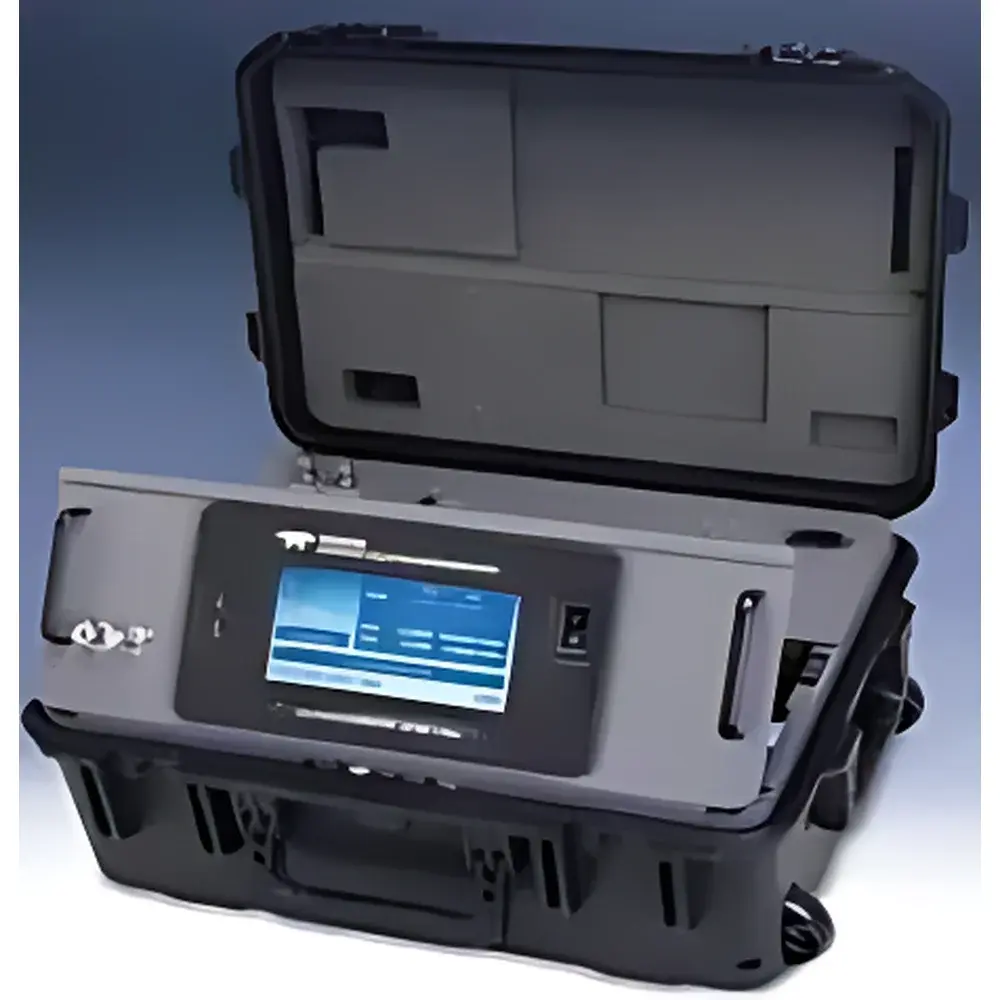
API T750 Portable Gas Calibration System
| Brand | API |
|---|---|
| Origin | USA |
| Manufacturer Type | Authorized Distributor |
| Origin Category | Imported |
| Model | T750 |
| Pricing | Upon Request |
Overview
The API T750 Portable Gas Calibration System is a microprocessor-controlled, field-deployable calibration platform engineered for high-accuracy span and zero calibration of fixed and portable gas analyzers. It operates on the principle of dynamic gas dilution using precision mass flow controllers (MFCs) and certified standard gas cylinders to generate traceable, stable calibration gas mixtures across multiple target concentrations. Unlike static permeation or diffusion-based calibrators, the T750 employs active volumetric blending—enabling true multi-point calibration with programmable step sequences, reproducible concentration ramps, and real-time feedback control. Its architecture complies with fundamental metrological requirements outlined in ISO 6145 (gas mixture preparation), ISO 17025 (calibration laboratory competence), and EPA Method 205 (calibration of ambient air monitors). Designed for regulatory-grade field use, the system supports both direct calibration of continuous emission monitoring systems (CEMS) and laboratory verification of portable gas detectors under ASTM D6348 and EN 14181.
Key Features
- Triple-mode calibration capability: zero gas generation, span gas dilution, and gas-phase titration (GPT) for NO₂ synthesis via controlled NO + O₃ reaction
- High-stability mass flow control: ±1% full-scale accuracy, ±0.2% repeatability, and ±0.5% linearity across all flow paths
- Integrated ozone generation module (0.1–6 ppm output) with optional UV photometric feedback loop for closed-loop O₃ concentration control
- Configurable dilution airflow: standard 0–10 SLPM, optionally extendable to 0–20 SLPM or 0–5 SLPM for low-flow analyzer compatibility
- Standardized analog and digital I/O: dual RS-232 ports (300–115,200 baud), 10/100Base-T Ethernet, eight digital control outputs, twelve digital inputs, and eight status outputs
- Capacitive touchscreen interface with 7-inch color display, supporting intuitive menu navigation, real-time flow visualization, and on-device calibration sequence programming
- Ruggedized transit case with integrated handle and heavy-duty casters; operational weight: 16.78 kg (standard), 21.14 kg (with ozone photometer, GPT chamber, and O₃ generator)
- Firmware-upgradable via front-panel USB port; remote configuration and diagnostics enabled through APIcom software over local network or serial link
Sample Compatibility & Compliance
The T750 is validated for calibration of analyzers measuring SO₂, H₂S, NO, NO₂, CO, O₃, and other common ambient and stack gases. Its dilution methodology ensures compatibility with UV photometers, chemiluminescence NOₓ analyzers, electrochemical sensors, and NDIR CO/CO₂ instruments. All gas pathways are constructed from electropolished stainless steel and PTFE-lined components to prevent adsorption or catalytic interference. The system meets mechanical and electrical safety requirements per UL 61010-1 and IEC 61000-6-2/6-3 (EMC immunity and emissions). When operated with certified zero air (<1 ppb hydrocarbons, <0.5 ppb NOₓ, <1 ppb SO₂) and NIST-traceable standard gases, calibration records satisfy GLP documentation standards and support FDA 21 CFR Part 11-compliant audit trails when used with APIcom’s secure logging module.
Software & Data Management
APIcom software provides full local and remote instrument control, including calibration protocol definition, real-time parameter monitoring, event logging, and report export in CSV and PDF formats. The embedded memory stores up to one year of scheduled calibration routines with time-stamped execution logs. Firmware updates, configuration backups, and diagnostic snapshots can be transferred via USB or Ethernet. Optional APIcom Enterprise Edition enables centralized fleet management, role-based user access control, and integration with LIMS platforms via OPC UA or Modbus TCP. All communication channels support TLS 1.2 encryption for secure data transmission in regulated environments.
Applications
- Field calibration of EPA-certified ambient air quality monitors (e.g., FRM/FEM PM₂.₅ samplers with integrated gas correction)
- Zero/span verification of CEMS in power plants, refineries, and cement kilns per 40 CFR Part 60 Appendix B
- Performance testing of portable multi-gas detectors used in industrial hygiene and confined space entry
- Method validation and inter-laboratory comparison studies requiring traceable gas standards
- Research applications involving reactive gas generation (e.g., controlled NO₂ synthesis via GPT for kinetic studies)
- Calibration of ozone monitors in UV photolysis chambers and atmospheric simulation facilities
FAQ
What zero air specifications are required for optimal T750 operation?
A minimum flow of 10 SLPM at 30 psi is required; optional 20 SLPM configuration supports high-flow analyzers. Zero air must contain ≤1 ppb total hydrocarbons, ≤0.5 ppb NOₓ, and ≤1 ppb SO₂ to avoid calibration bias.
Can the T750 generate NO₂ without an external ozone source?
Yes—when equipped with the optional ozone generator and GPT chamber, the T750 synthesizes NO₂ in situ via stoichiometric reaction of NO and O₃, eliminating reliance on unstable NO₂ cylinders.
Is the UV photometric ozone monitor traceable to NIST?
The optional ozone photometer is factory-calibrated against NIST SRM 2691a (ozone primary standard) and includes documented uncertainty budgets per ISO/IEC 17025.
How is calibration traceability documented?
Each calibration event generates a timestamped log file containing MFC setpoints, actual flows, gas cylinder lot numbers, operator ID, and environmental conditions—exportable for inclusion in QA/QC records.
What maintenance intervals are recommended?
MFCs require annual recalibration; ozone generator lamps are rated for 10,000 hours; photometer optics should be inspected quarterly for contamination. Full preventive maintenance is advised every 12 months or after 500 operational hours.
Related Products







