
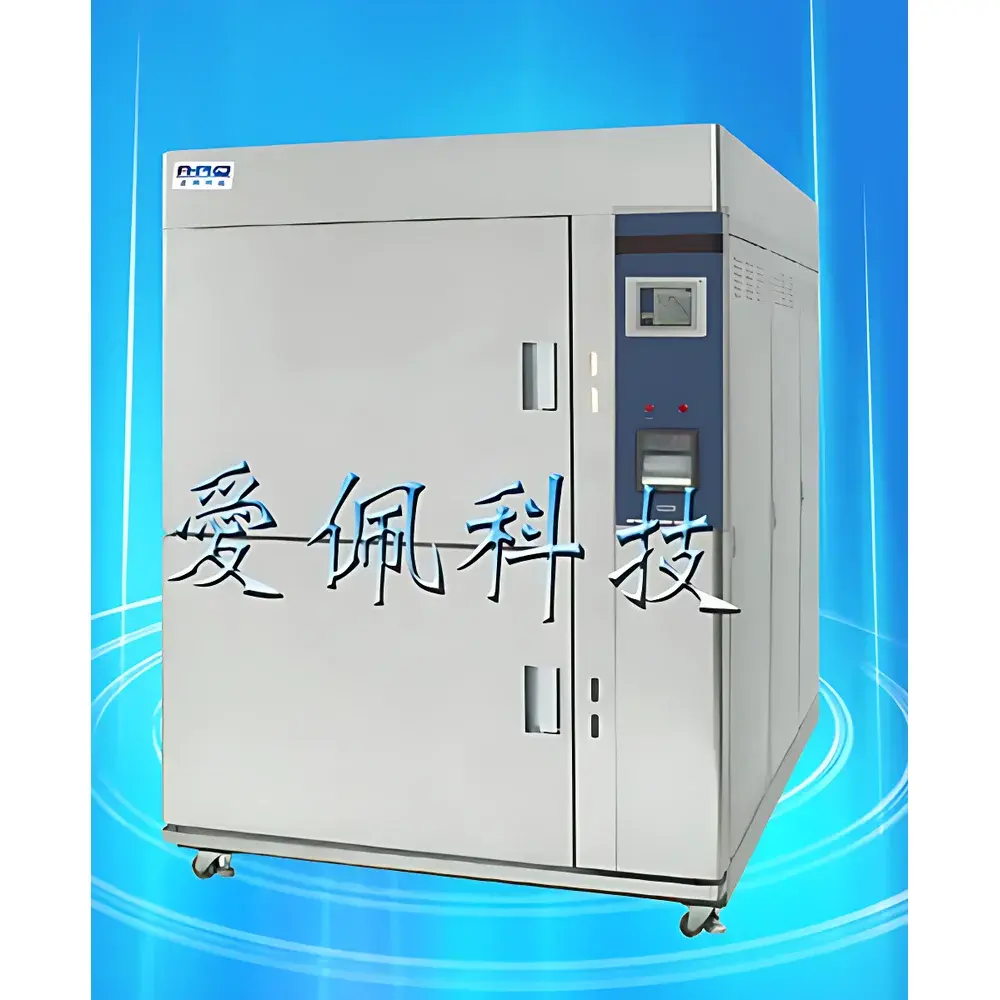
Apkem AP-CJ-11 Thermal Shock Test Chamber
| Brand | Apkem |
|---|---|
| Origin | Guangdong, China |
| Manufacturer Type | Direct Manufacturer |
| Model | AP-CJ-11 |
| Temperature Range Options | A: −40 °C to +100 °C |
| B | −50 °C to +150 °C |
| C | −60 °C to +180 °C |
| Pre-cooling Range | −50 °C to −75 °C |
| Pre-heating Range | +120 °C to +180 °C |
| Temperature Transition Time | ≤15 s |
| Temperature Recovery Time | ≤5 min |
| Temperature Uniformity | ≤±0.5 °C |
| Internal Dimensions (W×D×H) | 400×400×500 mm |
| Volume | 80 L |
| Weight (approx.) | 220–260 kg |
| Power Supply | AC 380 V, 50/60 Hz |
| Heating System | Nickel-Chromium Alloy Heaters |
| Refrigeration System | EU-imported Hermetic Compressor, Reverse Carnot Cycle |
| Control Interface | Imported Color LCD Touchscreen with RS232/RS485 Port |
| Compliance Standards | GB/T 2423.5–1995, GJB 150.5–1987, IEC 60068-2-14, MIL-STD-810G, JIS C 0025, CNS 12417 |
Overview
The Apkem AP-CJ-11 Thermal Shock Test Chamber is an engineered environmental test system designed for rapid, high-fidelity evaluation of material and component reliability under extreme temperature transitions. It operates on the reverse Carnot refrigeration cycle—comprising two isothermal and two adiabatic processes—to deliver precise, repeatable thermal shock profiles. The chamber alternates between independently controlled high-temperature and low-temperature zones using a dual-compartment lift-basket mechanism, enabling specimen exposure to abrupt thermal gradients without mechanical repositioning. This architecture supports standardized thermal shock testing per international protocols including IEC 60068-2-14 (Test N), MIL-STD-810G Method 503.5, and GB/T 2423.5–1995. Its primary function is to accelerate failure modes induced by coefficient-of-thermal-expansion (CTE) mismatch, interfacial delamination, solder joint fatigue, and microcrack propagation—critical for qualification of aerospace components, automotive electronics, PCB assemblies, and polymer-based enclosures.
Key Features
- Robust dual-zone thermal architecture with independent heating (Ni-Cr alloy) and refrigeration (EU-sourced hermetic compressor) systems, ensuring stable zone setpoints during rapid transfer cycles
- Lift-basket transfer mechanism with ≤15 s transition time and ≤5 min temperature recovery—validated per IEC 60068-2-14 Annex A requirements
- High-uniformity airflow design using optimized vane-guided circulation, achieving ≤±0.5 °C temperature deviation across the 80 L test volume (400 × 400 × 500 mm internal dimensions)
- Industrial-grade control interface: 7-inch full-color TFT LCD touchscreen with embedded real-time curve plotting, multi-segment program storage, and event logging
- Comprehensive safety architecture including overtemperature protection (chamber & heater), high-pressure cut-off, oil pressure monitoring, phase-loss detection, and earth-leakage circuit interruption
- Corrosion-resistant construction: cold-rolled steel exterior with electrostatic epoxy powder coating; SUS304B stainless steel interior chamber and basket assembly
Sample Compatibility & Compliance
The AP-CJ-11 accommodates specimens up to 300 mm in height and 350 mm in footprint, with standard dual-layer lift basket configuration supporting concurrent testing of heterogeneous samples. It is routinely deployed for qualification of metallic alloys (e.g., aluminum 6061-T6, Invar 36), thermoplastics (PBT, PEEK), elastomers (silicone, EPDM), printed circuit boards, LED modules, and MEMS packaging. All operational parameters—including ramp rates, dwell times, cycle counts, and thermal overshoot limits—are configurable to align with product-specific test plans derived from ASTM F1876, IPC-9701, or JEDEC JESD22-A104. The system complies with GLP-relevant data integrity requirements via timestamped, non-erasable event logs and supports audit-ready documentation per ISO/IEC 17025 laboratory accreditation frameworks.
Software & Data Management
Embedded firmware enables full-cycle programmability with up to 99 segments per test profile, each specifying target temperature, dwell duration, and ramp rate. Real-time data acquisition records Pt100 sensor outputs at 1 Hz resolution, storing time-stamped values internally and exporting via RS232/RS485 to external PCs running Windows-based analysis software (supplied). Export formats include CSV and Excel-compatible .xls, facilitating integration into LIMS or statistical process control (SPC) platforms. Audit trails capture operator ID, parameter modifications, alarm events, and calibration history—supporting compliance with FDA 21 CFR Part 11 when paired with user-access controls and electronic signature workflows.
Applications
- Accelerated life testing of solder joints and wire bonds in automotive ECUs subjected to −40 °C ↔ +150 °C cycling
- Evaluation of thermal interface material (TIM) adhesion stability under repeated expansion/contraction stress
- Validation of hermetic seal integrity in medical device housings per ISO 11607-2 accelerated aging protocols
- Screening of optical lens coatings for micro-delamination after 500+ shock cycles between −60 °C and +180 °C
- Qualification of battery module thermal management systems under simulated fast-charging thermal transients
FAQ
What temperature ranges are available for the AP-CJ-11 model?
Three standard configurations are offered: Option A (−40 °C to +100 °C), Option B (−50 °C to +150 °C), and Option C (−60 °C to +180 °C), with pre-cooling down to −75 °C and pre-heating up to +180 °C.
Is the chamber compliant with international test standards?
Yes—it meets the technical and procedural requirements of IEC 60068-2-14, MIL-STD-810G Method 503.5, GB/T 2423.5–1995, JIS C 0025, and CNS 12417, with documented traceability to NIST-traceable reference sensors.
Can the unit be integrated into an automated test lab environment?
Yes—standard RS232 and RS485 interfaces support SCPI command sets for remote start/stop, parameter upload, and real-time data streaming to central test management systems.
What maintenance intervals are recommended for long-term reliability?
A preventive maintenance schedule includes quarterly refrigerant pressure verification, biannual condenser coil cleaning, annual calibration of Pt100 sensors against certified references, and replacement of desiccant filters every 18 months under continuous operation.



