
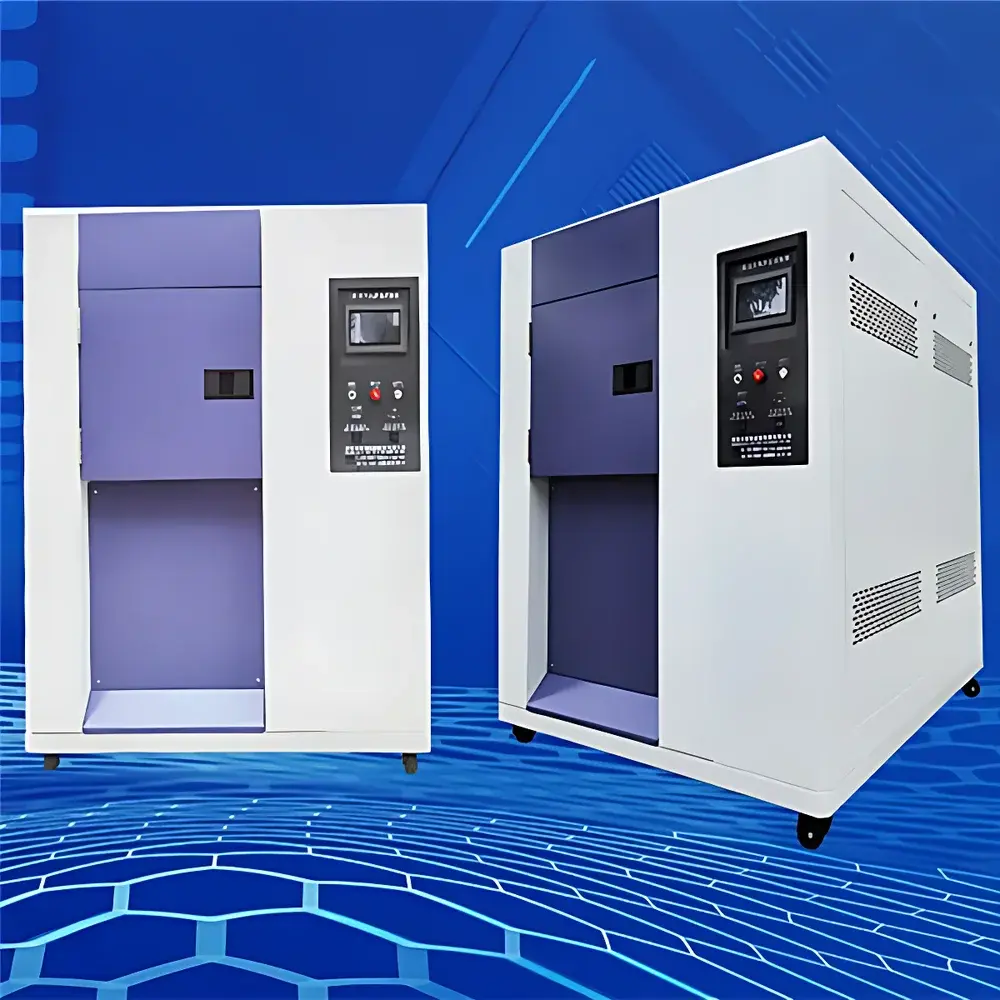
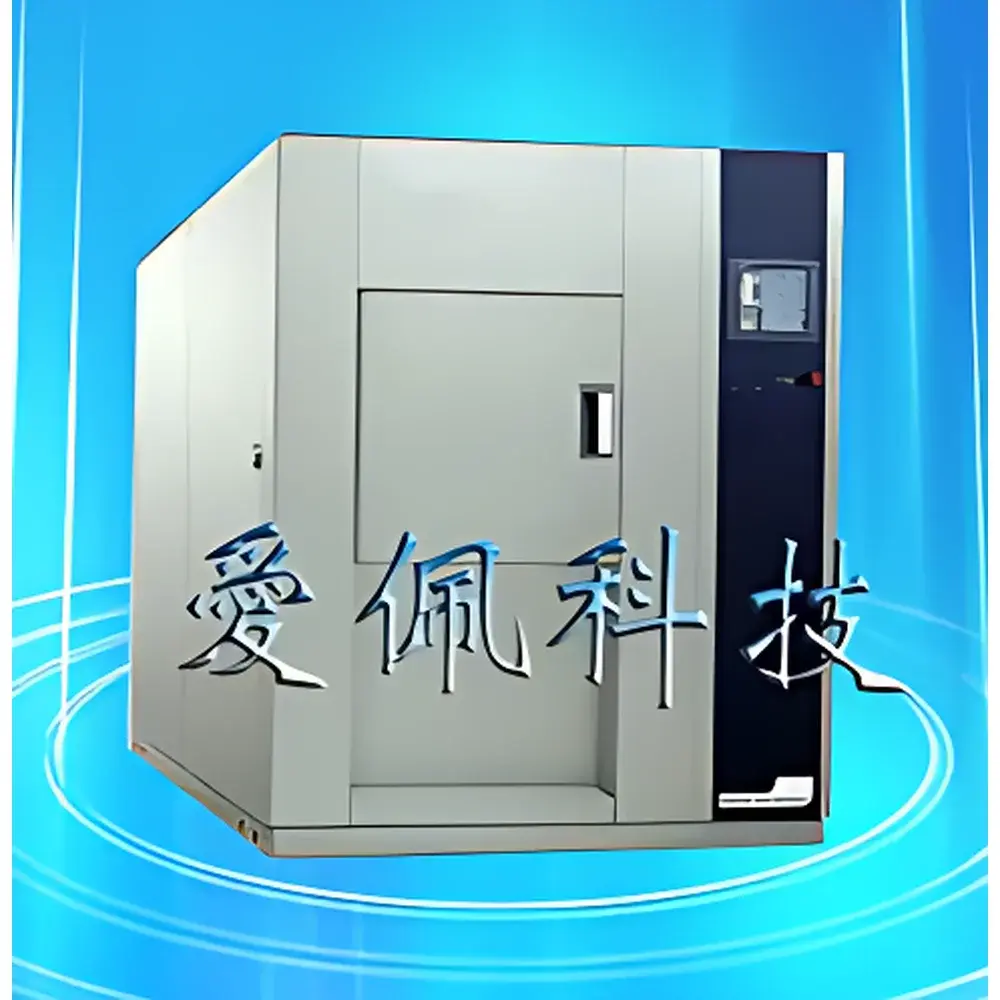
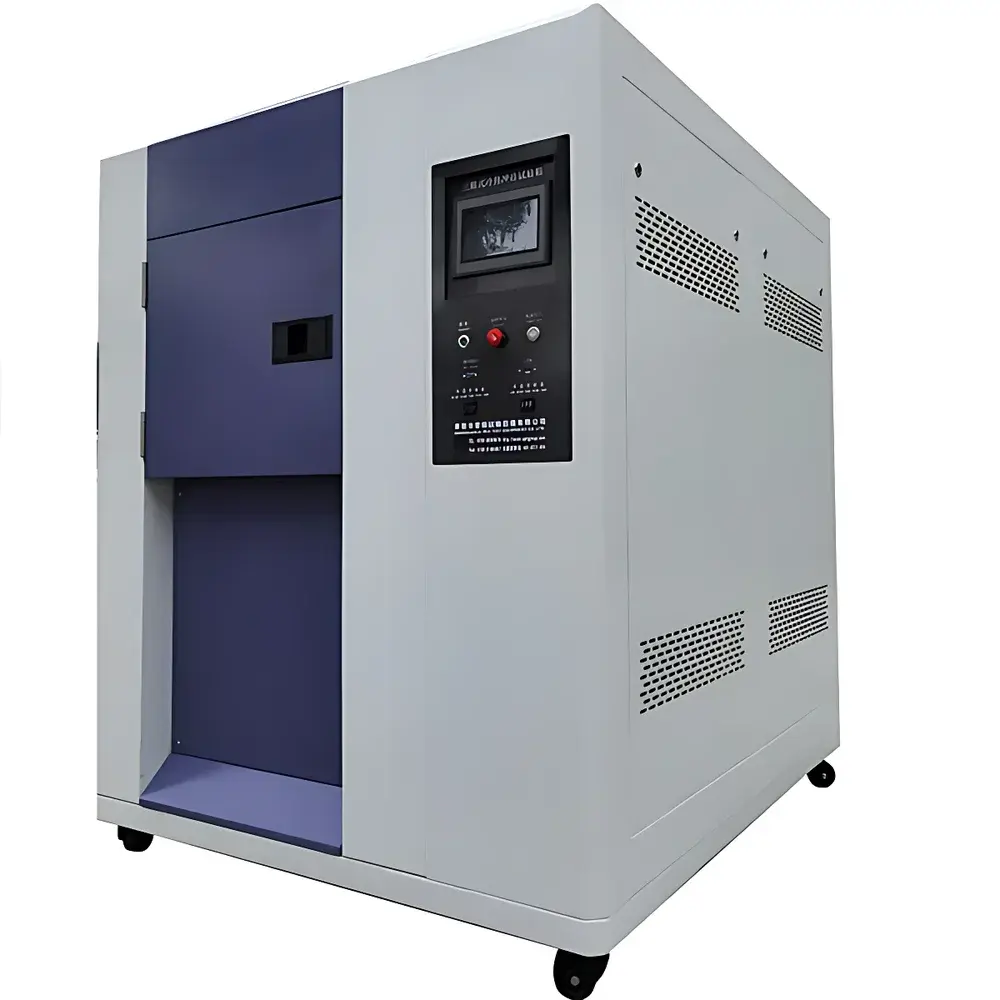
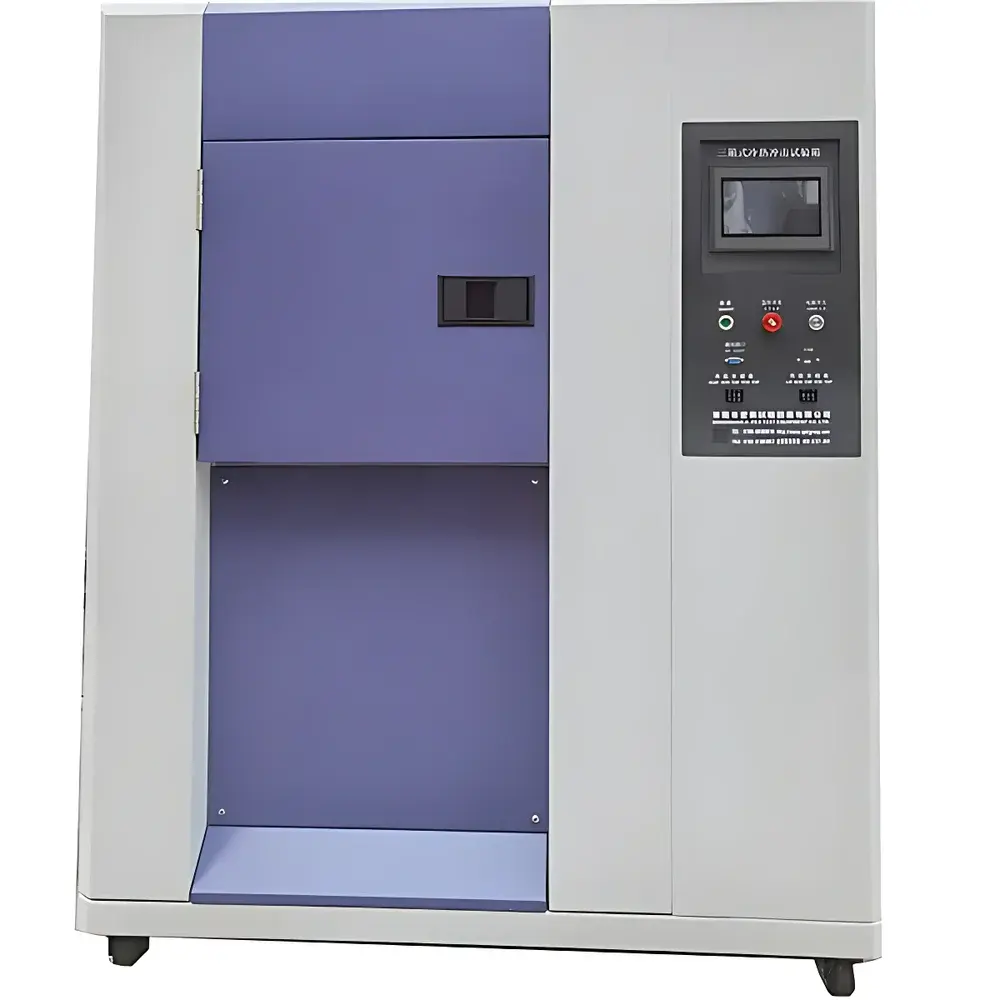
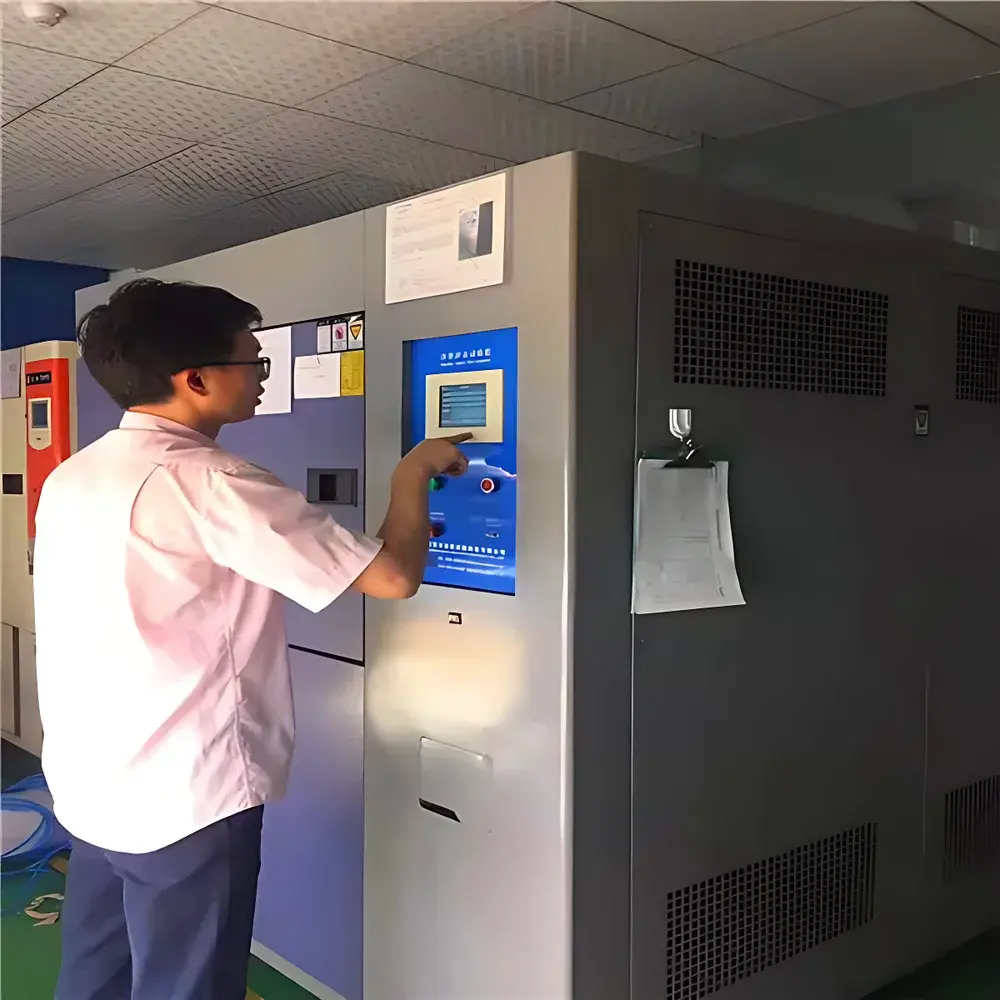
APKJ 3AP-CJ-27 Triple-Zone Thermal Shock Test Chamber for Lithium Battery and Electronic Component Reliability Testing
| Brand | APKJ |
|---|---|
| Origin | Guangdong, China |
| Manufacturer Type | Direct Manufacturer |
| Model | 3AP-CJ-27 |
| High-Temperature Range | +150 °C |
| Low-Temperature Range | −60 °C |
| Thermal Shock Range | −60 °C to +150 °C |
| Temperature Stability | ±2 °C |
| Heating Rate | 3.0 °C/min |
| Cooling Rate | 1.0 °C/min |
| Internal Dimensions (W×H×D) | 300 mm × 300 mm × 300 mm |
| External Dimensions (W×H×D) | 1200 mm × 1660 mm × 1020 mm |
| Construction Material | SUS#304 Stainless Steel (Interior & Exterior) |
| Insulation | High-Density Glass Wool + Polyurethane Foam |
| Test Port | One φ50 mm Access Port (Left Side) |
| Control Interface | Touchscreen LCD with Bilingual (English/Chinese) HMI |
| Programmable Cycles | 1–999 |
| Soak Time per Zone | Up to 999 h 59 min |
| Compliance Standards | IEC 60068-2-14, JIS Z 8702, MIL-STD-202G, CNS 12045 |
Overview
The APKJ 3AP-CJ-27 Triple-Zone Thermal Shock Test Chamber is an engineered solution for accelerated reliability validation of lithium-ion batteries, automotive electronics, aerospace components, and polymer-based assemblies subjected to extreme thermal cycling. Operating on the principle of rapid, controlled thermal transients between independently regulated high-temperature (+150 °C), low-temperature (−60 °C), and test zones, this chamber eliminates mechanical movement of test specimens—ensuring zero vibration-induced artifacts during evaluation. Its triple-chamber architecture utilizes segregated thermal reservoirs with high-efficiency heat storage and cold retention, enabling precise, repeatable shock profiles without cross-contamination between temperature domains. Designed for compliance-driven testing environments, the system supports deterministic thermal stress protocols required by international standards including IEC 60068-2-14 (Change of Temperature), MIL-STD-202G Method 107, and JIS Z 8702, making it suitable for R&D labs, QC/QA departments, and third-party certification facilities operating under GLP or ISO/IEC 17025 frameworks.
Key Features
- Triple-zone configuration with fully independent temperature control for high, low, and test chambers—eliminating specimen repositioning and ensuring static test conditions throughout thermal transition cycles.
- High-fidelity PID-controlled touchscreen HMI with bilingual (English/Chinese) interface, supporting up to 96 pre-programmed test profiles, cycle counts from 1 to 999, and soak durations configurable in 1-minute increments up to 999 hours 59 minutes.
- Robust thermal management architecture: French Tecumseh industrial-grade compressors, Swedish Alfa Laval brazed-plate heat exchangers, German ESK oil separators, and Japanese Taiyo synthetic refrigeration oil ensure long-term stability and minimal maintenance intervals.
- Structural integrity optimized for thermal isolation: SUS#304 stainless steel interior and exterior panels; multi-layer insulation combining high-density glass wool (high-temp zone) and closed-cell polyurethane foam (low-temp zone); anti-sweat K-type copper tubing integrated into chamber walls.
- Modular refrigeration design supporting environmentally compliant refrigerants: R134a (for mid-range operation), R404A (broad-range dual-stage), and R23 (ultra-low sub-zero capability), selected per application requirements and regional regulatory mandates (e.g., EU F-Gas Regulation).
- Dual-mode thermal transfer: selectable two-zone (hot/cold) or three-zone (hot/test/cold) shock sequences; programmable dwell times per zone; automatic compressor sequencing with intelligent defrost logic to prevent ice accumulation and maintain thermal fidelity across extended test durations.
Sample Compatibility & Compliance
The 3AP-CJ-27 accommodates samples up to 27 L volume (300 mm × 300 mm × 300 mm internal cavity), with a standard φ50 mm feedthrough port on the left side for external power, signal, or sensor cabling—enabling real-time voltage, impedance, or surface temperature monitoring during thermal shock. The chamber meets structural and operational requirements of IEC 60068-2-14 (Test Na), JIS Z 8702 (Thermal Shock Testing Methods), and MIL-STD-202G Method 107 (Temperature Shock). Its design facilitates integration into GMP-compliant validation workflows: all controller logs—including setpoints, actual temperatures, cycle counters, alarm timestamps, and user actions—are timestamped and exportable via USB or RS-485, supporting audit-ready documentation per FDA 21 CFR Part 11 when paired with validated software modules.
Software & Data Management
The embedded controller records full-cycle thermal history at 1-second resolution, storing up to 10,000 data points internally. Data export is supported in CSV format compatible with MATLAB, Excel, and statistical process control (SPC) platforms. Optional Ethernet-enabled firmware enables remote monitoring and centralized fleet management via industry-standard Modbus TCP or OPC UA protocols. Audit trail functionality includes user login tracking, parameter change logging, and electronic signature support for SOP adherence. All firmware updates are digitally signed and verified to ensure integrity—a prerequisite for laboratories maintaining ISO/IEC 17025 accreditation.
Applications
- Lithium battery cell and module qualification: assessment of electrolyte volatility, SEI layer integrity, and interfacial delamination under repeated −60 °C/+150 °C transitions.
- Automotive ECUs and ADAS sensors: verification of solder joint fatigue resistance and housing dimensional stability across OEM-defined thermal shock envelopes.
- Medical device PCBs and hermetic packages: detection of microcracks, seal failure, or moisture ingress induced by coefficient-of-thermal-expansion (CTE) mismatch.
- Aerospace composites and adhesives: evaluation of matrix cracking, fiber-matrix debonding, and outgassing behavior under simulated launch/re-entry thermal gradients.
- Consumer electronics enclosures and display assemblies: validation of optical clarity retention, touch sensitivity drift, and gasket compression set after 500+ shock cycles.
FAQ
What is the difference between two-zone and three-zone thermal shock configurations?
A two-zone system alternates airflow between hot and cold reservoirs into a single test chamber, while the three-zone 3AP-CJ-27 maintains dedicated hot, cold, and test compartments—reducing thermal inertia, improving transition repeatability, and eliminating residual temperature carryover.
Can the chamber operate continuously for extended validation runs?
Yes. With redundant compressor staging, auto-defrost logic, and continuous oil management, the system supports unattended operation for ≥72 hours—validated via MTBF analysis exceeding 12,000 hours.
Is calibration traceability available for metrological compliance?
Factory calibration certificates are provided with NIST-traceable reference sensors (±0.3 °C accuracy). On-site recalibration services include ISO/IEC 17025-accredited thermocouple verification and chamber uniformity mapping per ASTM E2203.
How is refrigerant selection determined for a specific test profile?
R134a suffices for −40 °C to +150 °C applications; R404A extends low-temperature capability to −60 °C with acceptable efficiency; R23 is reserved for specialized ultra-low shock profiles requiring <−65 °C, subject to local environmental regulations.
Does the system support custom protocol scripting beyond preset standards?
Yes. The controller accepts user-defined ramp-soak sequences with variable rates, conditional branching (e.g., “if T > 145 °C, hold for 15 min”), and external trigger inputs—enabling proprietary stress-testing methodologies.



