
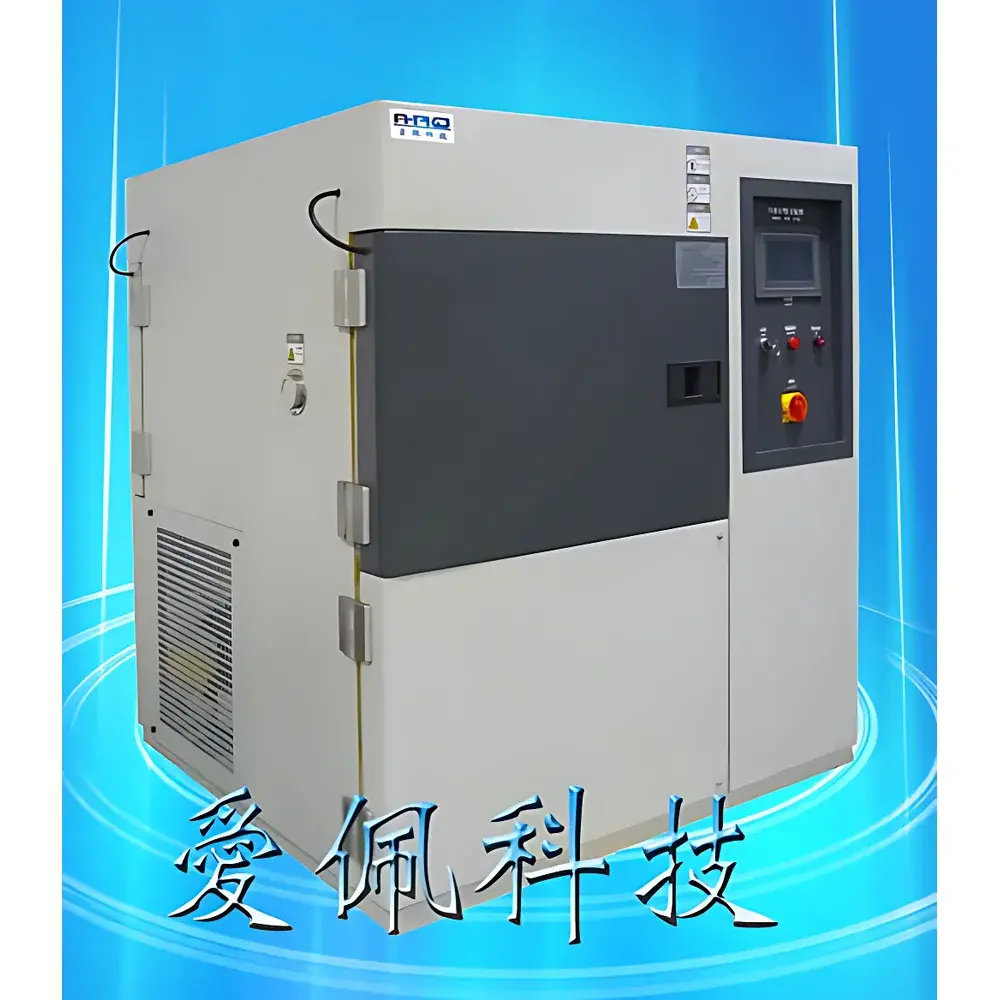
APKJ AP-CJ-5 Programmable Thermal Shock Test Chamber for LED Industry
| [Brand | APKJ |
|---|---|
| Origin | Guangdong, China |
| Manufacturer Type | OEM/ODM Manufacturer |
| Product Category | Domestic |
| Model | AP-CJ-5 |
| Pricing | Upon Request |
| Preheating Temperature Range | RT to +200 °C |
| Precooling Temperature Range | RT to −70 °C |
| Test Temperature Ranges | +150 °C ↔ −40 °C, +150 °C ↔ −55 °C, +150 °C ↔ −65 °C |
| Temperature Stability | ±2 °C |
| Transfer Time | ≤10 s |
| Recovery Time | 3–5 min |
| High-Temp Soak Duration | Up to 999 h at +150 °C |
| Low-Temp Soak Duration | Up to 999 h at −40 °C |
| Max Cycles | 9999 |
| Cooling System | Dual-stage cascade refrigeration with water-cooled condenser |
| Control Interface | Touchscreen color LCD HMI with PID auto-tuning |
| Compliance | MIL-STD-810G Method 503.5, GJB 150.5A-2009, GJB 360B-2009 (Method 211), GB/T 2423.22–2012, IEC 60068-2-14, QC/T 17–1992, EIA-364-32] |
Overview
The APKJ AP-CJ-5 Programmable Thermal Shock Test Chamber is a three-zone (hot zone / cold zone / test zone) environmental stress screening system engineered for accelerated reliability validation of LED modules, drivers, encapsulants, and optoelectronic assemblies subjected to rapid thermal transients. It operates on the principle of mechanical transfer—where the test specimen remains stationary in the insulated test chamber while conditioned air from either the preheated or prechilled reservoir is pneumatically directed into the test zone via high-speed airflow switching valves. This architecture eliminates mechanical movement of samples, ensuring zero vibration-induced artifacts during measurement—a critical requirement for evaluating solder joint integrity, die attach delamination, and coefficient-of-thermal-expansion (CTE) mismatch failures in high-brightness LED packaging.
Key Features
- Three-compartment design isolates thermal mass: independent hot zone (RT to +200 °C), cold zone (RT to −70 °C), and static test zone—enabling repeatable, contamination-free thermal shock without sample repositioning.
- High-fidelity temperature control using dual-loop PID algorithms with real-time auto-tuning; achieves ±2 °C stability across full operational range per IEC 60068-2-14 Annex A requirements.
- Sub-10-second transfer time between extreme temperature zones, verified per GJB 150.5A-2009 Clause 4.4.2, ensuring compliance with military-grade thermal shock ramp rate specifications.
- Dual-stage cascade refrigeration system with water-cooled condensers delivers rapid cooldown to −65 °C within <12 minutes from ambient—optimized for high-throughput LED qualification testing.
- Industrial-grade touchscreen HMI (10.4″ TFT-LCD) with multilingual UI supports intuitive programming of up to 9999 cycles, variable soak durations (1 min–999 h), and user-defined start conditions (hot-first or cold-first sequence).
- Comprehensive safety architecture includes overtemperature cutouts, refrigerant pressure monitoring, door interlock switches, phase failure protection, and automatic defrost scheduling with manual override capability.
- Modular electrical feedthroughs (IP65-rated) allow live-load testing of powered LED arrays through dedicated cable ports—enabling in-situ optical output and forward-voltage monitoring during thermal cycling.
Sample Compatibility & Compliance
The AP-CJ-5 accommodates LED packages ranging from 0402 SMDs to 100 mm × 100 mm COB substrates. Internal dimensions (W×H×D: 36×35×40 cm) support standard JEDEC trays, carrier boards, and bare-die fixtures. The chamber meets structural and procedural requirements of multiple international standards: MIL-STD-810G Method 503.5 (Thermal Shock), GJB 150.5A-2009 (China National Military Standard), GB/T 2423.22–2012 (IEC 60068-2-14 equivalent), and EIA-364-32 (for electro-optical connector reliability). It is routinely deployed in ISO/IEC 17025-accredited labs for AEC-Q102 qualified LED component validation and supports full traceability for GLP/GMP-aligned test records when integrated with external data acquisition systems.
Software & Data Management
The embedded controller logs timestamped temperature profiles (hot zone, cold zone, test zone) at 1 Hz resolution, storing ≥30 days of continuous cycle data onboard. Export formats include CSV and PDF reports compliant with FDA 21 CFR Part 11 audit trail requirements when paired with optional PC-based supervision software. Real-time curve visualization, alarm event logging (with cause codes per IEC 62443-3-3), and configurable email/SMS notifications enable remote operational oversight. All firmware updates are digitally signed and validated prior to installation to maintain system integrity throughout the equipment lifecycle.
Applications
- Accelerated life testing of phosphor-converted white LEDs under repeated −65 °C ↔ +150 °C transitions.
- Evaluation of silicone vs. epoxy encapsulant cracking resistance in high-power UV LED packages.
- Qualification of ceramic substrate metallization adhesion after 1000+ thermal cycles.
- Screening of driver IC thermal runaway thresholds under combined thermal shock and load switching.
- Validation of conformal coating performance on PCB-mounted LED arrays per IPC-CC-830B.
- Supporting JESD22-A104F (Temperature Cycling) and JESD22-A106B (Highly Accelerated Temperature and Humidity Stress Test – HAST) pre-screening protocols.
FAQ
What is the maximum allowable sample weight for static placement in the test zone?
The test chamber supports loads up to 30 kg uniformly distributed on the stainless-steel shelf—verified per ASTM E145-20 Annex A3 for thermal mass compensation.
Does the system support automated data export to LIMS platforms?
Yes—via Modbus TCP or OPC UA interface (optional add-on module), enabling direct integration with laboratory information management systems for electronic batch record generation.
Can the unit be configured for two-zone operation (hot/cold only) instead of three-zone?
No—the AP-CJ-5 is exclusively a three-zone architecture; however, programmable bypass logic allows simulated two-zone behavior by disabling one reservoir during specific cycle phases.
Is calibration certification included with shipment?
A factory-as-found calibration report (NIST-traceable sensors, ±0.5 °C accuracy) is provided; ISO/IEC 17025 accredited field calibration services are available upon request.
What maintenance intervals are recommended for the cascade refrigeration system?
Compressor oil analysis and refrigerant purity verification every 12 months; water-cooling circuit descaling every 6 months in hard-water environments.



