
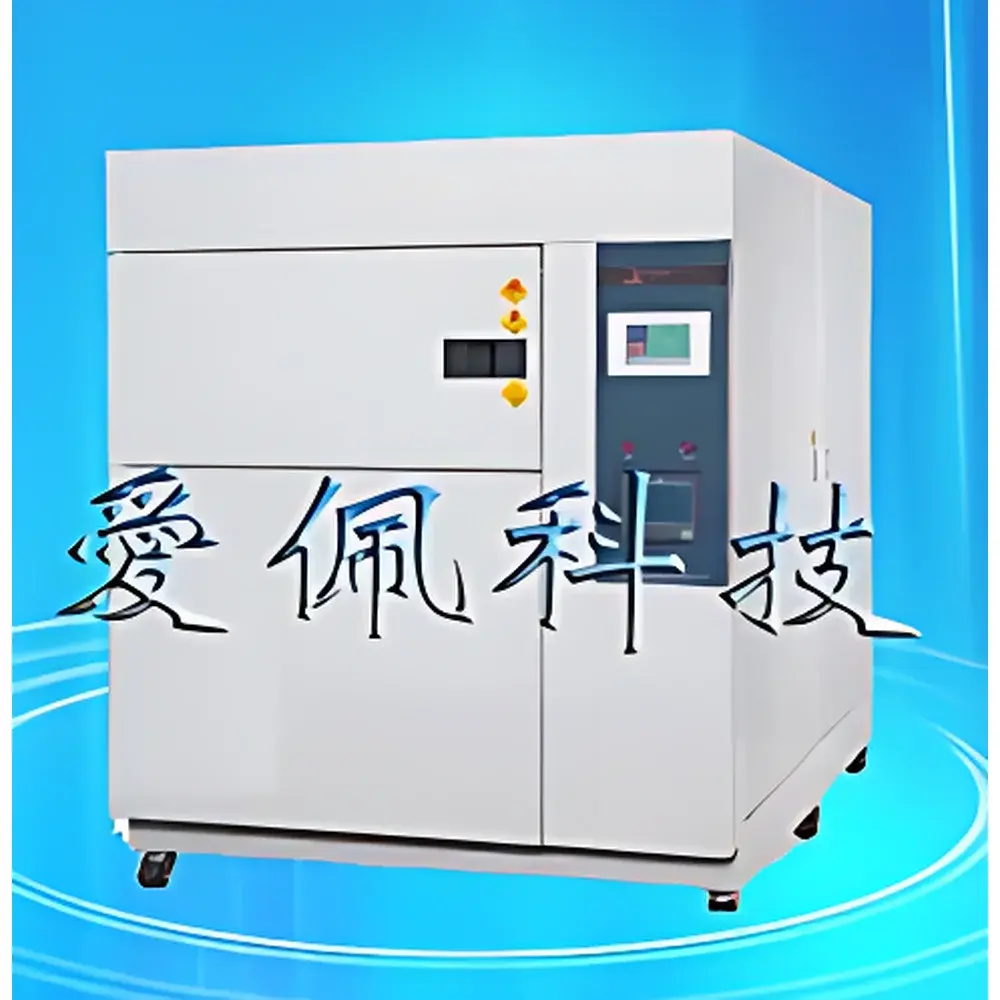
APKJ AP-CJ Series Three-Zone Thermal Shock Test Chamber for LCD Display Reliability Testing
| Brand | APKJ |
|---|---|
| Model | AP-CJ-50 / AP-CJ-80 / AP-CJ-100 / AP-CJ-150 / AP-CJ-250 |
| Chamber Type | Three-Zone (Hot Zone / Cold Zone / Test Zone) |
| Temperature Range | +150 °C to –70 °C |
| Preheat Range | RT to +200 °C |
| Precool Range | RT to –70 °C |
| Test Zone Temp. Stability | ±2 °C |
| Transfer Time | ≤10 s |
| Recovery Time | 3–5 min |
| Heating Rate (150 °C) | 30–40 min |
| Cooling Rate (to –55/–65/–75 °C) | 70–120 min |
| Interior Material | SUS304 Stainless Steel |
| Insulation | Rigid Polyurethane Foam + Glass Wool |
| Refrigeration | Cascade System with Dual Compressors (TECUMSEH or Bitzer) |
| Refrigerants | R404A/R507 (High Stage), R23/R508B (Low Stage) |
| Controller | TEMI (Korea) or OYO (Japan) |
| Compliance | Designed for ASTM D5229, IEC 60068-2-14, MIL-STD-810H Method 503.5, JIS Z 8701-2, and GLP-aligned validation protocols |
| Sample Mounting | Static in Test Zone |
| Power Supply | 3-phase 380 VAC ±10%, 50/60 Hz |
Overview
The APKJ AP-CJ Series Three-Zone Thermal Shock Test Chamber is an engineered environmental simulation system specifically optimized for accelerated reliability assessment of liquid crystal display (LCD) modules, driver ICs, polarizer assemblies, and associated optoelectronic components. It operates on the principle of rapid, controlled thermal transients—inducing mechanical stress through differential thermal expansion across heterogeneous material interfaces (e.g., glass substrates, ITO layers, adhesive films, and PCB interconnects). Unlike conventional two-zone chambers, the AP-CJ’s three-compartment architecture isolates the test specimen statically within a dedicated chamber while enabling independent control and high-fidelity thermal energy transfer from pre-conditioned hot and cold reservoirs. This design eliminates sample movement-related vibration artifacts and ensures repeatable shock profiles per IEC 60068-2-14 Ed. 4.0 (2021), supporting both air-to-air thermal shock and extended dwell-based cycling protocols.
Key Features
- Three-zone configuration: thermally isolated hot zone (+150 °C to +200 °C), cold zone (–40 °C to –70 °C), and static test zone—eliminating mechanical actuation of samples during transfer.
- Cascade refrigeration system with dual-stage compressors (TECUMSEH hermetic or Bitzer semi-hermetic), enabling stable operation down to –70 °C with low-temperature refrigerants R23/R508B and high-stage R404A/R507.
- Thermal transfer via forced-air switching: high-efficiency centrifugal blowers independently manage airflow routing between zones, achieving ≤10 s transfer time and ≤5 min temperature recovery per ASTM D5229 Annex A3.
- Programmable multi-mode operation: supports standalone high-temperature soak, low-temperature soak, two-zone thermal shock (hot ↔ cold), and three-zone shock including ambient-reference transitions (hot ↔ ambient ↔ cold).
- SUS304 stainless steel interior and exterior construction with ≥100 mm composite insulation (rigid polyurethane foam + glass wool) minimizes thermal leakage and ensures long-term dimensional stability under cyclic loading.
- Industrial-grade controller options: TEMI 990 (Korea) or OYO 7110 (Japan), featuring 100-segment programmability, real-time curve logging, USB data export, and password-protected parameter locking for audit compliance.
Sample Compatibility & Compliance
The AP-CJ chamber accommodates flat-panel display subassemblies up to 70 × 60 × 60 cm (W×H×D) internal volume. Its static test zone geometry preserves optical alignment integrity during thermal cycling—critical for evaluating delamination at glass–adhesive interfaces or pixel-level failure modes in TFT-LCDs. The system meets structural and operational requirements defined in IEC 60068-2-14 (Change of Temperature), MIL-STD-810H Method 503.5 (Temperature Shock), JIS Z 8701-2 (Environmental Testing), and ASTM D5229 (Low-Temperature Impact Resistance of Plastics). When configured with optional validation accessories (NIST-traceable PT100 sensors, calibrated data loggers, and IQ/OQ documentation packages), it supports GLP-compliant qualification for QC laboratories operating under ISO/IEC 17025 or FDA 21 CFR Part 11 environments.
Software & Data Management
Controller firmware includes built-in data logging at user-selectable intervals (1–60 s), with timestamped records for chamber setpoints, actual temperatures (hot/cold/test zones), compressor status, and alarm events. Export formats include CSV and Excel-compatible .xls files via USB interface. Optional Ethernet connectivity enables remote monitoring and integration into centralized MES or LIMS platforms using Modbus TCP protocol. Audit trails are maintained for all parameter modifications, user logins, and calibration events—meeting traceability requirements for GMP-regulated electronics manufacturing and automotive display qualification (e.g., AEC-Q200 compliance workflows).
Applications
- Qualification testing of LCD panels, OLED modules, and touch sensor laminates under extreme thermal gradients.
- Evaluation of solder joint fatigue, underfill cracking, and coefficient-of-thermal-expansion (CTE) mismatch in display driver boards.
- Accelerated aging studies for optical adhesives, polarizers, and encapsulant materials used in outdoor signage and automotive infotainment displays.
- Process validation for lamination, bonding, and curing steps where thermal hysteresis may induce latent defects.
- Reliability benchmarking against industry standards including JEDEC JESD22-A104 (Temperature Cycling) and IPC-9701 (Performance Classes for Printed Board Interconnects).
FAQ
What distinguishes the three-zone AP-CJ from conventional two-zone thermal shock chambers?
The AP-CJ eliminates mechanical sample transfer by maintaining specimens statically in a dedicated test zone. Thermal energy is delivered via rapid air switching from pre-conditioned reservoirs—reducing vibration-induced artifacts and enabling precise ambient-reference shock sequences not possible in moving-basket designs.
Can the AP-CJ perform extended dwell tests at intermediate temperatures?
Yes. While optimized for shock, its independent hot/cold zone control allows programmable soaks at any temperature between –70 °C and +200 °C, including ambient (23 ±2 °C) hold phases required for MIL-STD-810H Method 503.5 variant cycles.
Is the system compliant with FDA 21 CFR Part 11 for electronic records?
The TEMI and OYO controllers support user access levels, electronic signatures, and immutable audit logs when deployed with validated firmware and documented configuration management—fulfilling foundational Part 11 requirements for regulated electronics testing labs.
What refrigerant alternatives are available for regions with evolving F-gas regulations?
APKJ offers R450A and R452A as drop-in replacements for R404A in the high stage, and R170/R23 blends with enhanced GWP reduction, subject to local regulatory approval and system recalibration.
Does APKJ provide IQ/OQ documentation and on-site validation support?
Yes. Factory-applied IQ/OQ protocols aligned with ISO 14644-1, ASTM E2500, and Annex 15 of EU GMP are available as optional deliverables, including sensor mapping reports, uncertainty budgets, and 21 CFR Part 11 readiness assessments.
Related Products



