
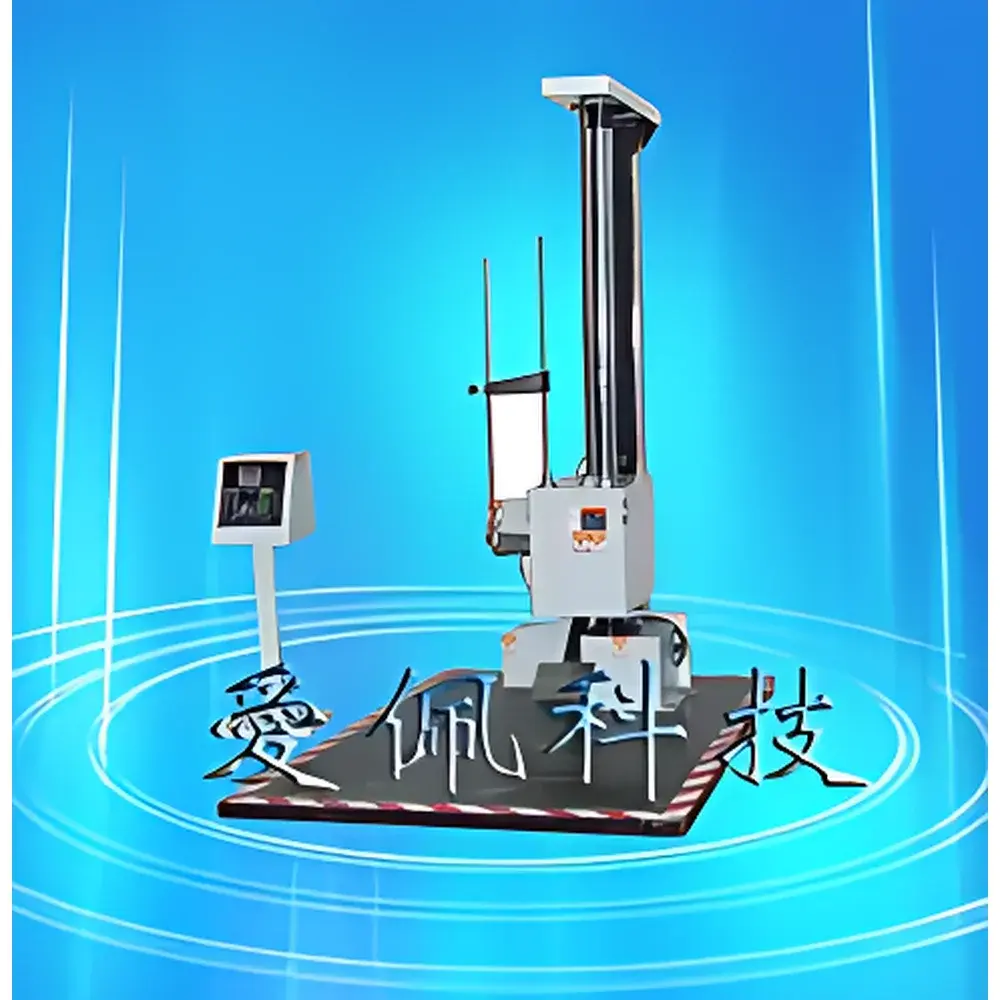
APKJ AP-DL-2 Drop Testing Machine
| Brand | APKJ |
|---|---|
| Origin | Guangdong, China |
| Manufacturer Type | Manufacturer |
| Model | AP-DL-2 |
| Drive System | Electric |
| Drop Method | Free Fall |
| Drop Height Range | 300–1500 mm |
| Height Accuracy | ±10 mm (or ≤2% of set height) |
| Maximum Test Specimen Dimensions | 1000 × 800 × 1000 mm (L×W×H) |
| Drop Platform Area | 1700 × 1400 mm (L×W) |
| Arm Dimensions | 290 × 240 × 8 mm |
| Leveling Tolerance of Drop Surface | <1° |
| Angular Alignment Tolerance (Impact Face vs. Base Plate) | ≤5° |
| Maximum Load Capacity | 80 kg |
| Overall Dimensions | 1700 × 1400 × 2015 mm (L×W×H) |
| Control Box Dimensions | 350 × 350 × 1100 mm (L×W×H) |
| Net Weight | 450 kg |
| Power Supply | 1-phase, AC 380 V, 50 Hz |
| Compliance Standards | ISO 2248, JIS Z0202-87, GB/T 4857.5–1992 |
Overview
The APKJ AP-DL-2 Drop Testing Machine is an electromechanically actuated free-fall impact tester engineered for standardized evaluation of packaging integrity and product resilience under simulated transport-related mechanical shock. It operates on the principle of controlled gravitational acceleration, releasing test specimens from preset heights onto a rigid, level impact surface to replicate real-world drop events during handling, loading, unloading, or logistics transit. Designed in accordance with internationally recognized packaging performance standards—including ISO 2248 (Packaging—Complete, filled transport packages—Vertical impact test by dropping), JIS Z0202-87 (Japanese Industrial Standard for package drop testing), and GB/T 4857.5–1992 (Chinese national standard equivalent to ISO 2248)—the AP-DL-2 delivers repeatable, traceable, and auditable test conditions essential for quality assurance, regulatory documentation, and comparative benchmarking across supply chains.
Key Features
- Single-arm, dual-column structural architecture enabling rapid specimen placement and unobstructed access to the drop zone;
- Electrically driven lifting, release, and auto-reset mechanisms ensuring consistent cycle timing and operator safety;
- Digital height display integrated with rotary encoder-based position feedback for precise height tracking—achieving accuracy within ±10 mm or ≤2% of set value;
- Hydraulic damping system mounted at base to absorb kinetic energy, minimizing mechanical stress on frame components and extending service life;
- Adjustable drop arm with angular alignment tolerance ≤5° relative to horizontal reference plane, guaranteeing reproducible impact orientation for face-, edge-, and corner-drop configurations;
- Leveling-adjustable impact surface with flatness deviation <1°, certified via built-in spirit level and validated during factory calibration;
- Robust steel frame construction (450 kg net weight) providing high rigidity and vibration isolation during repeated high-energy impacts.
Sample Compatibility & Compliance
The AP-DL-2 accommodates packaged units up to 1000 mm (L) × 800 mm (W) × 1000 mm (H), with maximum mass of 80 kg. Its 1700 × 1400 mm impact platform supports oversized cartons, palletized loads, and irregularly shaped assemblies. The machine is configured to execute all three primary drop configurations defined in ISO 2248: flat-face, edge, and corner impacts. All operational parameters—including height setting, drop count, and sequence—are manually initiated and recorded per test protocol. While the system does not include embedded audit trail or electronic signature functionality, its mechanical repeatability and physical calibration records support GLP-aligned test documentation when paired with laboratory-controlled SOPs and external data logging.
Software & Data Management
The AP-DL-2 operates as a standalone electromechanical instrument without onboard software or network connectivity. Height is displayed via a digital LED indicator; no data export, remote control, or PC interface is provided. Users are expected to record test parameters (e.g., drop height, orientation, number of drops, pass/fail observations) in external laboratory notebooks or LIMS-compatible spreadsheets. For laboratories requiring 21 CFR Part 11 compliance, integration with third-party data acquisition systems (e.g., USB-connected height loggers or video-based impact validation tools) is feasible but requires external configuration and validation by the end user.
Applications
- Validation of corrugated box, wooden crate, and molded plastic container performance under vertical impact;
- Pre-shipment qualification of consumer electronics, medical devices, and industrial components in their final shipping configuration;
- Root cause analysis of packaging failure modes—including seam rupture, lid detachment, internal component displacement, and crush deformation;
- Comparative assessment of alternative cushioning materials (e.g., foam, air pillows, molded pulp) under identical drop conditions;
- Internal QA/QC screening for production-line packaging consistency prior to full-scale distribution;
- Supporting ISTA-certified test protocols when combined with supplementary environmental conditioning and vibration profiling.
FAQ
What standards does the AP-DL-2 comply with?
The machine is mechanically and dimensionally aligned with ISO 2248, JIS Z0202-87, and GB/T 4857.5–1992. Calibration certificates and mechanical verification reports are supplied upon request.
Can the AP-DL-2 perform sequential multi-drop tests?
Yes—operators may manually reposition and re-lift specimens between drops. No automated sequencing or programmable cycles are built-in.
Is height calibration traceable to national metrology institutes?
Factory calibration uses NIST-traceable laser distance meters and precision spirit levels. End users should perform periodic mechanical verification using certified gauge blocks and inclinometers.
What maintenance is required?
Monthly inspection of hydraulic buffer fluid level, encoder coupling integrity, and guide rail lubrication is recommended. Annual recalibration of height display and leveling verification are advised for regulated environments.
Does APKJ offer installation and training outside China?
Installation, commissioning, and operator training are included for domestic deliveries. International deployment requires separate quotation covering travel, customs clearance, and local electrical adaptation support.



