
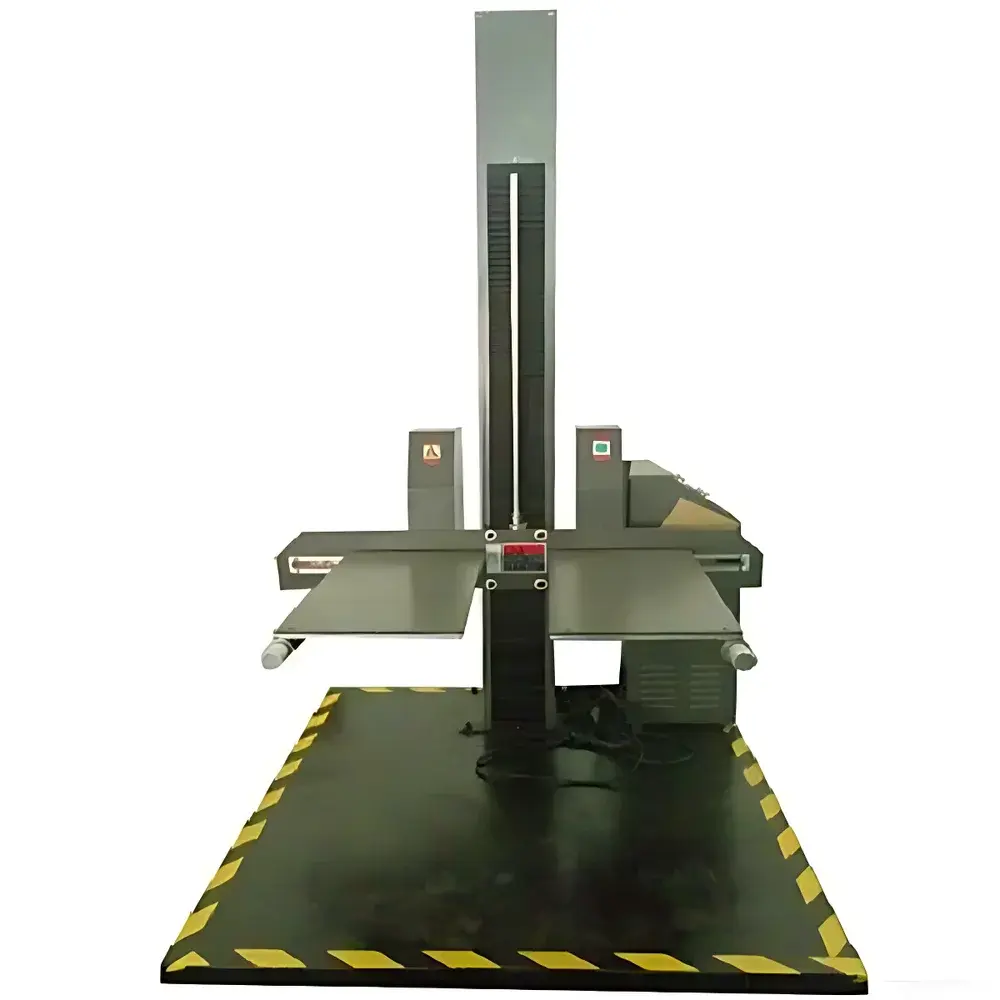
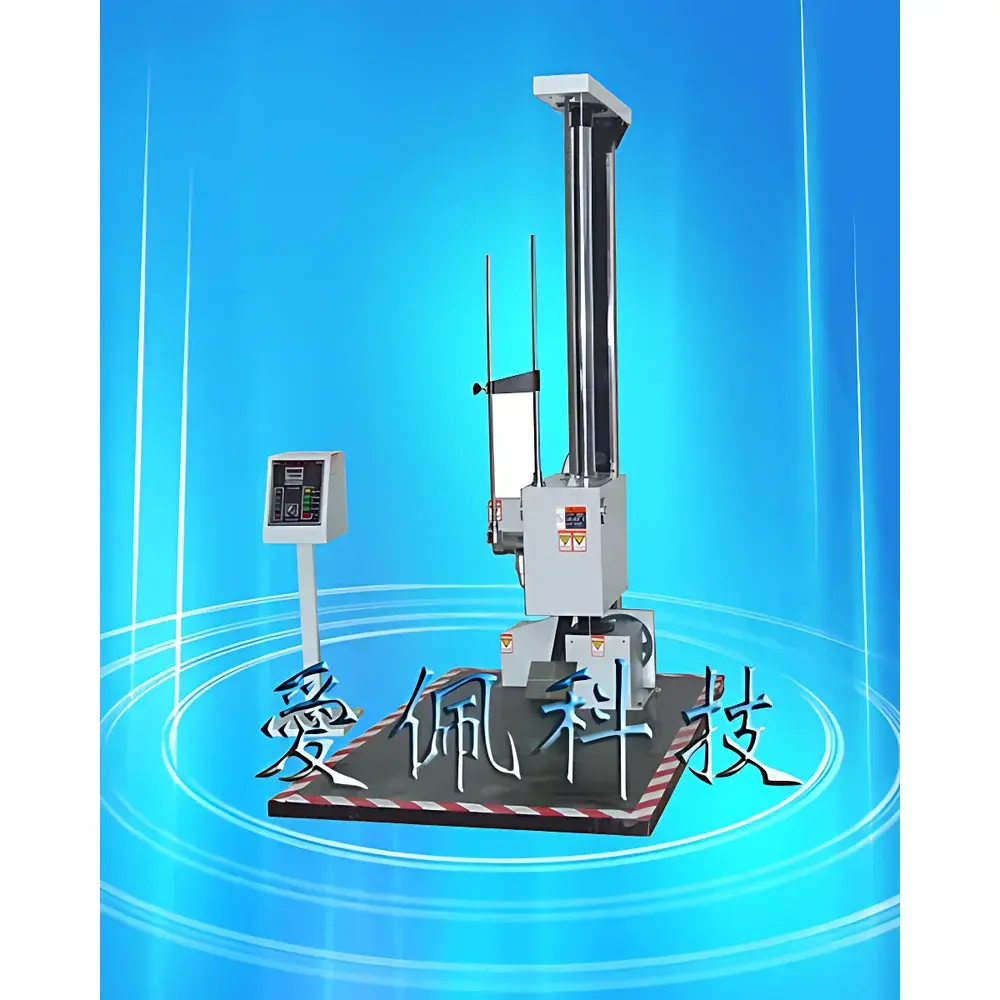
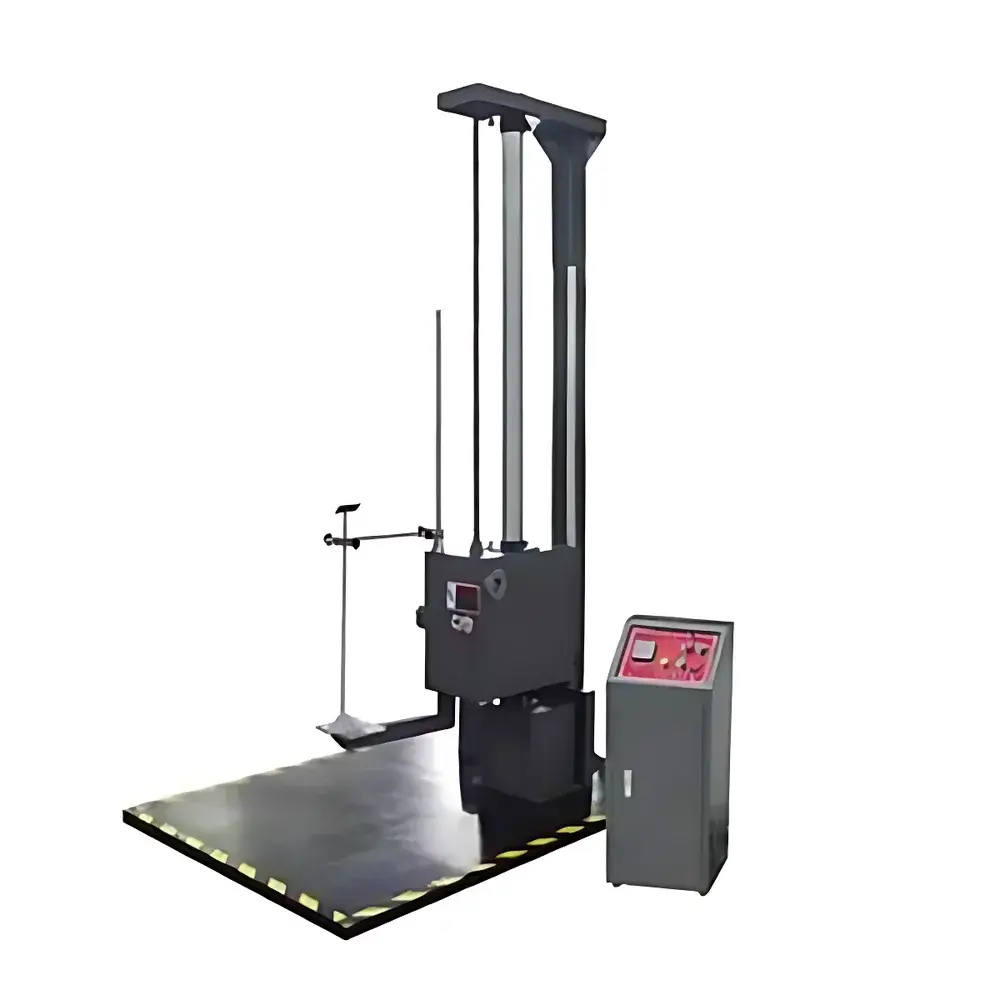
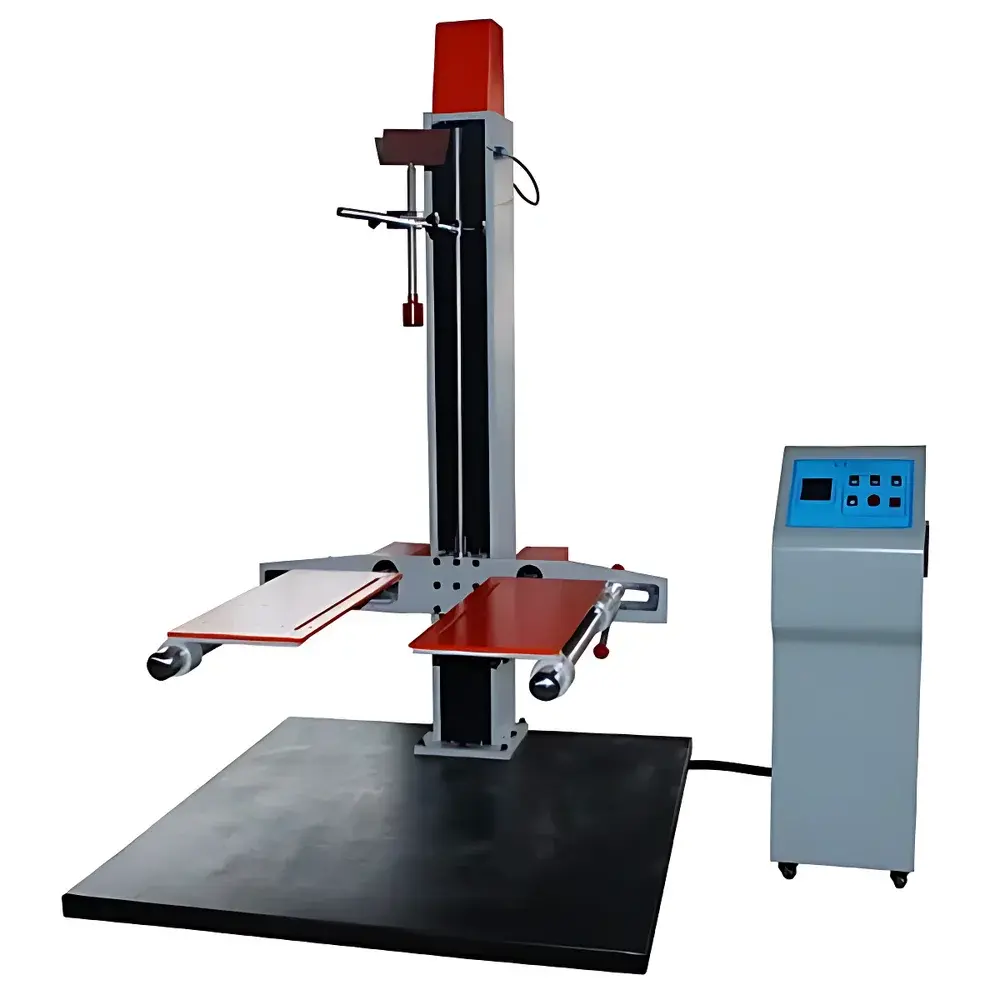
APKJ AP-DL Single-Arm Drop Testing Machine
| Brand | APKJ |
|---|---|
| Origin | Guangdong, China |
| Manufacturer Type | Manufacturer |
| Country of Origin | China |
| Model | AP-DL |
| Price Range | USD 1,400–2,800 (est.) |
| Drop Height Range | 300–1500 mm |
| Max. Specimen Weight | 60 kg |
| Max. Specimen Dimensions | 200 × 800 × 1000 mm |
| Impact Surface Dimensions | 600 × 1100 × 20 mm |
| Height Accuracy | ±10 mm or ≤2% of set height |
| Drop Orientation | Face, Edge, Corner |
| Structural Configuration | Single-arm, dual-column |
| Actuation | Electromechanical lift & release |
| Height Tracking | Rotary encoder-based |
| Display | Optional digital height indicator |
| Base Plate Angular Tolerance | ≤5° relative to horizontal |
| Safety System | Hydraulic damping buffer |
| Compliance Standard | GB/T 2423.8 |
Overview
The APKJ AP-DL Single-Arm Drop Testing Machine is an electromechanically actuated physical testing system engineered for standardized free-fall impact evaluation of packaged products and consumer electronics—particularly smartphones, tablets, and other portable devices subject to handling-related mechanical stress during logistics and distribution. It operates on the principle of controlled gravitational acceleration, releasing test specimens from preselected heights onto a rigid, horizontally aligned impact surface under defined orientation conditions (face, edge, or corner). Designed in strict accordance with GB/T 2423.8—China’s national adaptation of IEC 60068-2-32—the instrument delivers repeatable, traceable drop events essential for quality assurance, packaging validation, and regulatory conformance in supply chain engineering.
Key Features
- Single-arm, dual-column structural architecture enables unobstructed specimen loading and precise angular alignment; impact surface remains fixed while the lifting arm positions the specimen at user-defined height and orientation.
- Electromechanical vertical positioning system with rotary encoder feedback ensures height repeatability within ±10 mm or ≤2% of set value—critical for inter-laboratory comparability and audit-ready documentation.
- Hydraulic damping buffer integrated into the base frame absorbs kinetic energy upon impact, minimizing mechanical shock transmission to the machine structure and extending service life beyond 50,000 operational cycles.
- Motor-driven lift mechanism (1.1 kW) supports smooth, programmable elevation across the full 300–1500 mm range; electric release trigger ensures consistent drop initiation without manual intervention.
- Impact surface constructed from 20 mm-thick steel plate (600 × 1100 mm), mounted on a reinforced concrete foundation interface to maintain rigidity and minimize deflection (<0.1 mm under 60 kg load).
- Optional digital height display provides real-time readout during setup; all height data are synchronized with encoder output for GLP-compliant recordkeeping when paired with external logging systems.
Sample Compatibility & Compliance
The AP-DL accommodates specimens up to 60 kg and 200 × 800 × 1000 mm in volume, making it suitable for single-unit smartphone packages, retail cartons, and mid-sized industrial enclosures. Its modular mounting interface allows rapid reconfiguration between face-down, edge-first, and corner-first drop configurations—each validated per ISO/IEC 17025-aligned calibration procedures. The system meets GB/T 2423.8 requirements for drop test methodology, including permissible angular deviation (≤5° between specimen impact plane and base plate), environmental operating conditions (15–35°C, RH ≤85%), and mechanical stability verification. While not certified to ASTM D5276 or ISTA 3A out-of-the-box, its dimensional and functional specifications align with core performance criteria of both standards, enabling straightforward adaptation for international certification workflows.
Software & Data Management
The AP-DL operates as a standalone electromechanical platform with no embedded software stack. All control logic resides in a hardened PLC-based controller housed in a dedicated 350 × 350 × 1100 mm control cabinet. Height setpoints, drop count, and orientation mode are configured via front-panel membrane switches. For digital data capture, the rotary encoder outputs analog voltage (0–10 V) or pulse train signals compatible with third-party DAQ systems (e.g., National Instruments cDAQ, Keysight 34972A) supporting CSV export, timestamping, and audit trail generation. When integrated into GMP/GLP environments, users commonly pair the system with LIMS platforms that enforce 21 CFR Part 11-compliant electronic signatures and change control for test protocols.
Applications
- Validation of primary and secondary packaging integrity for consumer electronics under simulated shipping hazards.
- Design verification of smartphone chassis, glass substrates, and internal component mounts against mechanical shock exposure.
- Comparative analysis of protective foam inserts, air cushions, and corrugated board configurations using pass/fail criteria based on post-drop functional testing.
- Internal QA screening prior to ISTA or ASTM-compliant third-party certification submissions.
- Educational demonstration of Newtonian impact dynamics and energy dissipation principles in materials science laboratories.
FAQ
What standards does the AP-DL comply with?
It is designed and verified to meet GB/T 2423.8, which corresponds to IEC 60068-2-32. Users may extend compliance to ASTM D5276 or ISTA 3A through documented method adaptation and calibration verification.
Is the height display mandatory?
No—the digital height indicator is optional; height tracking relies on the rotary encoder regardless of display presence, ensuring metrological integrity in all configurations.
Can the machine be installed on a standard laboratory floor?
Yes, but the impact base must be anchored to a minimum 300 mm-thick reinforced concrete slab to prevent resonance and ensure measurement stability under maximum load.
What maintenance intervals are recommended?
Hydraulic buffer oil should be inspected quarterly and replaced annually; guide rail lubrication and encoder calibration are advised every 6 months or after 5,000 drop cycles.
Does the system support automated test sequences?
Not natively—but the PLC’s dry-contact I/O interface enables integration with external sequencers or SCADA systems for multi-height, multi-orientation batch testing with full event logging.



