
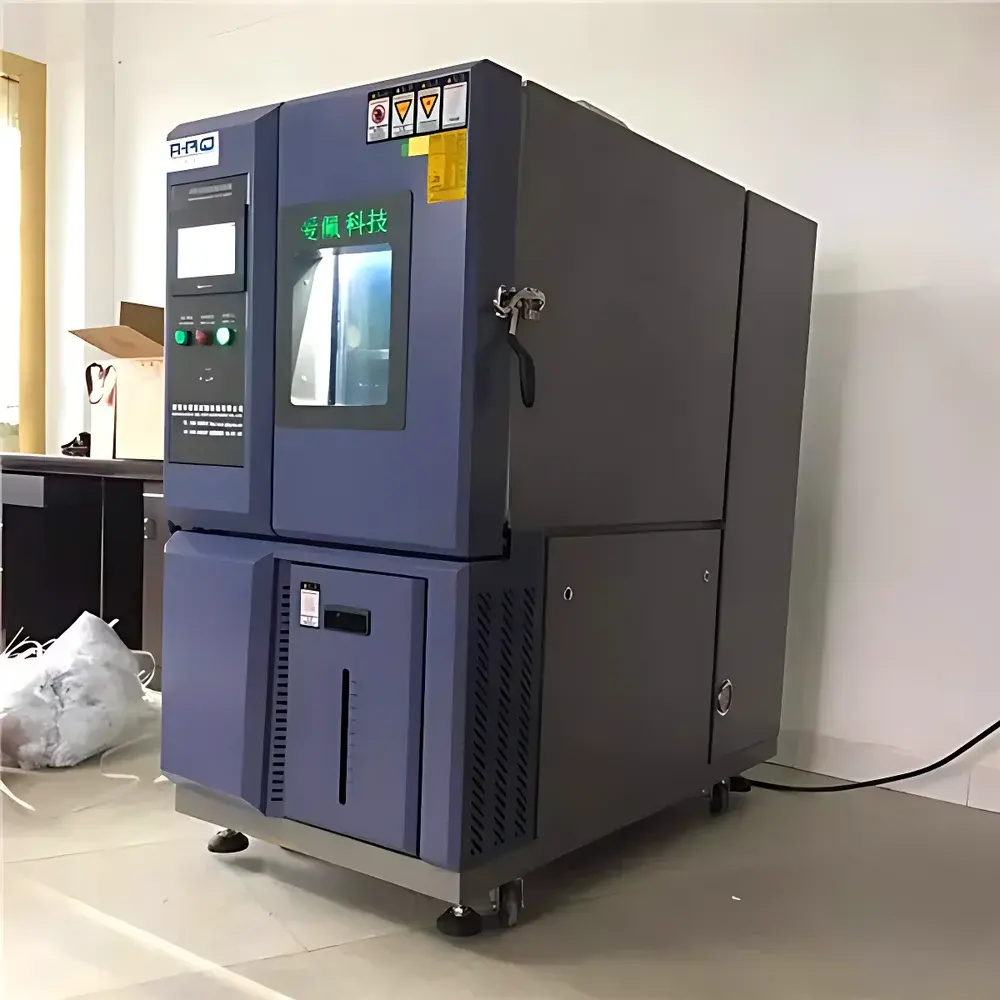
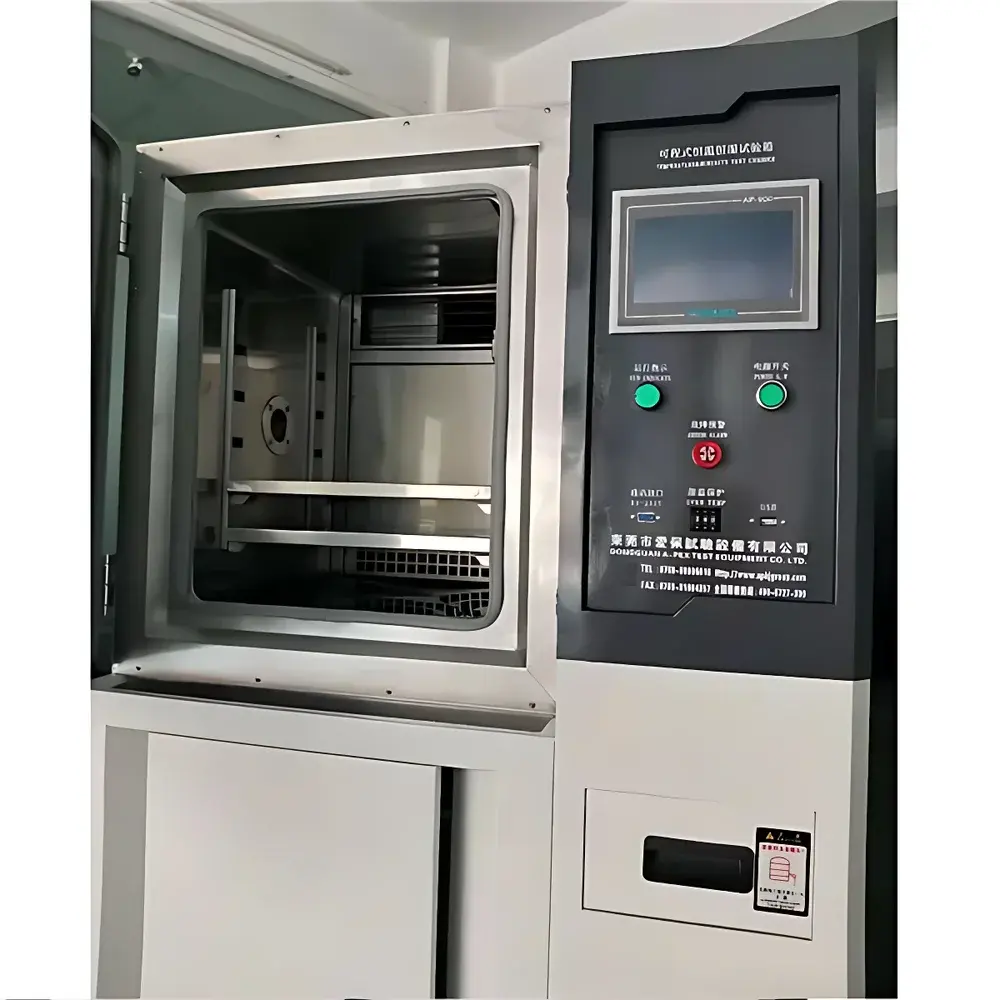
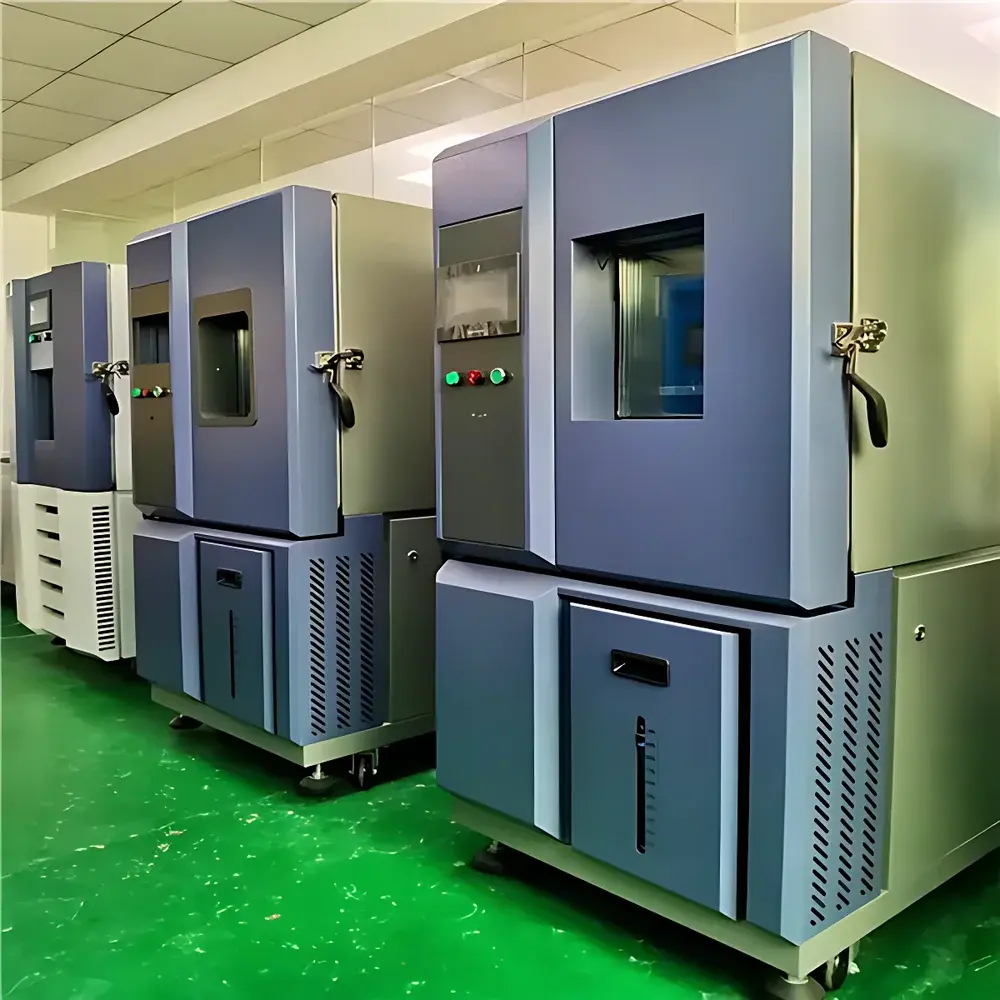
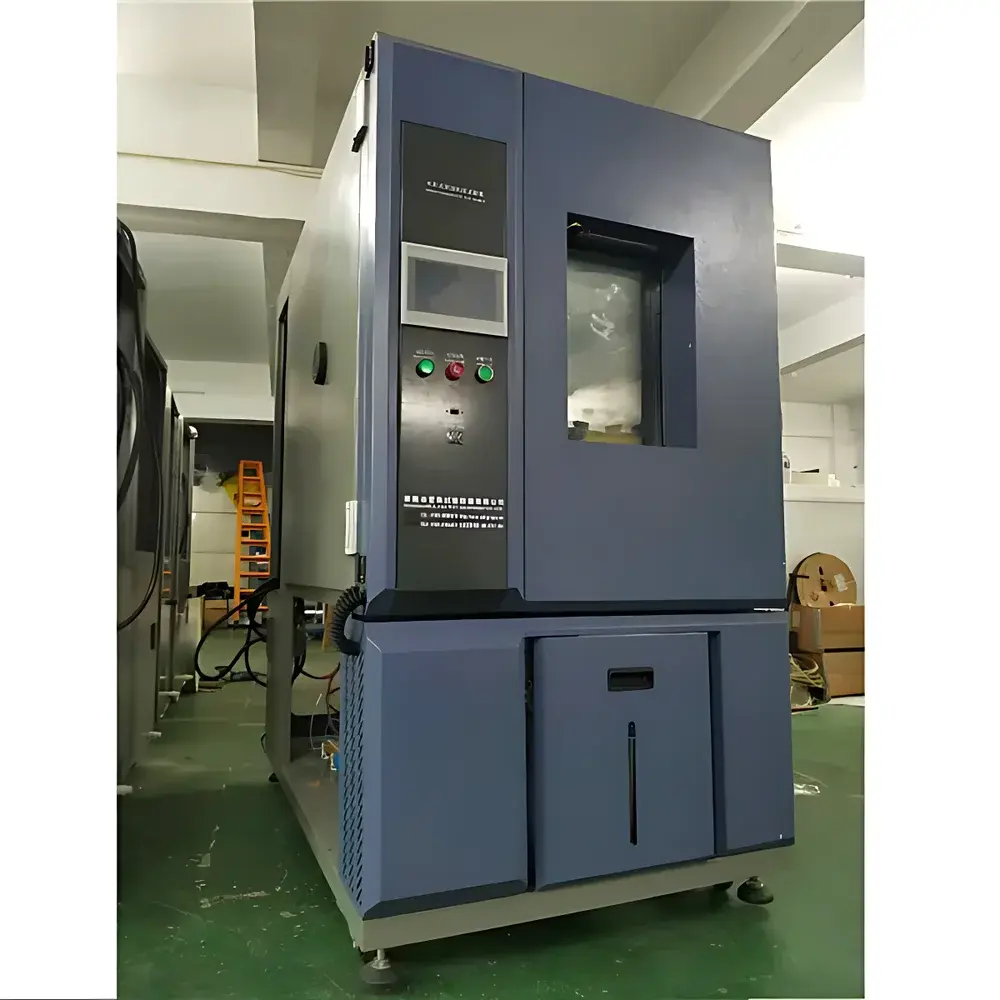
APKJ AP-GD-150AS Battery Pack High-Low Temperature Alternating Environmental Test Chamber
| Brand | APKJ |
|---|---|
| Model | AP-GD-150AS |
| Internal Volume | 150 L |
| Temperature Range | −70 °C to +150 °C |
| Temperature Uniformity | ±2 °C |
| Temperature Control Accuracy | ±0.2 °C |
| Heating Rate | ~3 °C/min (RT to 150 °C in ~40 min) |
| Cooling Rate | ~1 °C/min (RT to −70 °C in ~100 min) |
| Inner Chamber Material | SUS304 Mirror-Finish Stainless Steel |
| Refrigerant | R404A/R23 (Honeywell) |
| Compressor | Hermetic or Semi-Hermetic (Tecumseh or Bitzer) |
| Controller | Programmable LCD Touchscreen (100 programs × 1000 segments × 999 cycles) |
| Compliance | Designed for IEC 62133, UN 38.3, GB/T 31467.3, ISO 16750-4, and automotive battery thermal validation protocols |
Overview
The APKJ AP-GD-150AS Battery Pack High-Low Temperature Alternating Environmental Test Chamber is an engineered solution for rigorous thermal stress validation of lithium-ion battery packs, modules, and energy storage systems under controlled, repeatable, and auditable conditions. It operates on the principle of forced-air convection with dual-stage (single- or cascade) refrigeration and precision resistive heating, enabling precise simulation of operational, storage, and abuse thermal profiles defined in international battery safety and reliability standards. The chamber is purpose-built to replicate extreme ambient environments encountered during vehicle operation (e.g., arctic cold starts, desert heat soak), accelerated life testing, and regulatory qualification—supporting both static temperature hold and dynamic ramp-hold cycling per programmable sequences. Its structural integrity, uniform airflow architecture, and traceable control system make it suitable for use in GLP-compliant laboratories, Tier-1 automotive supplier QA labs, and battery R&D centers requiring documented thermal exposure data.
Key Features
- Robust chamber construction with mirror-finish SUS304 stainless steel interior and exterior, featuring radius-rounded corners and removable adjustable shelves for full accessibility and residue-free cleaning.
- High-efficiency cascade refrigeration system using environmentally compliant refrigerants (R404A/R23, Honeywell certified), paired with either Tecumseh hermetic or Bitzer semi-hermetic compressors for stable low-temperature performance down to −70 °C.
- Precision temperature control via fuzzy PID algorithm with ±0.2 °C accuracy and ±2 °C uniformity across the 150 L working volume (measured at 1/10 chamber boundary per ISO 16750-4 methodology).
- Programmable touchscreen controller supporting up to 100 user-defined test programs, each with 1000 time–temperature–humidity segments and 999 loop repetitions—enabling full automation of complex thermal cycling profiles (e.g., UN 38.3 T.5, IEC 62133 thermal shock).
- Dedicated 25 mm diameter cable port with silicone gasket seal, facilitating real-time voltage, current, and surface thermocouple monitoring during active battery testing without compromising chamber integrity.
- Comprehensive safety architecture including over-temperature cut-off, compressor high-pressure/overheat/over-current protection, low-refrigerant level detection, dry-run prevention, and emergency stop functionality—fully compliant with IEC 61000-6-2/6-4 EMC requirements.
Sample Compatibility & Compliance
The AP-GD-150AS accommodates standard EV battery packs (up to 1.2 m × 0.8 m × 0.3 m footprint) and modular assemblies with integrated BMS communication interfaces. Its internal dimensions (50 × 60 × 50 cm W×H×D) provide ample clearance for thermal imaging, IR thermography, and external load cabling. The chamber meets functional and documentation requirements for battery qualification under UN Manual of Tests and Criteria Part III, Subsection 38.3 (T1–T5), IEC 62133-2:2017 (Clause 8.3 thermal abuse), ISO 16750-4 (road vehicle environmental conditions), and GB/T 31467.3–2015 (electric vehicle battery system thermal testing). All control parameters—including setpoints, ramps, holds, and alarm events—are timestamped and stored locally with optional USB export for 21 CFR Part 11–compliant audit trails when integrated with APKJ’s optional data logging module.
Software & Data Management
The embedded controller features a 7-inch capacitive touchscreen interface with dual-language support (English/Chinese), real-time graphical display of chamber temperature vs. setpoint, and on-screen curve plotting of up to four concurrent channels (e.g., chamber air, pack surface, inlet/outlet coolant). Test logs—including start/stop timestamps, deviation alarms, and cycle completion status—are saved in CSV format. Optional Ethernet or RS485 connectivity enables remote supervision via APKJ’s LabControl Suite v3.2, which supports centralized fleet management, scheduled firmware updates, and integration with LIMS platforms through Modbus TCP or OPC UA. All configuration changes are recorded with operator ID and timestamp, satisfying GLP/GMP traceability requirements for regulated battery development workflows.
Applications
- Thermal shock validation of traction battery packs per UN 38.3 T.5 (−40 °C ↔ +85 °C, 30-min dwell, 5-cycle minimum).
- Calendar and cycle life acceleration testing under variable temperature profiles (e.g., 25 °C ↔ 45 °C ↔ 60 °C ramp sequences).
- Low-temperature discharge capacity characterization at −20 °C and −40 °C per SAE J2929 and ISO 12405-2.
- High-temperature storage stability assessment (e.g., 85 °C/85% RH hold for 1000 h) for electrolyte decomposition and SEI growth analysis.
- Thermal runaway propagation studies using synchronized thermal imaging and voltage monitoring during controlled heating ramp tests.
- Pre-conditioning of battery modules prior to mechanical vibration, crush, or nail penetration testing per FMVSS No. 305 and ECE R100.
FAQ
What temperature range does the AP-GD-150AS support?
The standard configuration covers −70 °C to +150 °C; custom variants extend to −85 °C or +200 °C upon request.
Is humidity control available on this model?
The AP-GD-150AS is a temperature-only alternating chamber; for combined temperature/humidity testing, refer to APKJ’s AP-TH series with capacitive RH sensors and steam humidification.
Can the chamber be integrated into an automated battery test cell?
Yes—standard RS485/Modbus RTU and optional Ethernet/IP interfaces enable bi-directional communication with battery cyclers (e.g., Keysight, Digatron, NHR) and SCADA systems.
Does the controller support audit trail and electronic signature compliance?
With the optional Data Integrity Package (DIP), the system provides 21 CFR Part 11–aligned user authentication, role-based access control, and immutable event logs exportable in PDF/A format.
What maintenance intervals are recommended for long-term reliability?
Compressor oil and refrigerant analysis every 24 months; condenser coil cleaning quarterly; calibration verification of temperature sensors annually per ISO/IEC 17025 procedures.



