
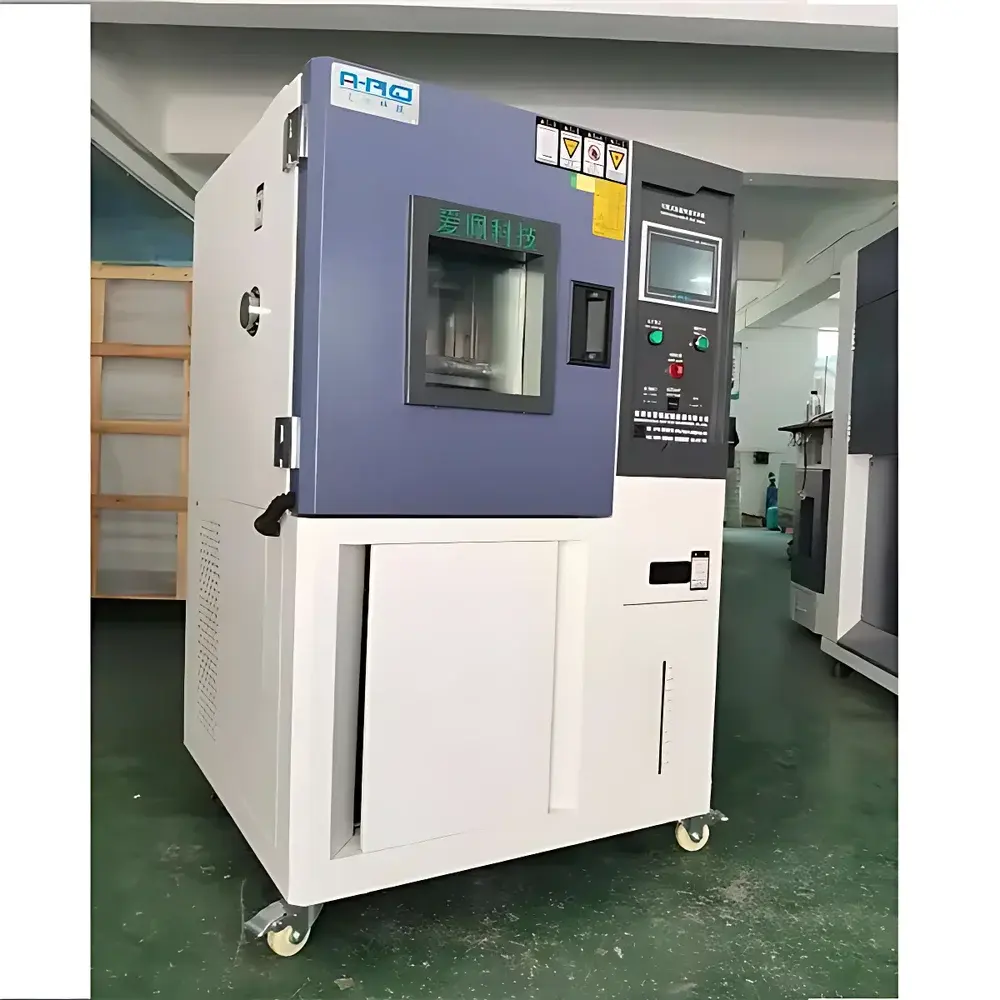
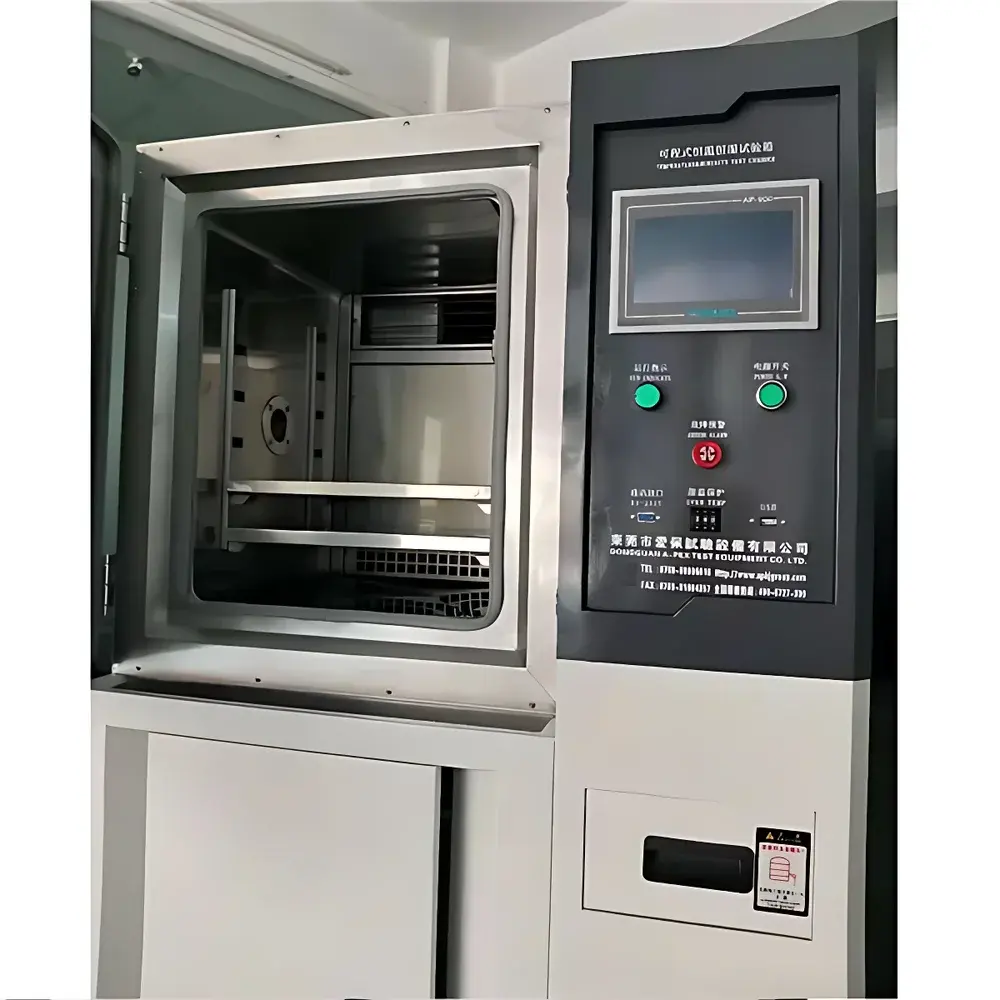
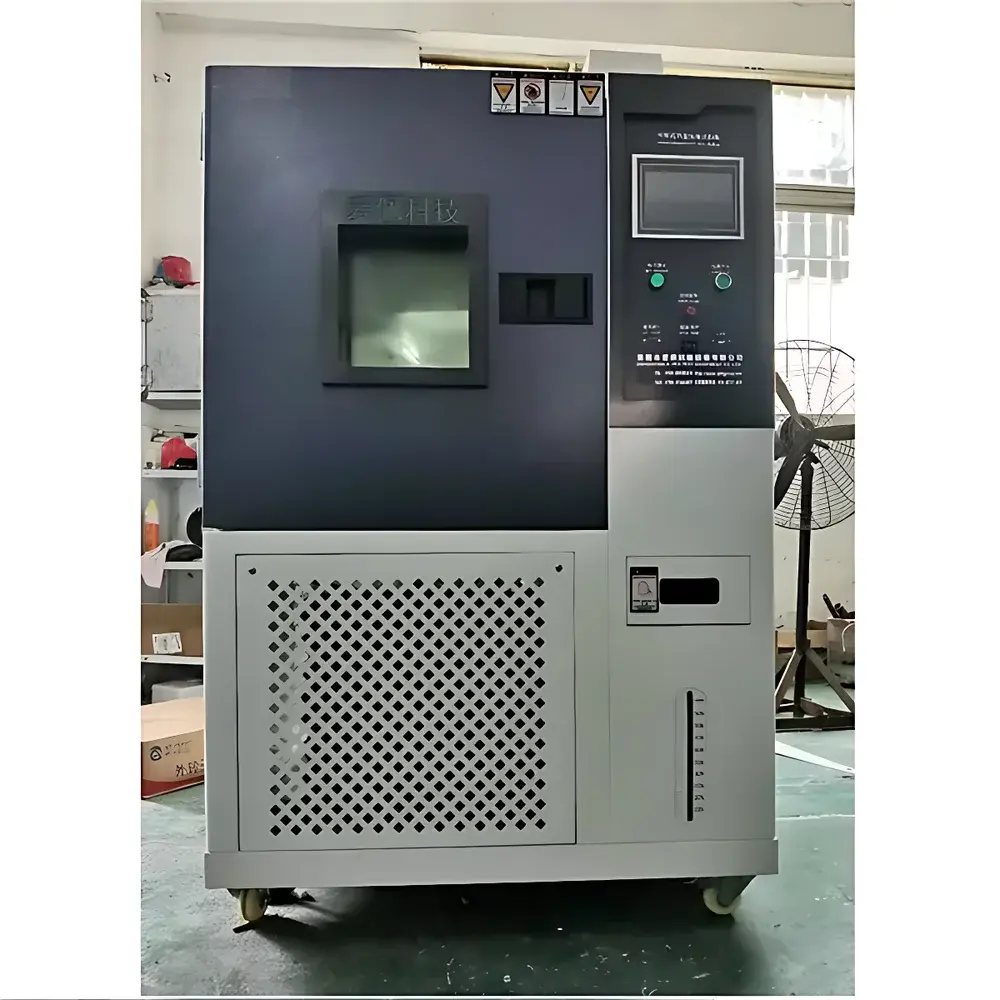
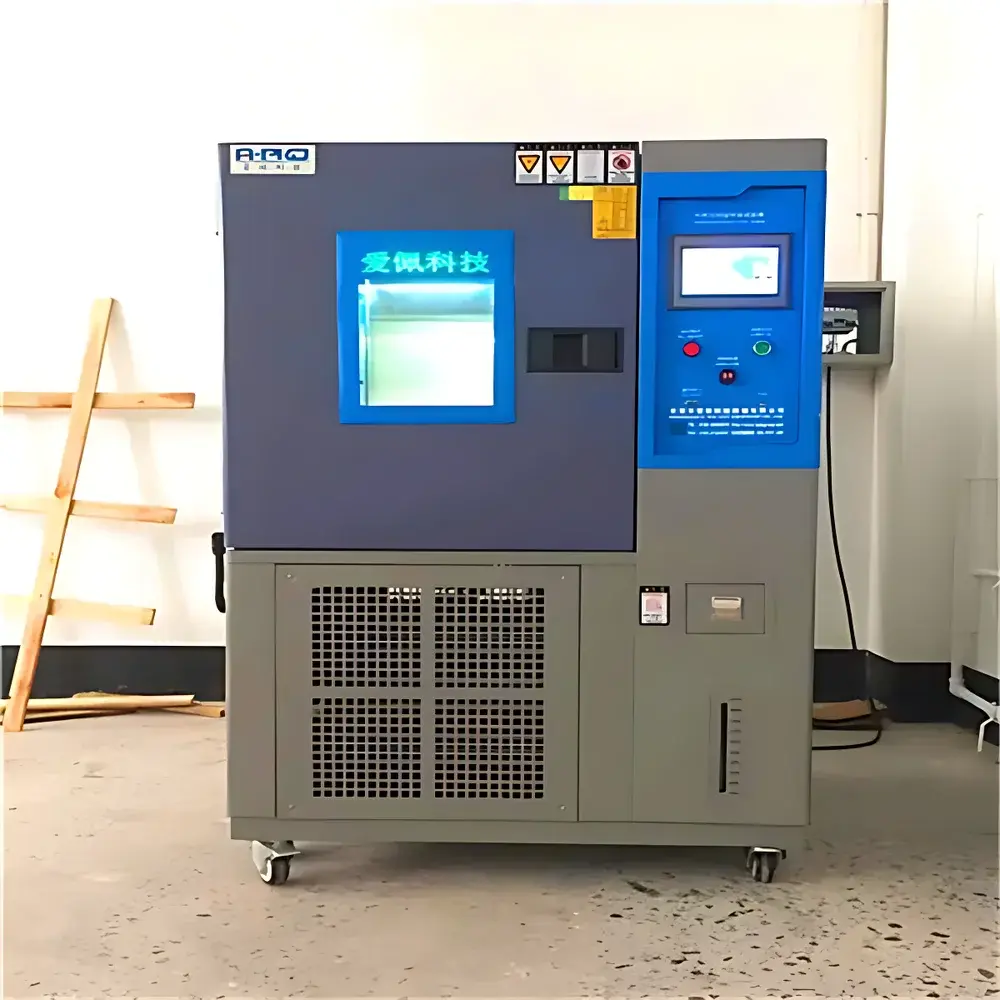
APKJ AP-GD-225A1 Large-Scale Sand and Dust Environmental Test Chamber
| Brand | APKJ |
|---|---|
| Origin | Guangdong, China |
| Manufacturer Type | Direct Manufacturer |
| Model | AP-GD-225A1 |
| Temperature Range | −40 °C to +150 °C |
| Temperature Uniformity | ±0.5 °C |
| Temperature Fluctuation | ±0.5 °C |
| Heating Rate | 1–3 °C/min |
| Cooling Rate | 0.7–1 °C/min |
| Operating Temperature Range (Dust Mode) | RT+5 °C to 60 °C |
| Airflow Velocity | 0–3.5 m/s |
| Sieve Mesh Wire Diameter | 75–100 µm (100–200 mesh) |
| Test Dust | Talcum Powder, 2–4 kg/m³ |
| Dust Blowing Cycle | Programmable Intermittent Control |
| Optional Vacuum System | Available upon request |
| Chamber Internal Dimensions (W×H×D) | 1000 mm × 1000 mm × 1000 mm |
| Dust Retention Mesh Wire Diameter | 50 µm |
| Humidity Control | Capacitive or Dry/Wet Bulb Sensor-Based |
| Controller | Multi-Stage Programmable PID Controller with Fuzzy Logic Algorithm |
| Refrigerant | Eco-Friendly Non-CFC/HFC-Free Refrigerant |
Overview
The APKJ AP-GD-225A1 Large-Scale Sand and Dust Environmental Test Chamber is an industrial-grade climatic simulation system engineered for rigorous evaluation of equipment resilience under abrasive particulate exposure and wide-range thermal stress. Designed in accordance with IEC 60529 (IP5X/IP6X), MIL-STD-810H Method 510.6 (Sand and Dust), and ISO 20653:2013 (Road Vehicles – Degrees of Protection Against Ingress of Solid Objects and Water), this chamber replicates real-world desert, arid, and industrial dust environments while maintaining precise temperature control across −40 °C to +150 °C. Its core architecture integrates dual-function environmental simulation: thermally regulated airflow delivery through calibrated dust dispersion nozzles, coupled with high-efficiency cyclonic separation and recirculation filtration. Unlike standard thermal chambers, the AP-GD-225A1 features a dedicated dust suspension subsystem—including programmable intermittent blowing cycles, adjustable air velocity (0–3.5 m/s), and standardized sieve meshes (75–100 µm)—ensuring reproducible particle entrainment and deposition kinetics per test protocol requirements.
Key Features
- Spacious internal working volume: 1000 mm × 1000 mm × 1000 mm (1 m³), accommodating large-scale enclosures, vehicle components, or outdoor-rated electronics.
- High-fidelity thermal performance: ±0.5 °C temperature uniformity and fluctuation; heating rate of 1–3 °C/min and cooling rate of 0.7–1 °C/min across full operational range.
- Dust generation system compliant with ASTM D5755 and IEC 60529 dust classification criteria, utilizing talcum powder at controlled densities (2–4 kg/m³) and calibrated mesh specifications (100–200 mesh, i.e., 75–100 µm).
- Integrated 50 µm retention mesh upstream of the blower to prevent oversized agglomerates from entering the test airstream—critical for maintaining particle size distribution integrity.
- Eco-conscious refrigeration: CFC-free and low-GWP refrigerant system aligned with EU F-Gas Regulation (EU) No 517/2014 and China’s HCFC Phase-Out Management Plan.
- Advanced control architecture: Multi-segment programmable PID controller with fuzzy logic compensation, supporting complex thermal-dust profiles including ramp-hold sequences, dwell times, and synchronized dust-on/dust-off triggers.
Sample Compatibility & Compliance
The AP-GD-225A1 accommodates samples up to 800 mm × 800 mm × 800 mm within its 1 m³ workspace, with provision for external cable/port feedthroughs (standardized electrical conduit entries). It supports testing of IP-rated enclosures (IP5X, IP6X), automotive ECUs, aerospace avionics housings, solar inverters, military communication terminals, and rail signaling hardware. All operational parameters adhere to traceable calibration standards per ISO/IEC 17025-accredited procedures. The chamber’s temperature control system complies with IEC 60068-3-5 (Environmental testing — Part 3-5: Supporting documentation and guidance — Confirmation of the performance of temperature chambers), while dust dispersion dynamics are validated against MIL-STD-810H Appendix A (Test Method Standards Matrix) for Method 510.6 repeatability.
Software & Data Management
Equipped with APKJ’s proprietary WinTest Pro v4.2 control software, the chamber enables full remote supervision via Ethernet or RS485 interface. Software features include real-time graphing of temperature, airflow velocity, and cycle status; automated data logging at user-defined intervals (minimum 1 s); CSV export compatible with LIMS and statistical process control platforms (e.g., Minitab, JMP); and electronic audit trail functionality meeting FDA 21 CFR Part 11 requirements for electronic records and signatures. Calibration history, operator logins, and parameter modification timestamps are retained for ≥12 months and exportable for GLP/GMP audits.
Applications
- Validation of ingress protection (IP) ratings for consumer electronics, industrial control panels, and outdoor LED lighting systems.
- Reliability screening of automotive HVAC actuators, battery management systems, and ADAS sensor housings exposed to desert road conditions.
- Qualification testing of defense-grade radios, UAV payload enclosures, and field-deployable power supplies per MIL-STD-810H.
- Material degradation studies on polymer gaskets, conformal coatings, and elastomeric seals subjected to combined thermal cycling and abrasive particulate loading.
- Research into dust adhesion mechanisms on photovoltaic panel surfaces and anti-soiling coating efficacy under controlled wind-dust interaction.
FAQ
Does the AP-GD-225A1 include vacuum capability for dust evacuation?
No—the vacuum pump and associated piping are optional accessories and must be specified at time of order.
Can the chamber operate continuously in dust mode at sub-zero temperatures?
Dust suspension is limited to RT+5 °C to 60 °C per safety and dispersion efficiency constraints; low-temperature operation (−40 °C to RT) is conducted in dust-free thermal cycling mode only.
Is third-party calibration certification available?
Yes—NIST-traceable calibration certificates for temperature sensors and airflow meters are provided upon request, with optional ISO/IEC 17025 accreditation.
What dust types besides talcum powder are supported?
Standard configuration supports talc per IEC 60529; alternative dusts (e.g., Arizona Road Dust Test Dust A2, silica sand) require custom nozzle calibration and pre-test validation.
How is dust residue managed between test cycles?
An integrated high-efficiency particulate air (HEPA) filtration module (H13 class) captures >99.95% of airborne particles ≥0.3 µm, enabling safe chamber access post-test without external vacuuming.



