
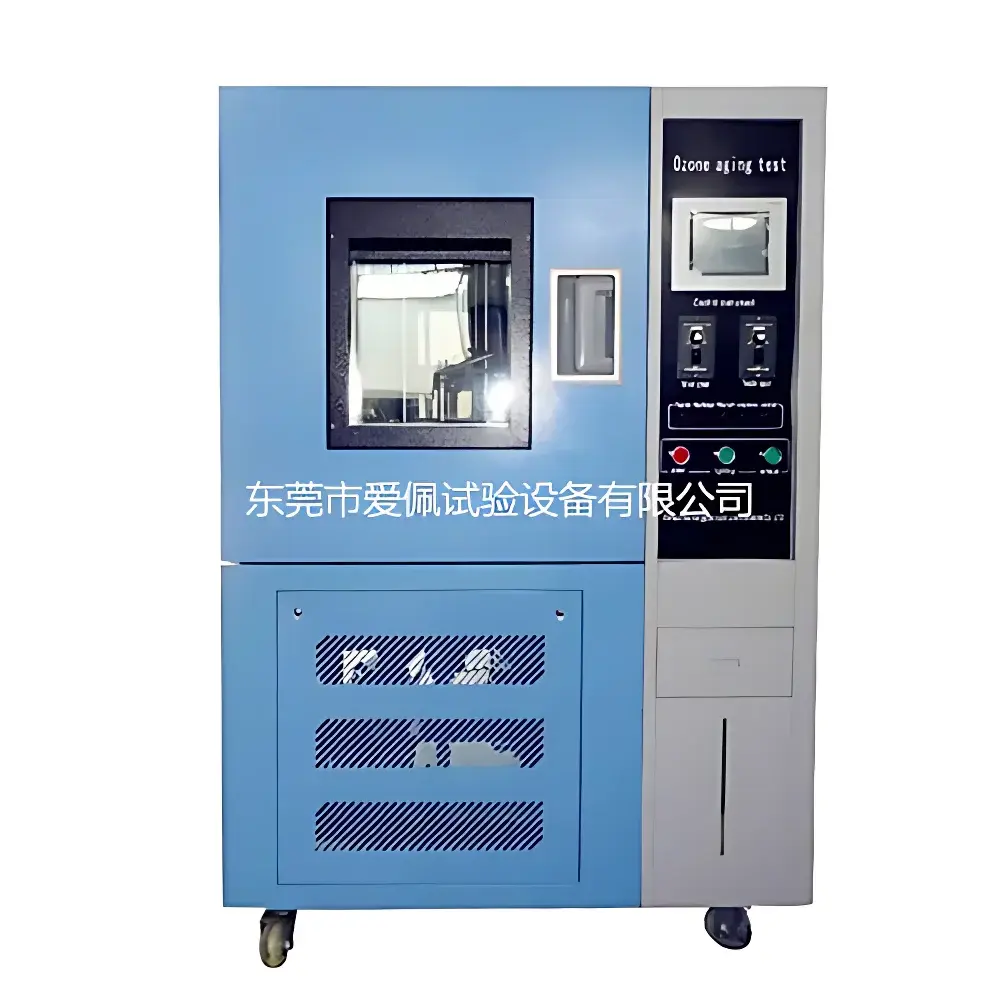
APKJ AP-GD-4081 High-Low Temperature Alternating Environmental Test Chamber
| Brand | APKJ |
|---|---|
| Origin | Guangdong, China |
| Manufacturer Type | Direct Manufacturer |
| Country of Origin | China |
| Model | AP-GD-4081 |
| Pricing | Upon Request |
| Internal Dimensions (W×H×D) | 60 × 85 × 80 cm |
| Temperature Range | −40 °C to +150 °C |
| Humidity Range | 20–98% RH |
| Temperature Uniformity | ±2 °C |
| Humidity Uniformity | ±2% RH |
| Temperature Fluctuation | ≤±0.5 °C |
| Humidity Fluctuation | ±2% RH |
| Heating Rate | ≥3 °C/min |
| Cooling Rate | ≥1 °C/min |
| Control System | TEMI880 Programmable Touchscreen Controller (Korean) |
| Refrigerant | R404A/R23 |
| Compressor | Hermetic French Tecumseh or Semi-Hermetic German Bitzer |
| Interior Material | SUS304 Mirror-Finish Stainless Steel |
| Exterior Material | SUS304 Brushed Stainless Steel |
| Insulation | High-Density Polyurethane Foam + Ultra-Fine Glass Wool |
| Air Circulation | Wide-Band Forced Convection (Top-Out/Bottom-In) |
| Standard Ports | One Φ25 mm Test Port |
| Safety Protections | Over-Temperature/Under-Temperature Cut-off, Dry-Run Prevention, Phase Failure Detection, High-Pressure & Overload Protection, Water Shortage Alarm |
Overview
The APKJ AP-GD-4081 High-Low Temperature Alternating Environmental Test Chamber is an engineered solution for evaluating the thermal and hygrothermal reliability of electronic devices—particularly smartphones, wearable modules, PCB assemblies, and battery packs—under rigorously controlled, dynamically alternating environmental conditions. Designed in accordance with IEC 60068-2-1 (Cold), IEC 60068-2-2 (Dry Heat), IEC 60068-2-14 (Change of Temperature), and ISO 16750-4 (Road Vehicles – Environmental Conditions), this chamber employs a balanced heating and cooling (BTHC) control architecture with dual PID regulation loops to maintain precise, stable, and reproducible temperature and humidity profiles across its full operational range (−40 °C to +150 °C; 20–98% RH). Its fully sealed SUS304 mirror-finish interior, seamless quarter-radius corners, and removable stainless-steel shelves facilitate contamination-free operation and meet cleanroom-compatible maintenance requirements for QA/QC laboratories operating under GLP or automotive Tier-1 supplier protocols.
Key Features
- High-stability BTHC (Balanced Temperature and Humidity Control) system ensuring minimal thermal overshoot and rapid stabilization during transition phases
- Dual-stage refrigeration circuit with selectable R404A (standard) or R23 (ultra-low temp) refrigerants, paired with either French Tecumseh or German Bitzer compressors for extended service life and energy-efficient operation
- TEMI880 programmable touchscreen controller (Korean origin) featuring 120 stored programs, up to 999 segments per program, and 0.1 °C / 0.1% RH resolution with real-time curve visualization
- Forced convection airflow design with top-out/bottom-in circulation pattern and optimized duct geometry to achieve ±2 °C temperature uniformity within the 60 × 85 × 80 cm test volume
- Φ25 mm unsealed test port with silicone gasket, positioned at the left side wall for uninterrupted signal/data cable routing during live device monitoring
- Comprehensive safety suite including over-temperature/under-temperature cut-offs, refrigerant high-pressure protection, phase failure detection, dry-run prevention for humidifier, and automatic water shortage alarm
Sample Compatibility & Compliance
The AP-GD-4081 accommodates full-assembly smartphones (including active 5G mmWave front-end modules), battery cells (Li-ion, solid-state prototypes), camera sensor stacks, and flex-rigid PCBs up to 25 cm diagonal. Its internal volume and airflow profile comply with ASTM E145 Class II requirements for forced-air thermal chambers. The chamber supports validation against JEDEC JESD22-A104 (Temperature Cycling), JESD22-A108 (Bias Humidity Life), and AEC-Q200 stress test schedules. All control logic, data logging, and alarm events are timestamped and traceable—enabling alignment with FDA 21 CFR Part 11 audit trail requirements when integrated with compliant LIMS or MES platforms.
Software & Data Management
The TEMI880 controller provides native RS-232 serial interface for external PC-based data acquisition and remote supervision. Optional Modbus RTU or Ethernet/IP gateways enable integration into factory-wide SCADA systems. Logged parameters—including chamber setpoint, actual temperature/humidity, compressor status, and alarm history—are exportable as CSV files with ISO 8601 timestamps. Controller firmware supports password-protected screen lock, user-level access control (operator/engineer/admin), and automatic backup of program configurations to non-volatile memory. For regulated environments, optional validation documentation packages (IQ/OQ/PQ templates) and calibration traceability to NIST-traceable standards are available upon request.
Applications
- Thermal shock screening of smartphone display laminates and under-display fingerprint sensors
- Accelerated aging of polymer housing materials (PC/ABS blends) under combined thermal cycling and humidity loading
- Functional validation of power management ICs across −30 °C to +85 °C operating envelopes
- Pre-compliance testing for MIL-STD-810H Method 502.7 (Low Temperature) and Method 503.6 (Temperature Shock)
- Reliability qualification of wireless charging coils subjected to repeated condensation/drying cycles
- Environmental stress screening (ESS) of assembled consumer electronics prior to burn-in and final functional test
FAQ
Does the AP-GD-4081 support ramp-hold-ramp profiles required for JEDEC JESD22-A104 testing?
Yes—the TEMI880 controller supports multi-segment ramp-and-soak sequences with programmable rates (≥1 °C/min cooling, ≥3 °C/min heating) and dwell times down to 1 minute, fully compliant with JESD22-A104’s defined cycle structure.
Can humidity be maintained independently during sub-zero temperature operation?
Humidity control is suspended below 0 °C per IEC 60068-3-5; however, the chamber maintains dew point stability during transitions and supports condensation simulation via controlled cooldown under saturated conditions above freezing.
Is third-party calibration certification included with shipment?
Factory calibration certificates (traceable to national metrology institutes) are provided standard; UKAS or A2LA-accredited field calibration services are available as an add-on option.
What is the maximum allowable load mass for thermal inertia compensation?
For optimal uniformity and response fidelity, total non-volatile test load should not exceed 35 kg; thermal mass compensation algorithms are embedded in the controller firmware.
Are custom test port configurations or internal modifications supported?
Yes—APKJ offers OEM engineering services for non-standard apertures, reinforced mounting rails, EMI-shielded feedthroughs, and internal LED lighting upgrades under formal NDA and design review protocols.



