
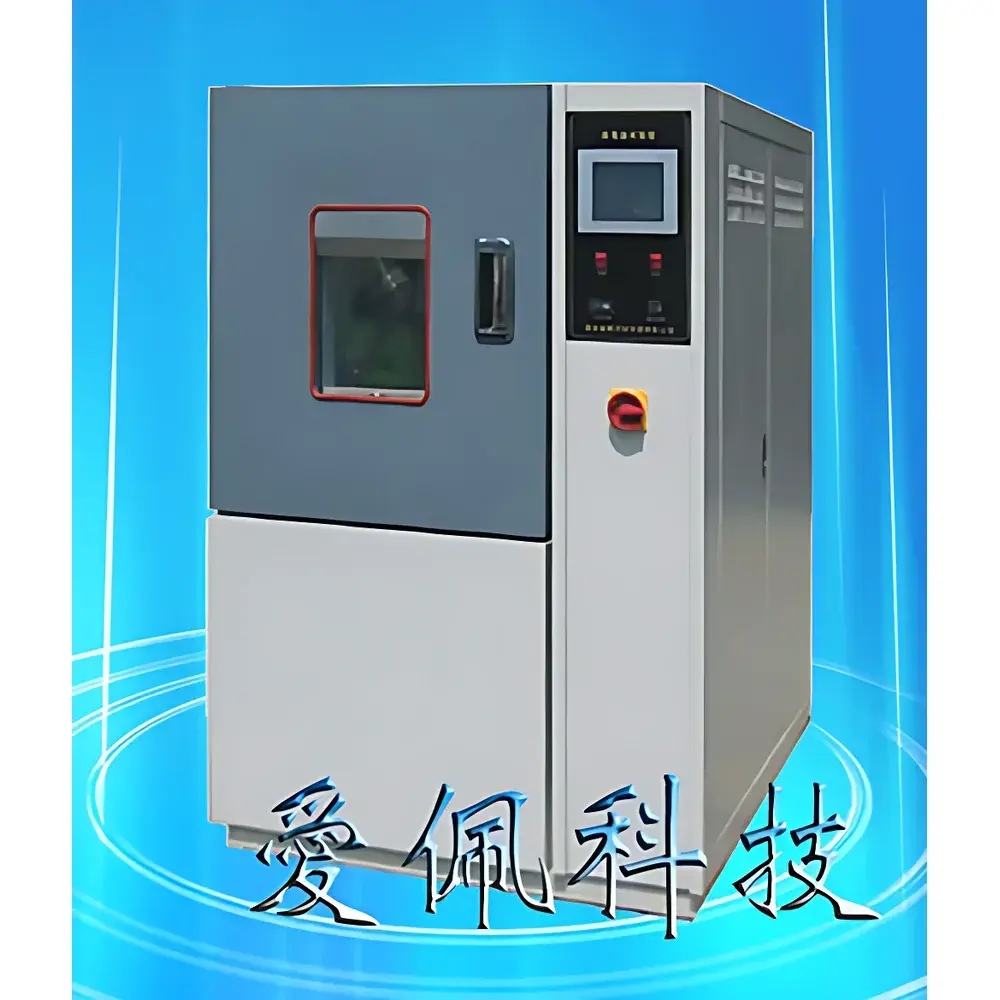
APKJ AP-HX-80 Low Temperature Environmental Test Chamber
| Brand | APKJ |
|---|---|
| Origin | Hebei, China |
| Manufacturer Type | Direct Manufacturer |
| Country of Origin | China |
| Model | AP-HX-80 |
| Pricing | Available Upon Request |
| Internal Dimensions (D×W×H) | 1000×1000×1000 mm |
| Temperature Range | −70 °C to +150 °C |
| Temperature Uniformity | ≤2 °C (unloaded) |
| Temperature Fluctuation | ±0.5 °C (unloaded) |
| Temperature Deviation | ≤±2 °C |
| Ramp Rate | 0.7–1.0 °C/min (unloaded) |
| Timer Range | 0–9999 h |
| Control Resolution | ±0.1 °C |
| Sensor | PT100 Platinum Resistance Thermometer |
| Heating System | Nickel-Chromium Far-Infrared Heaters |
| Refrigeration System | Hermetic French Tecumseh Compressor |
| Refrigerant | R404A |
| Cooling Method | Forced-Air Condensation |
| Compliance | GB/T 2423.1–2021, GB/T 2423.2–2021, GB/T 10592–2008 |
Overview
The APKJ AP-HX-80 Low Temperature Environmental Test Chamber is an engineered precision system designed for evaluating the thermal resilience and operational stability of electronic components, aerospace materials, automotive parts, and polymer-based products under controlled low-temperature and combined temperature-humidity stress conditions. Operating on the principle of forced-air convection thermal regulation, the chamber maintains uniform thermal distribution across its 1 m³ internal workspace through strategically positioned axial fans and baffle-guided airflow architecture. Its dual-mode capability—supporting both standalone low-temperature testing (down to −70 °C) and high-temperature exposure (up to +150 °C)—enables full-spectrum environmental stress screening per IEC 60068-2-1 (Cold), IEC 60068-2-2 (Dry Heat), and MIL-STD-810G Method 502.6. The chamber’s thermal design adheres to strict radiative isolation protocols: interior surface temperatures remain within ±8% of setpoint, preventing direct infrared irradiation from heating/cooling elements onto test specimens—a critical requirement for non-distorted thermal aging assessment.
Key Features
- Robust dual-circuit thermal architecture: fully independent heating and refrigeration systems prevent cross-interference during rapid thermal transitions;
- PID + SSR digital temperature control with 0.1 °C resolution and auto-tuning algorithm, ensuring stable setpoint maintenance under dynamic load conditions;
- Hermetically sealed French Tecumseh compressor paired with R404A refrigerant and copper evaporator coil assembly, validated via 48-hour positive-pressure leak testing;
- Far-infrared nickel-chromium heating elements with optimized spatial distribution for rapid, uniform thermal recovery after cold soak cycles;
- Comprehensive safety interlock suite including compressor high-pressure cutoff, fan overheat protection, phase failure detection, leakage current monitoring, and programmable emergency shutdown;
- Industrial-grade stainless steel inner chamber (SUS304) with seamless welding and electrostatically coated outer casing for corrosion resistance and long-term dimensional stability.
Sample Compatibility & Compliance
The AP-HX-80 accommodates a wide range of sample configurations—from PCB assemblies and battery modules to molded elastomers and composite laminates—within its 1000 × 1000 × 1000 mm workspace. Sample mounting fixtures are configurable to avoid thermal bridging; optional perforated shelves ensure unrestricted airflow around vertically oriented devices. The chamber is fully compliant with GB/T 2423.1–2021 (Cold Test), GB/T 2423.2–2021 (Dry Heat), GB/T 10592–2008 (Environmental Test Chamber Specifications), and aligns with foundational requirements of ISO 16750-4 (Road Vehicles – Environmental Conditions), ASTM D3418 (Transition Temperatures of Polymers), and JEDEC JESD22-A119 (Temperature Cycling). While not inherently humidity-capable in base configuration, select AP-HXW variants integrate steam-based humidification for combined temp/humidity profiling per IEC 60068-2-30.
Software & Data Management
The integrated touchscreen HMI runs a deterministic real-time control kernel with embedded data logging at user-defined intervals (1 s to 60 min). All temperature readings from the calibrated PT100 sensor array are timestamped and stored locally on industrial-grade SD memory with cyclic overwrite protection. Export formats include CSV and PDF test reports compatible with LIMS integration. Audit trails—including operator ID, parameter changes, alarm events, and calibration history—are retained for ≥12 months, supporting GLP and GMP documentation requirements. Optional Ethernet or RS485 interfaces enable remote supervision via Modbus TCP or proprietary APKJ Link protocol; third-party SCADA compatibility is verified per IEC 62443-3-3 cybersecurity guidelines.
Applications
- Qualification testing of avionics enclosures per DO-160 Section 4 (Operating Temperature) and Section 5 (Temperature Variation);
- Accelerated life testing of lithium-ion battery cells at sub-zero operating thresholds (−40 °C to −60 °C);
- Thermal shock pre-screening of solder joints and conformal coatings prior to HALT;
- Material embrittlement evaluation of thermoplastics and elastomers used in cryogenic fluid handling systems;
- Stability validation of medical device packaging under cold-chain logistics simulation (e.g., UN 3373 compliance verification);
- Calibration support for reference thermocouples and RTDs in metrology laboratories requiring traceable low-temperature environments.
FAQ
What standards does the AP-HX-80 chamber comply with?
It meets GB/T 2423.1–2021, GB/T 2423.2–2021, and GB/T 10592–2008, and supports test execution aligned with IEC 60068-2-1, MIL-STD-810G Method 502.6, and ISO 16750-4.
Is humidity control available on this model?
The base AP-HX series is temperature-only; humidity functionality requires the AP-HXW variant with integrated steam generator and RH sensor.
Can the chamber operate continuously at −70 °C?
Yes—continuous operation at −70 °C is supported when ambient conditions remain ≤28 °C and relative humidity ≤85%, per specified installation requirements.
Does the system support FDA 21 CFR Part 11 compliance?
The standard firmware does not include electronic signature or audit trail encryption; however, APKJ offers a validated 21 CFR Part 11 add-on package with role-based access control and digital certificate integration.
What maintenance intervals are recommended?
Compressor oil inspection every 2,000 operating hours; condenser coil cleaning quarterly; PT100 sensor calibration annually or per internal QA schedule.



