
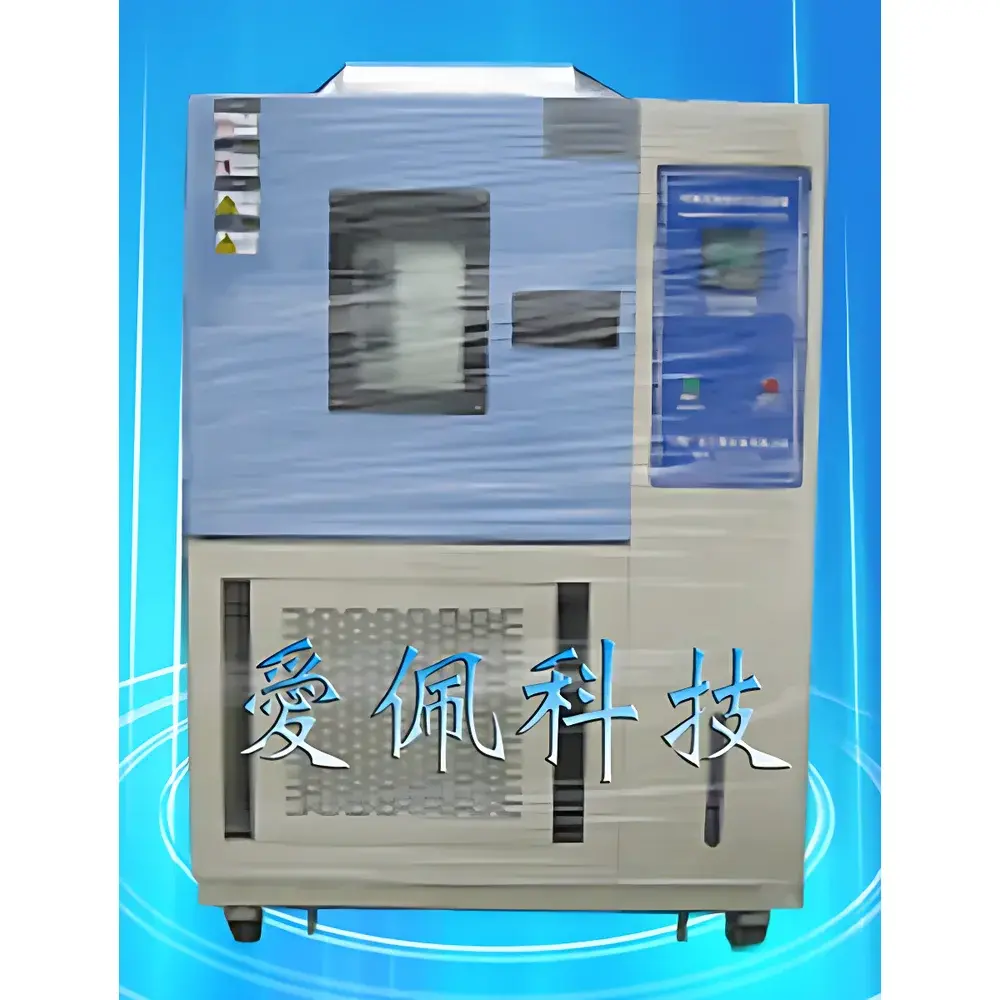
APKJ AP-HX-D1 Mobile High-Low Temperature & Humidity Environmental Test Chamber
| Brand | APKJ |
|---|---|
| Model | AP-HX-D1 |
| Type | Mobile Environmental Test Chamber |
| Application | Temperature Cycling, Thermal Shock, Constant/Alternating Humidity Testing |
| Construction | Stainless Steel Interior (SUS304), Cold-Rolled Steel Exterior with Electrostatic Coating |
| Insulation | Rigid Polyurethane Foam or Ultra-Fine Glass Wool |
| Sealing | Imported Silicone Gasket |
| Control System | Korean-Made Touchscreen PID Controller (0.1°C/0.1%RH Resolution), BTHC Balanced Heating/Cooling/Humidifying/Dehumidifying |
| Heating | Stainless Steel Finned Air Heater |
| Humidification | Shallow-Tank Steam Generator |
| Refrigeration | Original Imported Hermetic Compressor, Single-Stage or Cascade Low-Temperature System |
| Air Circulation | Custom Aluminum Impeller Driven by HVAC-Grade Motor |
| Safety Protections | Independent Over-Temperature Cut-off, Compressor Overheat/Overcurrent/Overload Protection, Fan Overheat Protection, Low-Water Alarm, Real-Time Deviation Alarms (High/Low/Out-of-Spec Temp & RH) |
| Data Interface | RS-485, USB Storage Port, Optional Printer Connectivity |
| Compliance | GB 10589, GB 10592, GB 10586, GB 11158, GB/T 5170.2–1996, GB/T 5170.5–1996, GB 2423.1–89, GB 2423.2–89, GB 2423.3–91, GB 2423.4–91, GB 2423.22–87 |
| Certifications | Designed for GLP/GMP-aligned validation workflows |
Overview
The APKJ AP-HX-D1 Mobile High-Low Temperature & Humidity Environmental Test Chamber is an engineered solution for dynamic environmental stress testing of electronic components, electrical equipment, automotive parts, and material specimens under controlled thermal and hygrothermal conditions. Built on the principles of balanced temperature and humidity control (BTHC), this chamber integrates precision thermodynamic regulation with robust mechanical architecture to deliver stable, repeatable, and traceable test environments. Unlike fixed-installation chambers, its mobile design—equipped with heavy-duty casters and reinforced structural framing—enables flexible deployment across laboratories, production floors, and field validation sites without permanent utility connections. The system operates across a wide operational envelope: typical standard configurations support temperature ranges from –40°C to +150°C and humidity ranges from 20% to 98% RH, with ramp rates and dwell stability calibrated per GB/T 5170.2 and GB/T 5170.5 verification protocols. Its primary function is to simulate real-world environmental exposure scenarios—including storage, transit, and operational service conditions—to assess product resilience, failure modes, and conformance to specification prior to release.
Key Features
- Modular mobility: Integrated industrial-grade swivel casters with locking brakes enable repositioning within ISO-classified labs or manufacturing cleanrooms without structural modification.
- Dual-layer thermal integrity: Inner chamber constructed from electropolished SUS304 stainless steel; outer shell formed from cold-rolled steel with epoxy-polyester electrostatic coating for corrosion resistance and mechanical durability.
- High-efficiency insulation: 100–150 mm thickness of rigid polyurethane foam (λ ≤ 0.022 W/m·K) or ultra-fine glass wool ensures low heat leakage and minimal energy consumption during prolonged thermal cycling.
- Precision climate control: Korean-manufactured touchscreen controller with auto-tuned PID algorithms, 0.1°C/0.1%RH resolution, and independent actuation of heating, cooling, humidification, and dehumidification subsystems.
- Fail-safe protection suite: Redundant thermal monitoring includes independent over-temperature cut-off circuitry, compressor thermal overload detection, fan motor current sensing, low-water-level interlock, and real-time deviation alarms for both temperature and relative humidity.
- Observability and accessibility: Large double-glazed observation window with anti-condensation heating element and integrated LED illumination supports non-intrusive visual monitoring during extended test cycles.
Sample Compatibility & Compliance
The AP-HX-D1 accommodates a broad spectrum of test specimens—from PCB assemblies and lithium-ion battery modules to polymer enclosures and aerospace fasteners—within its standard internal volume (customizable upon request). Its chamber geometry and airflow profile comply with IEC 60068-3-5 for uniformity requirements, ensuring ±2°C temperature uniformity and ±3% RH homogeneity across the working zone at steady state. All hardware and firmware design decisions align with national standards referenced in the GB 2423 series, including Test A (cold), Test B (dry heat), Test Ca (steady-state damp heat), Test Db (cyclic damp heat), and Test N (temperature change). The chamber’s calibration traceability path conforms to GB/T 5170.2–1996 (temperature) and GB/T 5170.5–1996 (humidity), supporting metrological validation under ISO/IEC 17025 frameworks. For regulated industries, the system provides foundational infrastructure for IQ/OQ/PQ execution and satisfies baseline requirements for GLP and GMP environmental qualification when integrated with validated data acquisition software.
Software & Data Management
While the embedded controller delivers standalone operation, the AP-HX-D1 includes native RS-485 Modbus RTU and USB host interfaces to interface with external PCs running third-party or OEM-supplied data logging platforms. Raw time-series data—including chamber setpoints, actual temperature/humidity values, alarm status flags, and runtime diagnostics—is timestamped and stored locally on removable USB media in CSV format. Optional printer integration enables hard-copy generation of test reports meeting internal QA documentation standards. When deployed with compliant software (e.g., APKJ’s optional LabView-based validation package), the system supports electronic signatures, user access levels, and full audit trails—fulfilling core technical requirements of FDA 21 CFR Part 11 for computerized system validation in pharmaceutical and medical device environments.
Applications
- Environmental stress screening (ESS) of avionics and defense electronics per MIL-STD-810G methods.
- Accelerated life testing (ALT) of consumer electronics under combined thermal-hygral load profiles.
- Qualification testing of electric vehicle battery packs per UN ECE R100 and GB/T 31467.3.
- Material compatibility studies for sealants, adhesives, and encapsulants exposed to cyclic condensation.
- Pre-compliance verification for CE marking under EN 60068-2 series environmental test standards.
- Process validation support for semiconductor packaging and MEMS device manufacturing lines.
FAQ
Is the AP-HX-D1 certified to international standards such as IEC 60068 or ISO 16750?
The chamber is designed and verified per Chinese national standards (GB series), which are technically harmonized with IEC 60068-2 clauses. Full IEC/ISO certification requires third-party notified body assessment; APKJ provides test reports and design documentation to facilitate customer-led conformity assessments.
Can the chamber perform rapid temperature transitions (e.g., <10 min from –40°C to +85°C)?
Transition speed depends on configured refrigeration architecture (single-stage vs. cascade), load mass, and setpoint delta. Standard single-stage units achieve ~3°C/min average ramp rate; cascade-configured variants support up to 5°C/min under no-load conditions per GB 2423.22.
Does the system include validation documentation for GxP use?
APKJ supplies Factory Acceptance Test (FAT) reports, calibration certificates for critical sensors, and user manuals with IQ/OQ protocol templates. Site-specific PQ execution remains the responsibility of the end-user’s qualified validation team.
What maintenance intervals are recommended for long-term reliability?
Compressor oil inspection every 12 months; condenser coil cleaning quarterly; steam generator descaling monthly; silicone gasket integrity check biannually; controller firmware updates per APKJ advisory bulletins.
Is remote monitoring supported via Ethernet or cloud platforms?
Native Ethernet connectivity is not included but can be added via optional RS-485-to-Ethernet gateway modules. Cloud integration requires middleware configuration and is implemented case-by-case under APKJ’s engineering services agreement.
Related Products



