
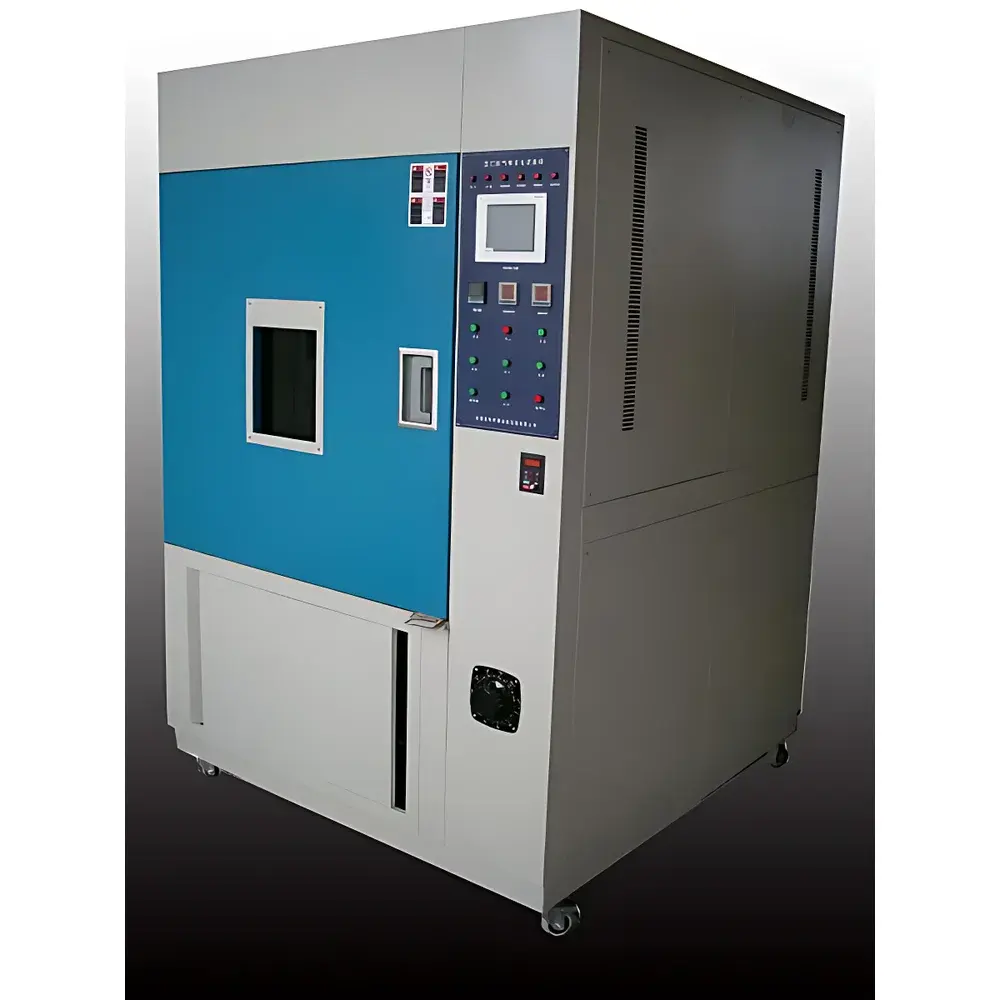
APKJ AP-XD-01 Xenon Arc Weathering Test Chamber
| Brand | APKJ |
|---|---|
| Origin | Guangdong, China |
| Manufacturer Type | Direct Manufacturer |
| Model | AP-XD-01 |
| Internal Chamber Dimensions (D×W×H) | 500×760×500 mm |
| External Dimensions (D×W×H) | 1350×1350×1700 mm |
| Sample Tray Size | 450×720 mm |
| Temperature Range | RT+10°C to 70°C (adjustable) |
| Humidity Range | 65–98% RH (adjustable) |
| Black Panel Temperature Range | 63–100°C |
| Temperature Uniformity | ±2.0°C |
| Temperature Stability | ±0.5°C |
| Light Source | 4 × imported air-cooled xenon arc lamps (3 operational + 1 spare) |
| Lamp Power | 1.8 kW per lamp |
| Total Heating Power | 2 kW |
| Humidification Power | 0.75 kW |
| Irradiance Spectrum | 290–800 nm |
| Max Irradiance | ≤300 W/m² |
| Sample-to-Lamp Distance | 230–280 mm |
| Filter System | Triple-layer quartz glass filter |
| Rainfall Duration | 0–999 min (continuous) |
| Rainfall Cycle | 0–240 min (intermittent) |
| Water Spray Cycle Options | 18 min ON / 102 min OFF or 12 min ON / 48 min OFF |
| Nozzle Orifice Diameter | Ø0.8 mm |
| Light Exposure Time Control | 1–999 h or min (continuously adjustable) |
| Compliance | GB/T 2423.24–1995, ISO 4892-2 Method A |
| Power Supply | AC 380 V ±10%, 50 ±0.5 Hz, 3-phase 5-wire |
| Ambient Operating Conditions | 5–30°C, ≤85% RH, flat & ventilated floor, no strong vibration/EMI, ≥500 Ω·m purified water required for humidification and spray systems |
Overview
The APKJ AP-XD-01 Xenon Arc Weathering Test Chamber is an engineered environmental simulation system designed to replicate the full spectrum of outdoor solar radiation, temperature, humidity, and precipitation cycles under controlled laboratory conditions. Utilizing air-cooled xenon arc lamps with a spectral output spanning 290–800 nm—closely matching natural sunlight—the chamber enables accelerated evaluation of material degradation mechanisms including photolysis, thermal oxidation, hydrolysis, and pigment fading. Its architecture adheres to internationally recognized exposure protocols defined in ISO 4892-2 (Method A) and GB/T 2423.24–1995, ensuring traceability and inter-laboratory comparability for quality assurance, R&D validation, and regulatory submission support across polymer, coating, textile, automotive, and aerospace industries.
Key Features
- Four high-stability, imported air-cooled xenon arc lamps (three active + one redundant), each rated at 1.8 kW, delivering consistent irradiance up to 300 W/m² across the critical UV–visible range;
- Triple-layer quartz glass optical filter system to condition spectral output, minimizing non-solar UV-C emission and enhancing correlation with terrestrial insolation;
- Precisely regulated black panel temperature control (63–100°C) with ±0.5°C stability and ±2.0°C uniformity across the sample plane;
- Independent dual-loop climate control: temperature (RT+10°C to 70°C) and relative humidity (65–98% RH), both continuously adjustable and digitally logged;
- Programmable water spray subsystem with two configurable duty cycles (18/102 min or 12/48 min), supporting both continuous and intermittent wetting sequences per ISO 4892-2 requirements;
- Robust mechanical design featuring corrosion-resistant stainless-steel interior, reinforced insulation, and maintenance-accessible lamp and filter modules;
- Integrated safety interlocks—including door-open irradiance cutoff, overtemperature shutdown, and dry-run protection for humidification and spray systems—to ensure operator and equipment integrity.
Sample Compatibility & Compliance
The AP-XD-01 accommodates flat-panel and three-dimensional specimens up to 450 × 720 mm on its motorized or static sample tray, with adjustable lamp-to-sample distance (230–280 mm) to optimize irradiance uniformity and thermal loading. It supports standard specimen holders compliant with ASTM G155, ISO 4892-2, and JIS D 0205 test configurations. All operational parameters—including irradiance setpoints, temperature/humidity ramps, spray timing, and exposure duration—are fully programmable and auditable. The system is designed to operate within GLP-aligned environments: data logging meets minimum requirements for traceability, and optional timestamped event records (e.g., door openings, lamp replacements, calibration interventions) support internal audit readiness. While not inherently 21 CFR Part 11–compliant, the platform permits integration with validated third-party LIMS or electronic lab notebook (ELN) systems for regulated workflows.
Software & Data Management
The chamber operates via an embedded industrial-grade controller with intuitive touchscreen interface, enabling direct programming of multi-step exposure profiles (e.g., light/dark cycles, temperature ramps, humidity holds, and spray sequences). Real-time monitoring displays irradiance (W/m²), black panel temperature, chamber air temperature, RH%, and elapsed exposure time. All sensor data are sampled at 1-second intervals and stored internally for ≥30 days. USB export supports CSV-formatted datasets compatible with Excel, MATLAB, or statistical analysis platforms. Optional RS485/Modbus RTU or Ethernet TCP/IP interfaces allow centralized supervision in facility-wide environmental test networks. Firmware updates are delivered via secure offline package to maintain configuration integrity and cybersecurity compliance.
Applications
- Accelerated weathering validation of automotive exterior trim, dashboards, and sealants per SAE J2527 and GMW 14124;
- UV resistance assessment of architectural coatings, roofing membranes, and PVC window profiles against ISO 4892-2 and EN 927-6;
- Photostability testing of medical device packaging materials under ICH Q1B guidelines;
- Colorfastness and gloss retention evaluation of textiles and printed signage per AATCC TM16 and ISO 105-B02;
- Long-term durability screening of photovoltaic encapsulants and backsheet films prior to outdoor field trials;
- Material selection support for outdoor electronics enclosures exposed to tropical or desert climatic stressors.
FAQ
What standards does the AP-XD-01 comply with?
It is engineered to meet the technical specifications of ISO 4892-2 (Method A) and GB/T 2423.24–1995, with hardware and control logic validated against these methods’ irradiance, temperature, and humidity tolerances.
Is purified water mandatory for operation?
Yes—humidification and spray systems require purified water with resistivity ≥500 Ω·m to prevent nozzle clogging, scaling, and inconsistent droplet formation.
Can the chamber operate unattended for extended cycles?
Yes, provided ambient conditions remain within specified limits (5–30°C, ≤85% RH) and preventive maintenance intervals are observed; built-in alarms notify users of anomalies such as lamp failure or coolant flow interruption.
How is lamp aging compensated during long-term tests?
The controller supports manual or automated irradiance feedback mode using a calibrated broadband radiometer; users may adjust power output or schedule lamp replacement based on cumulative kWh or spectral drift verification.
What maintenance is required for routine operation?
Recommended tasks include quarterly quartz filter cleaning, biannual lamp inspection/replacement, annual calibration of temperature/RH sensors, and semi-annual verification of spray nozzle integrity and flow rate consistency.



