
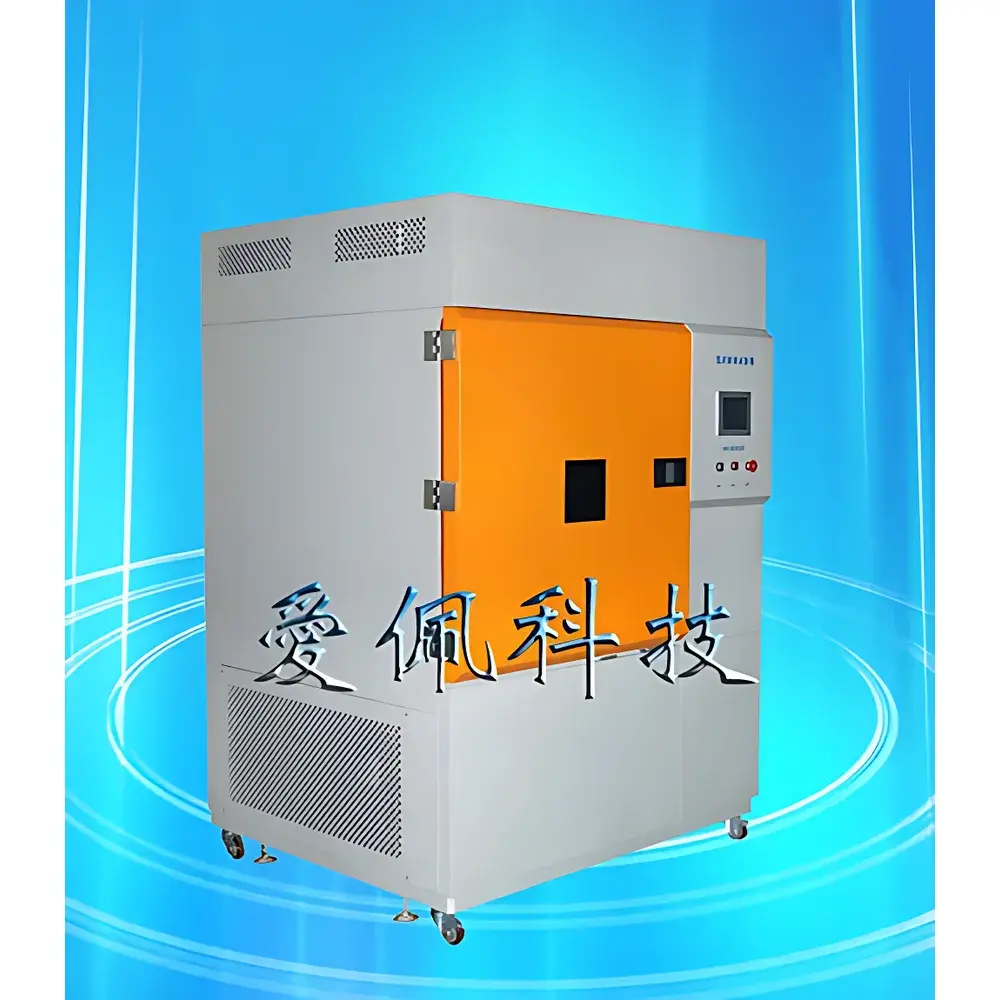
APKJ AP-XD-100A Xenon Arc Weathering Test Chamber
| Brand | APKJ |
|---|---|
| Origin | Guangdong, China |
| Manufacturer Type | OEM/ODM Manufacturer |
| Country of Origin | China |
| Model | AP-XD-100A |
| Working Chamber Dimensions | 450 × 1170 × 500 mm |
| Overall Dimensions | 500 × 1280 × 1450 mm |
| Temperature Range | RT+10°C to 70°C |
| Humidity Range | 0–98% RH |
| Temperature Uniformity | ±2°C |
| Temperature Stability | ±0.5°C |
| Control Method | PID Auto-Tuning |
| Lamp Center-to-Center Distance | 70 mm |
| Sample-to-Lamp Distance | 50 mm |
| Standard Specimen Size | 75 × 150 mm or 75 × 300 mm |
| Water Tray Depth | 25 mm (Auto-Controlled) |
| Effective Irradiated Area | 900 × 210 mm |
| UV-A Wavelength Range | 315–400 nm |
| UV-B Wavelength Range | 280–315 nm |
| Exposure Time Range | 0–999 h (Adjustable |
| Black Panel Temperature Range | 40–65°C |
| Power Supply | 3-Phase AC 380 V / 50 Hz, 5 kW |
| Weight | Approx. 110 kg |
Overview
The APKJ AP-XD-100A Xenon Arc Weathering Test Chamber is an engineered environmental simulation system designed for accelerated weathering evaluation of materials exposed to solar radiation, thermal cycling, and moisture stress. It employs a 3000 W long-arc xenon lamp—spectrally filtered to replicate the global solar irradiance spectrum (290–800 nm)—to deliver controlled, repeatable, and metrologically traceable exposure conditions. Unlike UV fluorescent or metal halide sources, xenon arc technology provides full-spectrum daylight simulation, including critical UV-A (315–400 nm), UV-B (280–315 nm), visible, and near-infrared components essential for evaluating photodegradation mechanisms such as polymer chain scission, pigment fading, and coating delamination. The chamber integrates real-time irradiance monitoring at user-selectable wavelengths (e.g., 340 nm, 420 nm, or broadband 300–400 nm or 300–800 nm), enabling compliance with internationally recognized exposure protocols.
Key Features
- High-fidelity spectral simulation using a 3000 W air-cooled xenon lamp paired with high-transmittance optical filters (≥95% transmission efficiency), minimizing power consumption while maintaining irradiance stability and spectral fidelity.
- Digital irradiance control with closed-loop feedback: irradiance setpoints are maintained automatically across the entire test duration via real-time photometric sensing and dynamic lamp power modulation.
- Co-located sensor architecture: black panel temperature (BPT), standard black standard thermometer (BST), and calibrated radiometer are mounted at the same radial plane as test specimens—ensuring spatial equivalence and eliminating measurement bias due to angular or distance variance.
- Multi-mode environmental conditioning: independent programmability of light/dark cycles, spray (rain simulation), condensation (humidity-induced dew formation), specimen rotation (planetary motion: simultaneous revolution and self-rotation), and temperature/humidity ramping.
- Intelligent climate control system featuring industrial-grade refrigeration, multi-stage humidification, and PID auto-tuning algorithms—achieving ±0.5°C temperature stability and ≤±3% RH fluctuation under dynamic load conditions.
- Modular specimen holder design supporting individual timing per sample position; enables concurrent testing of heterogeneous materials under identical exposure profiles while preserving traceable, time-stamped test records per specimen.
- 10.1-inch industrial capacitive touchscreen HMI with dual-mode visualization (real-time waveform graphs + animated chamber status), intuitive parameter navigation, and built-in data logging with timestamped event tagging (e.g., “spray start”, “lamp ignition”, “condensation onset”).
Sample Compatibility & Compliance
The AP-XD-100A accommodates flat-panel specimens up to 75 × 300 mm, secured in standardized stainless-steel clamps with uniform tension distribution. Its effective irradiated area (900 × 210 mm) ensures full coverage of multiple specimens without edge-shadowing artifacts. The system supports standardized mounting configurations per ISO 105-B02, ISO 105-B04, AATCC TM16-2003, GB/T 8427, GB/T 14576, and GB/T 15102–2006. All thermal and radiometric sensors are calibrated against NIST-traceable references prior to shipment. The controller firmware complies with GLP data integrity requirements, including electronic audit trails, user-access level management (admin/operator), and non-erasable session logs. While not certified to IEC 61000-4-x EMC standards out-of-box, the unit meets CE safety directives (2014/35/EU Low Voltage Directive and 2014/30/EU EMC Directive) when installed per manufacturer grounding and cabling specifications.
Software & Data Management
Embedded firmware supports local data storage (≥16 GB internal flash) with CSV export capability via USB 2.0 port. Test programs—including multi-step irradiance ramps, humidity hold phases, and synchronized spray sequences—are configured directly on-device or imported from PC-based template files. Optional Ethernet connectivity enables remote monitoring and alarm notification via Modbus TCP or HTTP API endpoints. All logged parameters (irradiance, BPT/BST, chamber RH, spray status, elapsed time) are time-aligned with millisecond resolution and tagged with operator ID and test batch number. Raw sensor outputs comply with ASTM G173-03 reference spectra for spectral mismatch correction during post-test analysis. Data export conforms to ISO/IEC 17025 clause 7.7 requirements for result reporting traceability.
Applications
This chamber is routinely deployed in R&D laboratories and QC departments for evaluating photochemical durability of organic materials subject to outdoor service life expectations. Typical use cases include: assessment of colorfastness to light and perspiration-light combination (ISO 105-B04, AATCC 16); evaluation of polymer matrix degradation in automotive interior trim (SAE J2527); validation of UV stabilizer efficacy in PVC flooring (GB/T 15104–2006); qualification of architectural coatings under cyclic wet/dry exposure (ASTM D4329); and accelerated aging of photovoltaic encapsulants per IEC 61215-2 MQT03. Its ability to decouple UV dose from thermal load enables mechanistic studies of wavelength-dependent degradation pathways—particularly valuable for developing next-generation UV absorbers and HALS stabilizers.
FAQ
What spectral bands can be monitored and controlled?
The system supports real-time irradiance regulation at user-defined wavelengths: 340 nm (UV-A critical for polymer degradation), 420 nm (broadband visible), or integrated bands (300–400 nm UV, 300–800 nm full spectrum).
Is the chamber compatible with ASTM G155 and ISO 4892-2 protocols?
Yes—its spectral output, irradiance control range (0.35–1.20 W/m² @ 340 nm), and environmental cycling capabilities fully satisfy the operational requirements of both standards.
How is calibration traceability ensured?
Each unit ships with a factory calibration certificate referencing NIST-traceable radiometers and thermistors; annual recalibration services are available through APKJ-accredited regional labs.
Can the system operate unattended for extended durations?
Yes—the controller includes UPS-compatible power-loss recovery, persistent memory for all active test parameters, and automatic resumption after grid interruption without data loss.
What maintenance intervals are recommended?
Xenon lamp replacement every 1500 hours; optical filter inspection every 500 hours; water tray cleaning and deionized water refill daily; full preventive maintenance (refrigerant pressure check, sensor verification, belt tension adjustment) every 6 months.



