
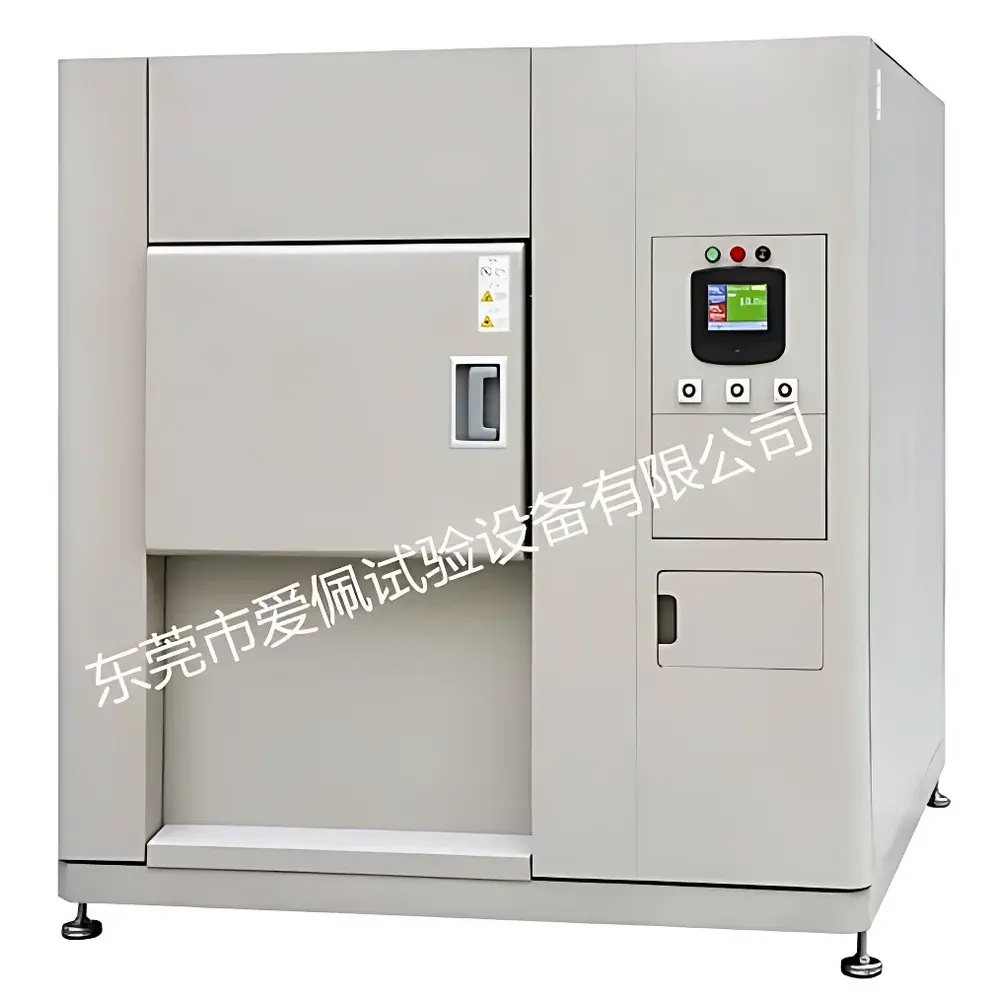
Apkji Ap-CJ-150L Thermal Shock Test Chamber
| Brand | Apkji |
|---|---|
| Origin | Guangdong, China |
| Manufacturer Type | Direct Manufacturer |
| Model | Ap-CJ-150L |
| Temperature Range Options | A-Type (−20 °C to +100 °C / +150 °C), B-Type (−40 °C to +100 °C / +150 °C), C-Type (−70 °C to +100 °C / +150 °C) |
| Temperature Uniformity | ≤ ±0.5 °C |
| Temperature Stability | ≤ 2 °C |
| Heating Rate | 1.0–3.0 °C/min |
| Cooling Rate | 0.7–1.0 °C/min |
| Internal Dimensions (W×D×H) | 700 × 600 × 600 mm |
| External Dimensions (W×D×H) | 1900 × 2000 × 1640 mm |
| Control System | Fuji Electric Intelligent LCD Temperature & Humidity Controller (AP-CJ-250 variant referenced) |
| Refrigeration | Twin-stage cascade refrigeration system with French Tecumseh hermetic compressors and multi-plate evaporators |
| Heating | Nickel-chromium alloy electric heaters |
| Air Circulation | Low-noise, high-efficiency centrifugal blower with stainless-steel impeller and adjustable multi-wing airflow ducting |
| Insulation | High-density polyurethane foam + ultra-fine glass fiber composite |
| Sensor | PT100 platinum resistance thermometer |
| Compliance | GB/T 2423.1–2008, GB/T 2423.2–2008, GB/T 2423.22–2012, GJB 150.5–1986, GJB 360.7–1987, GJB 367.2–1987, QC/T 17–1992, EIA-364-32, IEC 60068-2-14 |
| Safety Protections | Over-temperature/over-cooling cut-off, compressor high-pressure protection, leakage current interrupter, fast-acting fuse, grounding fault detection, audible alarm |
Overview
The Apkji Ap-CJ-150L Thermal Shock Test Chamber is an engineered environmental test system designed for rapid, repeatable, and highly controlled temperature transition testing of materials and components subjected to extreme thermal stress. It operates on the principle of two-zone or three-zone thermal shock—where specimens are mechanically transferred between independently controlled high-temperature and low-temperature chambers—or via a single-chamber alternating method with optimized air circulation and thermal mass management. This configuration enables precise simulation of real-world thermal cycling conditions encountered in aerospace, automotive, electronics, and rubber/elastomer manufacturing environments. The chamber supports programmable thermal profiles per international standards including IEC 60068-2-14 (Temperature Change), MIL-STD-810G Method 503.5, and GJB 150.5A, making it suitable for qualification, reliability screening, and failure mode analysis of critical assemblies.
Key Features
- Robust dual- or triple-zone architecture with independent heating and refrigeration circuits, minimizing cross-contamination of thermal zones and enabling stable setpoint maintenance during rapid transitions.
- Cascade refrigeration system utilizing French Tecumseh hermetic compressors and multi-plate evaporators—engineered for reliable operation at −70 °C and below, with optimized oil return and defrost management.
- Fuji Electric AP-CJ-250 intelligent LCD controller featuring PID auto-tuning, real-time trend logging, programmable ramp/soak profiles, and intuitive touchscreen interface compliant with industrial HMI ergonomics.
- High-efficiency forced-air circulation using corrosion-resistant stainless-steel centrifugal impellers and multi-directional ducting—ensuring temperature uniformity ≤ ±0.5 °C and stability ≤ 2 °C across the full working volume (700 × 600 × 600 mm).
- Double-layer silicone rubber door gasket with anti-aging formulation—maintaining integrity and sealing performance over repeated thermal cycles from −70 °C to +150 °C.
- Internally constructed from SUS304 stainless steel; exterior finished with electrostatically applied A3 steel coating—resistant to chipping, corrosion, and UV degradation under laboratory conditions.
- Comprehensive safety suite including dual-stage over-temperature/over-cooling cutoffs, compressor high-pressure interlock, ground-fault circuit interruption (GFCI), and audible visual alarms—fully documented in accordance with IEC 61000-6-2 EMC and IEC 61000-6-4 emission requirements.
Sample Compatibility & Compliance
The Ap-CJ-150L accommodates rigid and flexible specimens up to 50 kg total load—including rubber compounds, elastomeric seals, PCB assemblies, polymer housings, and automotive under-hood components. Its internal geometry and airflow design support standardized mounting on two included stainless-steel sample trays. The chamber meets full conformance with GB/T 2423.22–2012 (Temperature Change Testing), GJB 150.5–1986 (Military Standard Thermal Shock), and QC/T 17–1992 (Automotive Rubber Component Testing). Optional validation packages include IQ/OQ documentation templates aligned with ISO/IEC 17025 calibration traceability and GLP-compliant audit trails for regulated industries.
Software & Data Management
The Fuji controller provides native data logging at user-selectable intervals (1–60 seconds), exporting CSV-formatted files via USB port for post-test analysis in MATLAB, Excel, or statistical process control (SPC) platforms. Optional Ethernet connectivity enables remote monitoring and integration into centralized LabVantage or Siemens Desigo CC systems. Audit trail functionality records all parameter changes, operator logins, alarm events, and calibration actions—supporting compliance with FDA 21 CFR Part 11 electronic record requirements when paired with validated user access controls and digital signature modules.
Applications
- Evaluation of thermal expansion mismatch in bonded rubber-metal assemblies used in vibration isolation mounts.
- Accelerated aging studies of silicone, EPDM, and fluoroelastomer seals exposed to cyclic extremes in engine bays or outdoor infrastructure.
- Qualification testing of solder joints, conformal coatings, and encapsulated sensors in avionics subsystems.
- Material phase-transition analysis of thermoplastic elastomers (TPEs) and shape-memory polymers under controlled ramp rates.
- Pre-screening of electronic enclosures for condensation resistance and mechanical integrity following thermal shock exposure.
FAQ
What is the difference between two-zone and single-chamber thermal shock configurations?
Two-zone systems physically shuttle samples between hot and cold chambers, delivering faster transition times (< 10 s) and sharper thermal gradients. Single-chamber units rely on rapid air exchange and thermal mass modulation—offering lower footprint and reduced maintenance but slightly longer dwell-to-transition intervals.
Can this chamber perform humidity-controlled thermal shock tests?
No—the Ap-CJ-150L is a dry thermal shock chamber. For combined temperature/humidity shock, consider Apkji’s Ap-THS series, which integrates steam injection and desiccant drying modules compliant with IEC 60068-2-30.
Is calibration certification included with shipment?
Standard delivery includes factory-assembled verification report (traceable to NIM China). Full ISO/IEC 17025-accredited calibration with uncertainty budget is available as an optional service.
What maintenance intervals are recommended for the refrigeration system?
Compressor oil and filter replacement every 24 months; annual inspection of refrigerant charge, evaporator coil cleanliness, and door seal compression force per ASTM E283 protocol.
Does the controller support custom test sequence programming?
Yes—the Fuji AP-CJ-250 controller allows up to 99 segments per profile, including conditional branching, dwell steps, rate-limited ramps, and external trigger inputs for synchronized stimulus application.



