
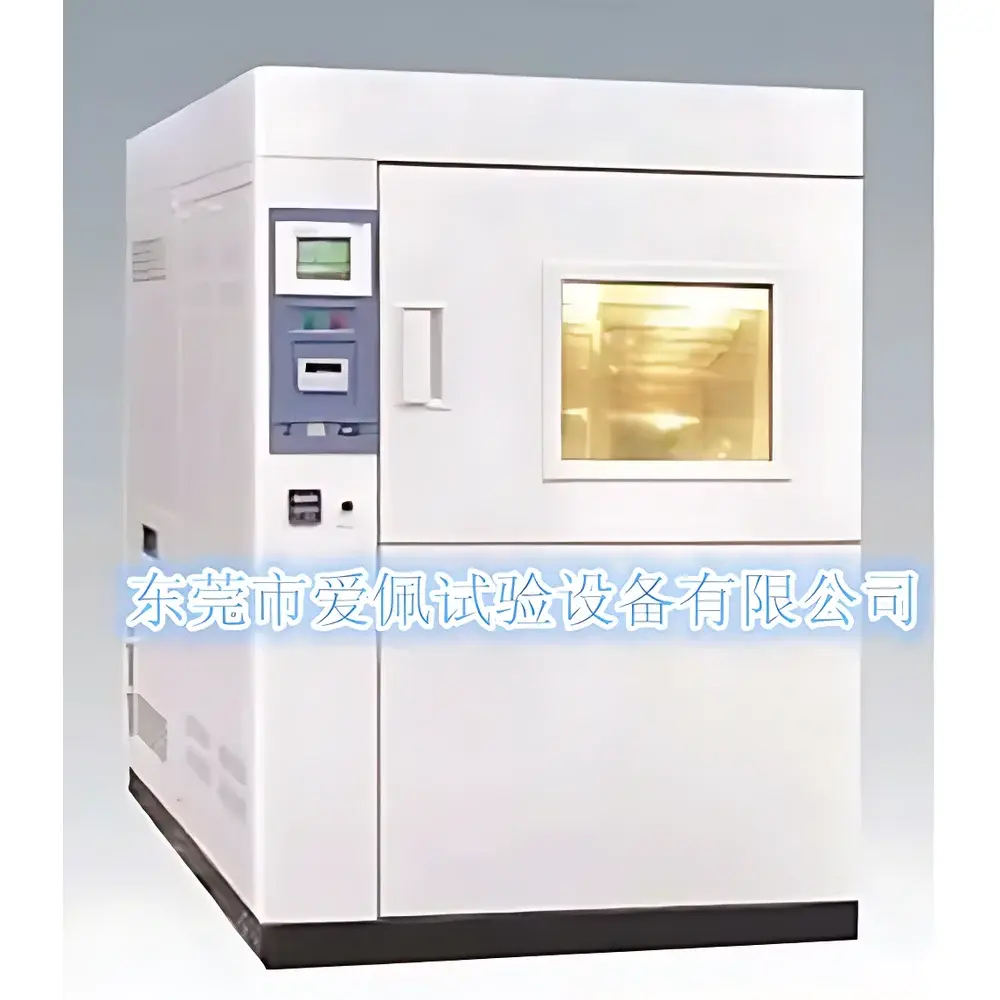
Apkji AP-CJ-2D Thermal Shock Test Chamber for Electronics and LED Lighting Products
| Brand | Apkji |
|---|---|
| Origin | Guangdong, China |
| Manufacturer Type | Manufacturer |
| Country of Origin | China |
| Model | AP-CJ-2D |
| Price | Upon Request |
| High-Temp Zone | 80–200 °C |
| Low-Temp Zone | −10 to −70 °C |
| Test Zone Range | −10 to +150 °C |
| Temperature Fluctuation | ±0.5 °C |
| Temperature Uniformity | ±2 °C |
| Heating Rate | ≤5 °C/min (avg.) |
| Cooling Rate | ≤5 °C/min (avg.) |
| Pre-cooling Limit | ≤−70 °C |
| Thermal Shock Range | +150 °C to −60 °C |
| Internal Dimensions (W×H×D) | 400×500×400 mm |
| Sample Tray Size | 150×150 mm |
| Temperature Recovery Time | ≤5 min |
| Basket Transfer Time | ≤10 s |
| Shock Mechanism | Vertical basket transfer or flip-door type |
| Power Supply | 380 V ±10%, 50 Hz |
| Refrigeration System | Twin-stage cascade refrigeration with imported Tecumseh (France) hermetic compressors |
| Controller | 7.5″ TFT LCD touch screen, wide-view angle, adjustable backlight, Chinese UI |
Overview
The Apkji AP-CJ-2D Thermal Shock Test Chamber is an industrial-grade environmental test system engineered for accelerated reliability assessment of electronic components, LED lighting modules, automotive ECUs, and polymer-based assemblies subjected to rapid thermal transients. It operates on the principle of mechanical thermal shock—repeated, abrupt transitions between extreme high- and low-temperature environments—to simulate real-world operational stresses induced by power cycling, outdoor exposure, or assembly-level thermal mismatch. Unlike steady-state temperature chambers, this dual-zone cascade system isolates hot and cold reservoirs, enabling precise control over shock amplitude, dwell time, and transition dynamics. The test zone is thermally decoupled from both conditioning zones via insulated lift baskets or flip doors, minimizing thermal lag and ensuring reproducible shock profiles compliant with IEC 60068-2-14, MIL-STD-810H Method 503.5, and JESD22-A104.
Key Features
- Twin-stage cascade refrigeration system using imported Tecumseh hermetic compressors—optimized for stable operation down to −70 °C and rapid thermal recovery;
- 7.5-inch high-contrast TFT LCD touchscreen controller with intuitive Chinese interface, programmable ramp/soak profiles, real-time data logging, and password-protected parameter locking;
- Robust chamber construction with high-density polyurethane insulation (≥150 mm thickness), seamless stainless-steel interior, and reinforced observation window with double-layer low-emissivity glass;
- Forced-air convection heating and cooling in each zone ensures uniform temperature distribution (±2 °C) and minimizes stratification effects;
- Dual independent PID control loops for heating and refrigeration circuits, coupled with redundant over-temperature protection (mechanical + electronic) meeting IEC 61000-4-11 immunity requirements;
- Two independently adjustable sample trays (150 × 150 mm each) mounted on a vertically actuated basket mechanism, achieving ≤10-second transfer time between zones;
- Compliance-ready architecture: supports audit trails, user access levels, and event logging suitable for GLP/GMP environments where traceability is required.
Sample Compatibility & Compliance
The AP-CJ-2D accommodates PCBAs, LED packages (COB, SMD, high-power arrays), connectors, sensors, and small molded plastic housings up to 400 × 400 × 500 mm (W × H × D). Its compact test volume and fast transition kinetics make it especially effective for evaluating interfacial delamination, solder joint fatigue, silicone encapsulant cracking, and coefficient-of-thermal-expansion (CTE) mismatch failure modes. The system meets structural safety standards per GB/T 10592–2008 and electrical safety per IEC 61010-1. Optional calibration certificates (NIST-traceable) and IQ/OQ documentation packages are available upon request to support ISO/IEC 17025-accredited lab validation.
Software & Data Management
The embedded controller records timestamped temperature values at user-defined intervals (1–60 s), stores up to 100 test programs with 99 segments each, and exports CSV-formatted logs via USB port. While no PC software is bundled as standard, raw data files are compatible with third-party analysis tools (e.g., MATLAB, JMP, or LabVIEW) for statistical process control (SPC) and Weibull life modeling. Audit trail functionality includes operator ID, parameter changes, alarm events, and door-open durations—enabling compliance with FDA 21 CFR Part 11 when deployed in regulated manufacturing settings under documented SOPs.
Applications
- Qualification testing of automotive LED headlamps per AEC-Q102;
- Failure mode analysis of BGA and QFN packages during JEDEC J-STD-020 reflow simulation;
- Validation of conformal coating integrity under cyclic thermal stress;
- Accelerated aging of OLED display substrates and flexible PCB interconnects;
- Reliability screening of power electronics (IGBTs, MOSFETs) prior to burn-in;
- Material compatibility studies involving adhesives, potting compounds, and thermal interface materials (TIMs).
FAQ
What is the minimum achievable temperature in the cold zone?
The low-temperature reservoir maintains stable operation at −70 °C, verified under full-load conditions per IEC 60068-3-4.
Can the chamber be configured for horizontal sample transfer instead of vertical basket motion?
Yes—flip-door configuration is available as a factory option; contact engineering support for mechanical integration details and lead-time implications.
Is remote monitoring supported via Ethernet or Modbus RTU?
Standard configuration includes only local USB data export; RS-485 Modbus RTU communication is available as an optional upgrade with custom firmware.
Does the system include calibration documentation out-of-the-box?
A factory-as-built temperature uniformity report is provided; NIST-traceable calibration certificates require separate purchase and scheduled onsite verification.
What maintenance intervals are recommended for the cascade refrigeration system?
Compressor oil analysis and filter-drier replacement every 24 months; annual inspection of refrigerant charge and heat exchanger cleanliness is advised for continuous operation environments.



