
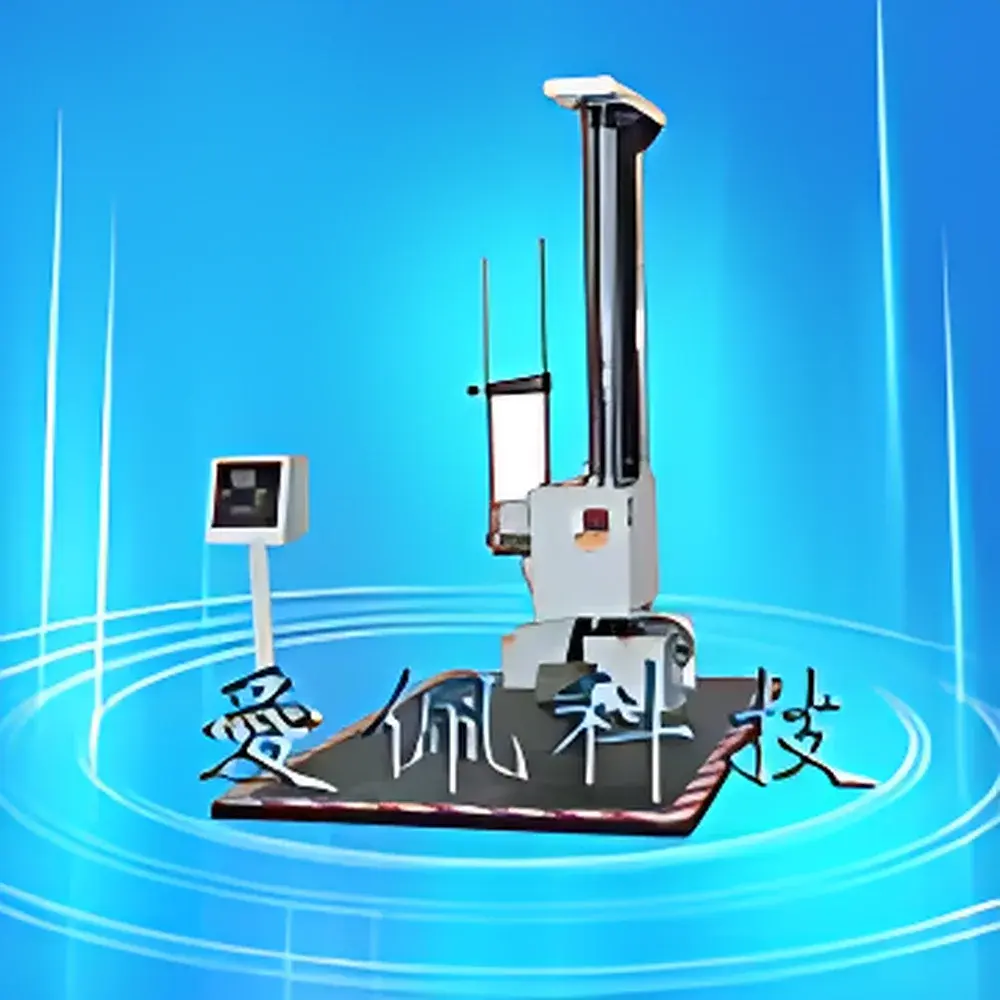
Apkji AP-DL Series Single-Arm Free-Fall Packaging Drop Tester
| Brand | Apkji |
|---|---|
| Origin | Guangdong, China |
| Manufacturer Type | Direct Manufacturer |
| Country of Origin | China |
| Model | AP-DL-150A / AP-DL-180A |
| Drop Height Range | 300–1500 mm / 300–1800 mm |
| Height Display | Digital Indicator with Encoder Feedback |
| Height Accuracy | ±10 mm or ±2% (whichever is greater) |
| Max. Specimen Weight | 60 kg |
| Max. Specimen Dimensions | 200 × 800 × 1000 mm |
| Impact Panel Size | 1600 × 1100 × 20 mm |
| Overall Dimensions (AP-DL-150A) | 1600 × 1100 × 2230 mm |
| Overall Dimensions (AP-DL-180A) | 1600 × 1100 × 2530 mm |
| Control Cabinet Size | 350 × 350 × 1100 mm |
| Height Adjustment | Motorized Vertical Drive |
| Drop Orientations | Face, Edge, Corner |
| Motor Power | 1.1 kW |
| Net Weight | 600 kg |
| Power Supply | 3-phase 5-wire AC 380 V ±10% |
| Compliance Standard | GB/T 2423.8 |
Overview
The Apkji AP-DL Series Single-Arm Free-Fall Packaging Drop Tester is an electromechanically actuated impact testing system engineered for evaluating the structural integrity and shock resistance of packaged products under simulated transport and handling conditions. Operating on the principle of controlled gravitational free-fall, the tester lifts specimens to a user-defined height and releases them onto a rigid horizontal impact surface—reproducing real-world drop events encountered during logistics, warehousing, and manual handling. Its single-arm, dual-column architecture provides unobstructed access for specimen loading and orientation adjustment, while integrated motorized vertical positioning ensures repeatable height selection across face, edge, and corner impact configurations. Designed in accordance with the mechanical shock test methodology specified in GB/T 2423.8 (equivalent to IEC 60068-2-32), the system delivers traceable, reproducible drop profiles essential for quality assurance, packaging validation, and regulatory documentation.
Key Features
- Single-arm dual-column structural design enables rapid specimen placement and precise angular alignment—impact surface orientation error ≤ 5° relative to the base plate.
- Motor-driven vertical lift mechanism with encoder-based height tracking ensures accurate positioning; height repeatability maintained within ±10 mm or ±2% of setpoint (whichever is greater).
- Electro-pneumatic release system guarantees consistent drop initiation timing and eliminates mechanical trigger variability.
- Hydraulic damping buffer system absorbs kinetic energy upon impact, significantly reducing mechanical stress on frame components and extending service life without compromising test fidelity.
- Digital height display (optional) provides real-time visual feedback during setup and supports post-test verification of actual drop elevation.
- Electric reset and motorized descent functions streamline test cycles and reduce operator intervention between successive drops.
- Robust impact platform (1600 × 1100 × 20 mm, hardened steel) meets flatness and rigidity requirements per GB/T 2423.8 Annex A for standardized shock transmission.
Sample Compatibility & Compliance
The AP-DL series accommodates packaged units up to 60 kg and 200 × 800 × 1000 mm in dimension, supporting standard orientations defined in ISO 2233 and ASTM D5276 for drop testing protocols. The system is validated for compliance with GB/T 2423.8—China’s national standard for environmental testing—covering procedures for free-fall shock simulation using rigid, non-resilient surfaces. While not certified to ISO/IEC 17025, the instrument’s mechanical design, encoder resolution, and height control architecture support data traceability required for internal QA/QC reporting and supplier qualification audits. All electrical components conform to IEC 61000-6-2 (immunity) and IEC 61000-6-4 (emission) standards for industrial environments.
Software & Data Management
The AP-DL operates via a dedicated PLC-based control interface housed in a standalone cabinet (350 × 350 × 1100 mm). While no proprietary PC software is bundled, the controller logs key operational parameters—including nominal drop height, actual measured height, drop sequence number, and timestamp—into non-volatile memory. Data export is supported via RS-232 or USB-to-serial interface for integration into laboratory information management systems (LIMS) or enterprise quality databases. Optional analog output signals (0–10 V) enable external monitoring of lift position and release status. The system architecture supports audit trail functionality when connected to compliant LIMS platforms adhering to FDA 21 CFR Part 11 requirements for electronic records.
Applications
- Validation of corrugated box, foam insert, and molded pulp packaging performance under vertical impact loading.
- Comparative evaluation of protective packaging designs prior to shipment qualification.
- Root cause analysis of field damage incidents by replicating suspected drop scenarios in controlled conditions.
- Supporting ISTA 1A, 1B, and 2A test protocols through manual configuration of drop height and orientation sequences.
- Internal QC screening of finished goods packages prior to warehouse dispatch or third-party logistics handover.
- Supplier packaging certification testing where GB/T 2423.8 compliance is contractually mandated.
FAQ
What standards does the AP-DL tester comply with?
It conforms to GB/T 2423.8, which aligns with IEC 60068-2-32 for free-fall shock testing.
Is height calibration traceable to national metrology institutes?
Encoder-based height measurement is factory-calibrated; users may perform periodic verification using certified tape measures or laser distance meters per ISO 17025 guidelines.
Can the system be integrated into automated test lines?
Yes—the control cabinet provides dry-contact I/O terminals and Modbus RTU communication for synchronization with conveyor systems or MES platforms.
What maintenance is required for the hydraulic buffer system?
Annual inspection of hydraulic fluid level and seal integrity is recommended; no scheduled replacement is required under normal operating conditions.
Does the tester support variable drop velocity or angled impact?
No—it implements vertical free-fall only; angular deviations are limited to specimen orientation (face/edge/corner), not trajectory modulation.



