
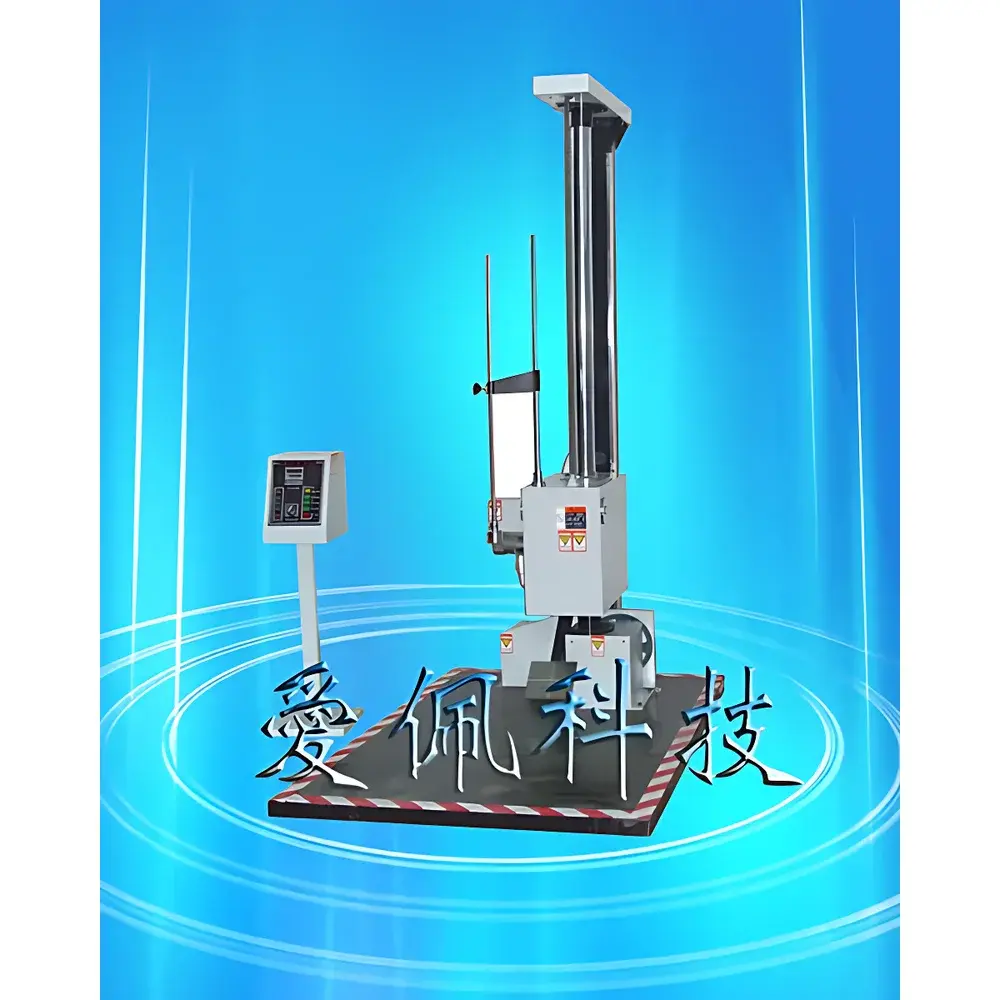
Apkji AP-DL Single-Arm Drop Tester
| Brand | Apkji |
|---|---|
| Origin | Guangdong, China |
| Manufacturer Type | Manufacturer |
| Model | AP-DL |
| Compliance | ISO 2248, JIS Z0202-87, GB/T 4857.5-92, GB/T 2423.8 |
| Drop Height Range | 300–1500 mm (AP-DL-150A) / 300–1800 mm (AP-DL-180A) |
| Height Display | Digital encoder-based readout with ±10 mm accuracy |
| Max Specimen Weight | 60 kg |
| Max Specimen Dimensions | 200 × 800 × 1000 mm |
| Impact Plate Size | 1600 × 1100 × 20 mm |
| Overall Dimensions | 1600 × 1100 × 2230 mm (AP-DL-150A) / 1600 × 1100 × 2530 mm (AP-DL-180A) |
| Control Box Dimensions | 350 × 350 × 1100 mm |
| Drive Motor Power | 1.1 kW |
| Net Weight | 600 kg |
| Power Supply | 3-phase 5-wire AC 380 V ±10% |
| Drop Orientation | Face, Edge, Corner |
| Angular Accuracy | ≤5° deviation between impact surface and base plate plane |
| Structural Design | Single-arm, dual-column frame with electro-hydraulic actuation |
| Key Mechanisms | Motorized height adjustment, electric reset, programmable release, hydraulic damping system |
| Height Repeatability | ≤2% or ±10 mm of set value |
Overview
The Apkji AP-DL Single-Arm Drop Tester is an electromechanical impact testing system engineered for standardized evaluation of packaging integrity under free-fall conditions. It operates on the principle of controlled gravitational acceleration, enabling precise simulation of real-world handling hazards—including face, edge, and corner impacts—during logistics, warehousing, and distribution. Designed in strict accordance with international transport simulation standards—including ISO 2248 (packaging—vertical impact tests), JIS Z0202-87 (Japanese industrial standard for drop testing), and Chinese national standards GB/T 4857.5-92 and GB/T 2423.8—the instrument delivers repeatable, traceable, and auditable test outcomes suitable for quality assurance, package development, and regulatory documentation. Its single-arm, dual-column architecture provides unobstructed specimen access while maintaining structural rigidity across the full operational height range (300–1800 mm). The integrated hydraulic damping system ensures smooth deceleration of the drop arm after impact, minimizing mechanical stress on critical components and extending service life without compromising test fidelity.
Key Features
- Electro-hydraulic actuation system with 1.1 kW motor drive for height adjustment, arm reset, and controlled release—enabling fully automated test cycles.
- Digital encoder-based height measurement with ±10 mm absolute accuracy and ≤2% relative error versus preset values—ensuring compliance with metrological requirements of ISO/IEC 17025-accredited labs.
- Modular drop orientation capability: programmable selection of face, edge, or corner impact configurations via mechanical fixture alignment—verified to maintain ≤5° angular deviation from nominal impact plane.
- Reinforced impact plate (1600 × 1100 × 20 mm, steel, hardened surface) mounted on vibration-damped foundation to preserve energy transfer consistency across repeated drops.
- Single-arm configuration optimized for rapid specimen loading/unloading; accommodates packages up to 60 kg and 200 × 800 × 1000 mm in dimension without reconfiguration.
- Integrated safety interlocks, emergency stop circuitry, and hydraulic buffer assembly compliant with IEC 60204-1 for industrial machinery safety.
Sample Compatibility & Compliance
The AP-DL series supports rigid and semi-rigid packaged goods—including cartons, crates, palletized loads, and consumer electronics enclosures—within defined mass and dimensional limits. It is validated for use in environments requiring adherence to Good Manufacturing Practice (GMP) and ISO 9001 quality management systems. Test reports generated using this equipment meet evidentiary requirements for internal audit trails and third-party certification submissions under ISO 2248, ASTM D5276 (standard test method for drop test of loaded containers), and ISTA 1A/2A protocols. While not inherently Part 11-compliant, the system’s analog control interface may be integrated with external data acquisition hardware supporting 21 CFR Part 11 audit logging when deployed in regulated pharmaceutical or medical device supply chains.
Software & Data Management
The AP-DL operates via a dedicated industrial control panel with tactile push-button interface and digital LED height display. While the base configuration does not include embedded PC-based software, it features analog signal outputs (0–10 V or 4–20 mA) compatible with external PLCs or SCADA systems for centralized test logging. Optional upgrades include RS-485 Modbus RTU communication for integration into lab information management systems (LIMS) or enterprise quality databases. All height settings, drop counts, and orientation selections are manually recorded per test sequence—supporting paper-based or electronic batch records aligned with GLP documentation practices.
Applications
- Validation of corrugated box compression strength and cushioning performance under vertical impact.
- Verification of primary and secondary packaging robustness for e-commerce fulfillment centers subject to automated sorting and conveyor drops.
- Development-stage testing of protective packaging for fragile instrumentation, optical components, and semiconductor carriers.
- Supplier qualification audits where drop resistance is specified in procurement contracts (e.g., automotive Tier-1 packaging specifications).
- Root cause analysis of field failure reports linked to transit damage—correlating laboratory drop severity with real-world incident data.
- Internal training of packaging engineers and QA technicians on ISTA and ASTM test methodology fundamentals.
FAQ
What standards does the AP-DL comply with?
The tester meets ISO 2248, JIS Z0202-87, GB/T 4857.5-92, and GB/T 2423.8 for free-fall impact testing of packaged products.
Can the machine perform corner and edge drops with verified angular accuracy?
Yes—mechanical alignment fixtures ensure impact surface orientation remains within ±5° of nominal plane during corner and edge configurations.
Is height calibration traceable to national metrology institutes?
Encoder-based height measurement is factory-calibrated; users may perform in-house verification using certified tape measures or laser distance meters traceable to SI units.
Does the system support automated test sequencing or cycle counting?
The base model supports manual initiation per drop; optional PLC integration enables programmable multi-cycle sequences with external counter logging.
What maintenance is required to sustain long-term repeatability?
Recommended quarterly inspection of hydraulic damping fluid level, guide rail lubrication, encoder coupling integrity, and impact plate surface flatness per OEM maintenance schedule.



