
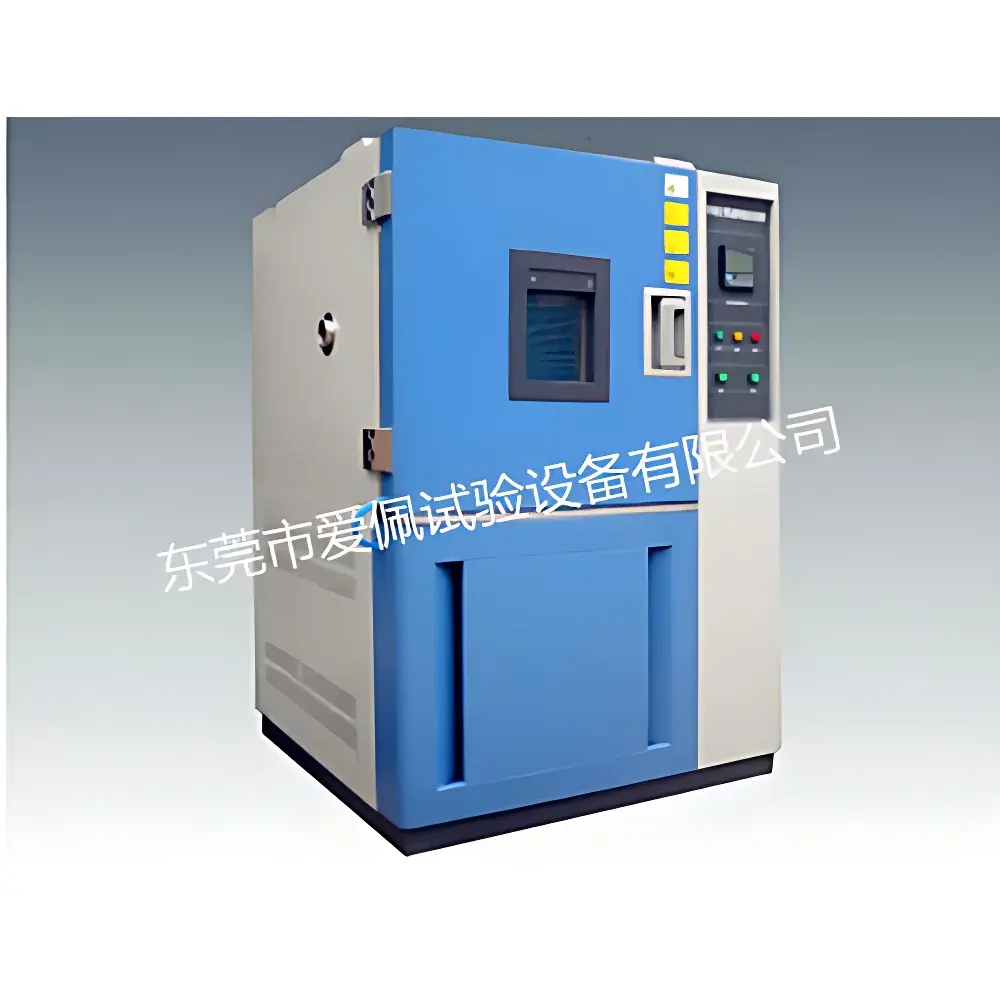
Apkji AP-GD-100D High-Low Temperature Alternating Test Chamber
| Brand | Apkji |
|---|---|
| Model | AP-GD-100D |
| Internal Volume | 100 L |
| Temperature Range | −70 °C to +150 °C |
| Temperature Control Accuracy | ±0.2 °C |
| Temperature Uniformity | ±2 °C |
| Heating Rate | ~3 °C/min (RT to +150 °C in ~40 min) |
| Cooling Rate | ~1 °C/min (RT to −70 °C in ~100 min) |
| Construction | SUS304 Stainless Steel Interior & Exterior |
| Insulation | Rigid Polyurethane Foam + Glass Wool |
| Refrigeration System | Cascade Refrigeration (R404A / R23) |
| Compressor | Tecumseh (France) Hermetic or Bitzer (Germany) Semi-Hermetic |
| Power Supply | 1φ3w AC220V ±10% 50/60 Hz or 3φ5w AC380/415V ±10% 50/60 Hz |
| Compliance | GB/T 10589, GB/T 10592, GB/T 2423.1, GB/T 2423.4, MIL-STD-810D Method 502.2 & 507.2 |
Overview
The Apkji AP-GD-100D High-Low Temperature Alternating Test Chamber is an engineered environmental simulation system designed for rigorous thermal stress evaluation of electronic components, polymer materials, automotive parts, aerospace assemblies, and industrial finished goods. It operates on the principle of controlled, programmable thermal cycling—precisely alternating between extreme low-temperature and high-temperature setpoints within a sealed, insulated chamber. The system employs cascade refrigeration architecture to achieve stable operation across a wide thermal envelope (−70 °C to +150 °C), enabling accelerated life testing, qualification validation, and failure mode analysis under repeatable, auditable conditions. Its robust mechanical design—including dual-stage refrigerant circuits, SUS304 stainless steel construction, and forced-air convection with centrifugal blower—ensures long-term stability, minimal thermal gradient deviation, and high reproducibility required for ISO/IEC 17025-compliant laboratories and GMP-regulated production environments.
Key Features
- Programmable temperature cycling profiles with up to 99 segments per program, supporting ramp-hold-soak sequences and multi-step thermal stress protocols.
- Lan-enabled controller interface compliant with Modbus TCP/IP, enabling remote program upload/download, real-time data logging, alarm event history retrieval, and machine power control from a Windows-based workstation.
- Forced-air circulation via multi-wing centrifugal fan with top-outlet/bottom-inlet airflow path—engineered to maintain ±2 °C temperature uniformity across the entire working volume (per GB/T 2423.4 Annex A).
- Redundant safety architecture including over-temperature cut-off, compressor high-pressure/overheat/over-current protection, refrigerant low-level detection, dry-run prevention, emergency stop circuitry, and auto-fault diagnosis with on-screen remediation guidance.
- Modular insulation system combining rigid polyurethane foam (≥100 mm thickness) and layered glass wool—optimized for thermal retention and condensation suppression during rapid transitions.
- Standard configuration includes two adjustable SUS304 shelves, one 50 mm cable port with blanking cap, LED interior lighting, and comprehensive operation manual with calibration certificate traceable to NIM (National Institute of Metrology, China).
Sample Compatibility & Compliance
The AP-GD-100D accommodates samples up to 50 × 50 × 40 cm (W × H × D) within its 100 L internal workspace. Its chamber geometry, airflow dynamics, and sensor placement comply with IEC 60068-3-5 for thermal test chamber performance verification. The unit meets national and international standards governing environmental testing—including GB/T 10589-1989 (Low-Temperature Chamber Specifications), GB/T 10592-1989 (Climatic Chamber General Requirements), GB/T 2423.1 (Cold Testing, Test Aa/Ab), GB/T 2423.4 (Temperature Cycling, Test Db), and MIL-STD-810D Methods 502.2 (Low Temperature) and 507.2 (Temperature Shock). While not certified to UL or CE for direct EU market placement without local Notified Body assessment, its electrical architecture, refrigerant selection (R404A/R23—EPA SNAP-approved through 2030), and safety interlocks align with foundational requirements of EN 61000-6-2 (EMC Immunity) and EN 61000-6-4 (EMC Emission).
Software & Data Management
The embedded controller firmware supports CSV export of time-stamped temperature logs (sampling interval configurable from 1 to 60 seconds), with timestamped alarm records and user-accessible audit trails. Data files are stored internally and transferable via USB 2.0 port or LAN connection. Optional PC software (Apkji EnviroLog v3.x) provides graphical trend analysis, statistical process control (SPC) charting (X̄-R, Cp/Cpk), automated report generation (PDF/Excel), and integration with LIMS platforms via OPC UA or REST API endpoints. All user actions—including parameter modification, program execution, and manual override—are logged with operator ID, timestamp, and change delta—supporting GLP/GMP documentation requirements and FDA 21 CFR Part 11 compliance when deployed with validated digital signature modules and role-based access controls.
Applications
- Electronics reliability testing: solder joint fatigue assessment, PCB delamination screening, capacitor ESR drift characterization under thermal cycling.
- Automotive component validation: battery module thermal runaway propagation studies, connector contact resistance stability, elastomer seal compression set evaluation.
- Materials science research: crystallinity transition mapping in thermoplastics, glass transition hysteresis in amorphous polymers, moisture absorption-desorption kinetics in composites.
- Pharmaceutical packaging qualification: blister pack integrity under cyclic humidity-temperature stress (when paired with optional humidity option).
- Aerospace hardware acceptance: avionics box operational margin verification at extreme ambient extremes per DO-160 Section 4.
- Quality assurance in manufacturing: incoming inspection of raw materials, final product burn-in, and lot-release thermal screening per internal QCPs.
FAQ
What is the standard temperature stabilization time after reaching setpoint?
Stabilization time is defined as the duration required for all chamber sensors to remain within ±0.5 °C of the target value for ≥10 minutes. Per GB/T 2423.4, typical stabilization is achieved within 15–25 minutes post-ramp completion, depending on load mass and thermal inertia.
Can the chamber be integrated into a factory automation system?
Yes—the LAN interface supports Modbus TCP/IP and optional OPC UA server mode, allowing bidirectional communication with SCADA, MES, or PLC systems for centralized monitoring and recipe-driven test orchestration.
Is third-party calibration certification available?
Apkji provides NIST-traceable calibration certificates (optional add-on) performed using Fluke 1524 thermometers and calibrated reference probes, valid for 12 months from issuance.
What maintenance intervals are recommended for the refrigeration system?
Compressor oil and filter dryer replacement is advised every 24 months under continuous operation; refrigerant leak checks should be conducted quarterly using electronic halogen detectors per ASHRAE Guideline 3-2021.
Does the unit support custom test profiles beyond preloaded standards?
Yes—users may define fully customizable multi-segment cycles (up to 99 steps) with independent ramp rates, dwell durations, and setpoint tolerances via the touchscreen HMI or PC software.



