
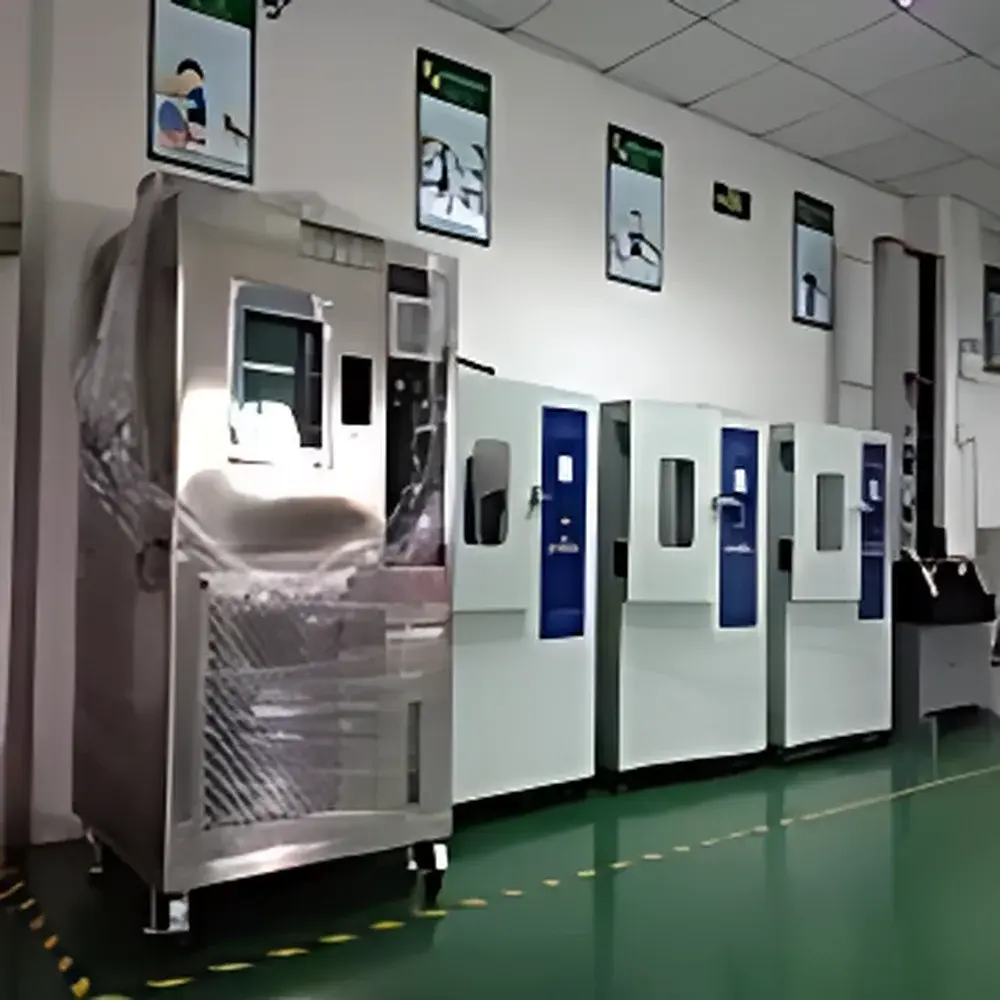
Apkji AP-GD-80LB High-Low Temperature Alternating Test Chamber
| Brand | Apkji |
|---|---|
| Origin | Guangdong, China |
| Manufacturer Type | OEM/ODM Manufacturer |
| Country of Origin | China |
| Model | AP-GD-80LB |
| Temperature Range | -70°C to +150°C |
| Temperature Uniformity | ±2°C |
| Temperature Fluctuation | ±0.5°C |
| Resolution | ±0.1°C |
| Heating System | Nickel-Chromium Alloy Heaters |
| Refrigeration System | French “Tecumseh” Hermetic Compressor |
| Refrigerant | R404A/R23 (Dual-Stage Low-Temp System) |
| Air Circulation | Long-Shaft Motor with Stainless Steel Multi-Wing Impeller |
| Compliance | GB/T 10589–1989, GB/T 10592–1989, GB/T 2423.1–1989, GB/T 2423.4–1993, MIL-STD-810D Method 502.2 & 507.2 |
Overview
The Apkji AP-GD-80LB High-Low Temperature Alternating Test Chamber is an engineered environmental simulation system designed for rigorous thermal stress testing of electronic components, industrial materials, and finished products across R&D, manufacturing, and quality assurance workflows. It operates on a dual-stage refrigeration principle—employing separate high-temperature (R404A) and low-temperature (R23) refrigerant circuits—to achieve stable, repeatable thermal transitions between –70°C and +150°C. The chamber’s thermodynamic architecture integrates forced-air convection via a stainless-steel multi-wing impeller driven by a long-shaft motor, ensuring uniform heat distribution and minimizing thermal gradients in accordance with ISO/IEC 17025–aligned validation protocols. Its structural design complies with fundamental thermal test chamber standards including GB/T 10592–1989 (General Technical Requirements for Environmental Testing Equipment) and MIL-STD-810D Method 507.2 (Temperature Shock), making it suitable for laboratories operating under GLP or pre-compliance QA frameworks.
Key Features
- Dual-stage refrigeration system with French Tecumseh hermetic compressors and environmentally compliant refrigerants (R404A/R23), certified for operational use beyond 2030 per U.S. EPA SNAP program guidelines
- Pt100 platinum resistance temperature sensors (±0.1°C resolution) mounted at multiple spatial locations for real-time monitoring and closed-loop PID control
- Independent heating and cooling circuits—enabling simultaneous ramp-hold-soak profiles without cross-interference, reducing cycle time and mechanical wear
- Robust insulation using high-density polyurethane foam (≥100 mm thickness) with seamless welded stainless-steel inner chamber and powder-coated steel outer shell
- LAN-enabled controller supporting remote program editing, data logging (CSV export), alarm history traceability, and USB backup—designed for audit-ready documentation per FDA 21 CFR Part 11 Annex 11 requirements
- Comprehensive safety architecture: over-temperature cut-off, compressor high-pressure protection, phase-sequence monitoring, and door interlock with visual/audio fault indication on HMI
Sample Compatibility & Compliance
The AP-GD-80LB accommodates samples up to 40 × 40 × 50 cm (W × D × H) within its insulated workspace. Its airflow dynamics—validated via ASHRAE 110-style tracer gas mapping—ensure ≤±2°C uniformity across the entire working volume during steady-state operation. The chamber meets mandatory national and international test standard prerequisites for thermal cycling validation, including GB/T 2423.1–1989 (Cold Testing), GB/T 2423.4–1993 (Temperature Cycling), and MIL-STD-810D Methods 502.2 (Low Temperature) and 507.2 (Temperature Shock). While not CE-marked for EU market placement, its electrical safety design conforms to IEC 61000-4 immunity criteria and GB 4793.1–2007 (Safety Requirements for Electrical Equipment for Measurement).
Software & Data Management
The embedded controller features a 7-inch TFT-LCD touchscreen interface with multilingual support (English, Chinese, Spanish). All test programs—including ramp rates (°C/min), dwell durations, cycle counts, and profile sequencing—are configurable and stored with timestamped revision history. Data acquisition occurs at 1-second intervals, with internal memory retaining ≥30 days of continuous logging. Export options include USB flash drive (FAT32 formatted) and Ethernet-based transfer to external SCADA or LIMS platforms. Audit trails record operator ID, parameter changes, start/stop events, and alarm triggers—satisfying traceability mandates under ISO/IEC 17025 Clause 7.7 and pharmaceutical GMP Annex 11.
Applications
- Accelerated life testing of PCBAs, connectors, and semiconductor packaging under thermal shock conditions
- Material characterization of elastomers, adhesives, and composite laminates per ASTM D6988 (low-temp brittleness)
- Pre-shipment validation of consumer electronics (smartphones, wearables) against IEC 60068-2-14 (Change of Temperature)
- Process qualification of automotive ECU housings per AEC-Q200 stress screening protocols
- Stability assessment of active pharmaceutical ingredients (APIs) and excipients during early-phase formulation development
FAQ
Does this chamber support automated thermal cycling with programmable ramp rates?
Yes—the controller supports up to 99 segments per program, with individually adjustable ramp rates from 0.5°C/min to 10°C/min and dwell times ranging from 1 minute to 999 hours.
Is the refrigeration system serviceable under field conditions?
All major refrigeration components—including the Tecumseh compressor, oil separator, expansion valve, and filter-drier—are accessible via front-service panels without disassembly of the chamber structure.
What calibration documentation is provided upon delivery?
A factory calibration certificate (traceable to NIM China) is included, covering temperature uniformity and fluctuation verification at three setpoints: –40°C, 25°C, and +85°C.
Can third-party calibration labs perform IQ/OQ/PQ validation?
Yes—the chamber’s mechanical and control architecture adheres to ASTM E74 and ISO/IEC 17025 metrological requirements, enabling full validation by accredited service providers.
Is remote firmware update capability available?
Firmware updates are delivered via encrypted USB media only; network-based OTA updates are intentionally disabled to maintain cybersecurity integrity in regulated lab environments.
Related Products



