
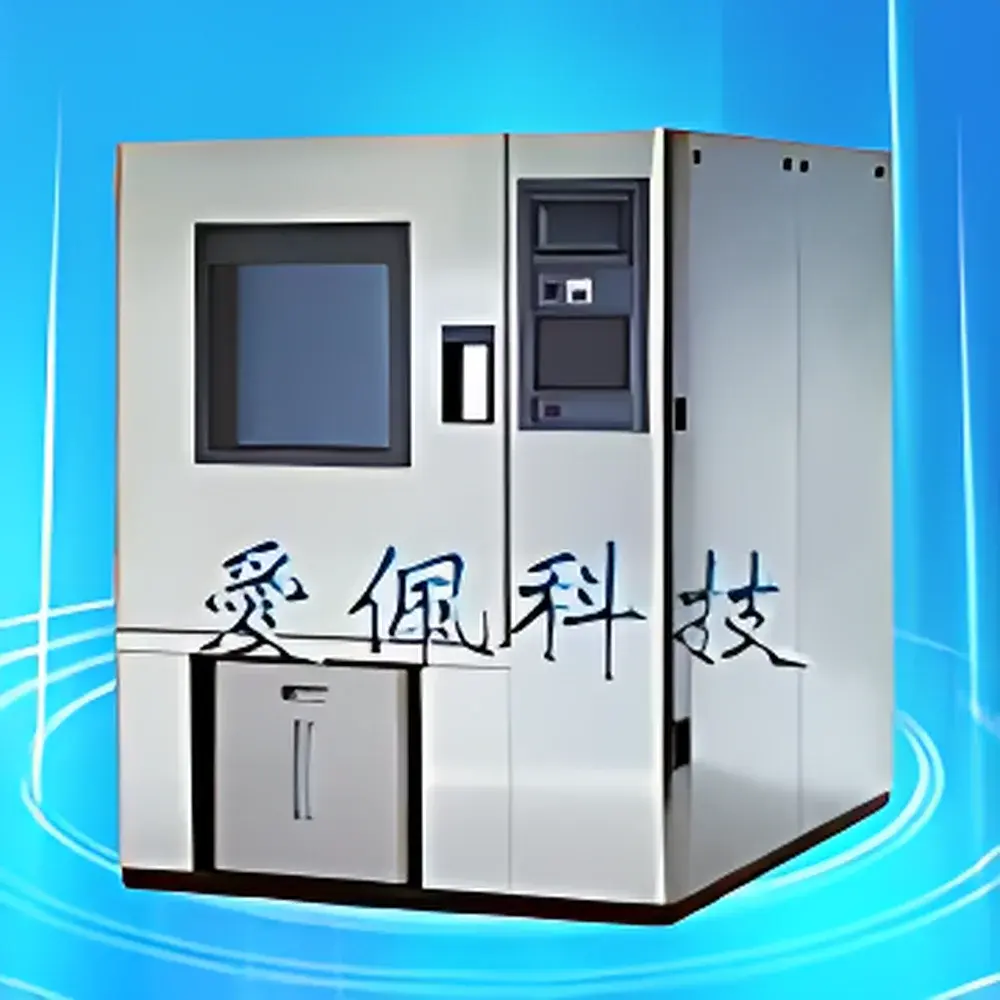
Apkji AP-GD-B High-Low Temperature Alternating Test Chamber
| Brand | Apkji |
|---|---|
| Origin | Guangdong, China |
| Manufacturer Type | Direct Manufacturer |
| Country of Origin | China |
| Model | AP-GD-B |
| Pricing | Available Upon Request |
| Temperature Range Options | -20°C to 150°C, -40°C to 150°C, -70°C to 150°C |
| Internal Dimensions (H×W×D) | 50×40×40 cm to 100×100×100 cm |
| Temperature Uniformity | ±2°C |
| Temperature Fluctuation | ≤ ±0.5°C |
| Resolution | ±0.1°C |
| Sensor | PT100 Platinum Resistance Thermometer |
| Heating System | Nickel-Chromium Alloy Resistive Heaters |
| Refrigeration System | French Tecumseh (original) hermetic compressors |
| Refrigerants | R404A/R507 (high stage), R23/R508B (low stage) |
| Air Circulation | Extended-shaft motor with stainless-steel multi-wing impeller |
| Compliance Standards | GB/T 10589–1989, GB/T 10592–1989, GB/T 2423.1–1989 (Test Aa/Ab), GB/T 2423.4–1993 (Test Db), MIL-STD-810D Method 502.2 & 507.2 |
Overview
The Apkji AP-GD-B High-Low Temperature Alternating Test Chamber is an engineered environmental simulation system designed for precise, repeatable thermal stress testing across industrial R&D, quality assurance, and production validation workflows. It operates on a dual-stage refrigeration architecture—combining high- and low-stage compressors with environmentally compliant refrigerants (R404A/R507 and R23/R508B)—to achieve stable, controllable temperature profiles from -70°C to +150°C. The chamber employs forced-air convection via a corrosion-resistant stainless-steel multi-wing impeller driven by an extended-shaft motor, ensuring uniform thermal distribution (±2°C) and minimal fluctuation (≤ ±0.5°C) throughout the test volume. Its structural design integrates insulated double-wall construction, optimized airflow ducting, and independent heating/cooling circuits—enabling rapid thermal transitions (e.g., 20°C to -40°C in ~35 minutes) without cross-interference between subsystems. This architecture meets the thermodynamic and temporal fidelity requirements of accelerated life testing, thermal shock evaluation, and environmental qualification per international product reliability standards.
Key Features
- Modular temperature range configuration: selectable variants supporting -20°C, -40°C, or -70°C minimum operating temperatures—all extending to +150°C.
- Intelligent controller with LAN interface enabling remote program design, real-time data logging, execution triggering, and machine power control from a host PC; USB data export support included.
- Multi-wing forced-air circulation system eliminates thermal stratification and ensures ISO/IEC 17025-aligned spatial uniformity across all standard internal volumes (from 80 L to 1000 L).
- Dual-circuit refrigeration design: primary and secondary stages operate independently to enhance system longevity, reduce maintenance frequency, and improve energy efficiency during extended cyclic operation.
- Comprehensive safety architecture: integrated overtemperature, overpressure, compressor overload, and phase-failure protection; fault codes displayed directly on controller LCD with diagnostic guidance.
- PT100 Class A platinum resistance sensors calibrated traceably to national metrological standards ensure measurement accuracy of ±0.1°C resolution across the full operational range.
Sample Compatibility & Compliance
The AP-GD-B accommodates a broad spectrum of physical samples—including PCB assemblies, polymer components, automotive ECUs, aerospace fasteners, medical device housings, and elastomeric seals—without requiring sample-specific fixtures or modifications. Its internal chamber dimensions (50×40×40 cm to 100×100×100 cm) support both single-unit validation and batch-level environmental screening. The system is certified to comply with multiple national and military environmental test standards, including GB/T 10589–1989 (Low-Temperature Chamber Specifications), GB/T 10592–1989 (High-Low Temperature Chamber Requirements), GB/T 2423.1–1989 (Cold Test Aa/Ab), GB/T 2423.4–1993 (Cyclic Damp Heat Db), and MIL-STD-810D Methods 502.2 (Low Temperature) and 507.2 (Temperature Shock). All calibration procedures, sensor verification, and performance validation reports are documented per ISO/IEC 17025 guidelines and support GLP/GMP audit readiness.
Software & Data Management
The embedded controller firmware supports programmable multi-step thermal profiles—including ramp-soak cycles, linear gradients, and dwell-hold sequences—with up to 99 segments per program and 100 stored programs. Logged temperature data is timestamped and stored internally (≥30 days at 1-second intervals) and simultaneously streamed via Ethernet to external servers or local PCs. Export formats include CSV and Excel-compatible .xls files, compatible with statistical process control (SPC) platforms and laboratory information management systems (LIMS). Audit trail functionality records all user actions—including parameter changes, program uploads, and manual overrides—with timestamps and operator IDs—meeting FDA 21 CFR Part 11 requirements for electronic records and signatures when deployed in regulated environments.
Applications
- Electronics reliability testing: solder joint fatigue assessment, capacitor derating validation, and semiconductor package integrity under thermal cycling.
- Automotive component qualification: dashboard module endurance, battery thermal management system verification, and gasket compression-set analysis.
- Materials science research: polymer crystallinity evolution, rubber vulcanization stability, and composite matrix microcrack propagation studies.
- Medical device compliance: ISO 11607 packaging seal integrity validation and implantable electronics thermal aging per ISO 14971 risk management protocols.
- Avionics environmental screening: DO-160 Section 4 (Temperature Variation) and RTCA/DO-160G compliance verification for airborne equipment.
FAQ
What temperature ranges does the AP-GD-B support?
The AP-GD-B is configurable for three base low-temperature limits: -20°C, -40°C, or -70°C, all extending to +150°C. Custom intermediate ranges (e.g., -30°C to +120°C) are available upon request.
Is the system compliant with FDA 21 CFR Part 11?
Yes—the controller’s electronic record system includes user authentication, audit trails, and electronic signature capability when configured with password-protected administrator access and time-stamped event logging.
Can the chamber be integrated into an existing factory MES or SCADA network?
Yes—standard Ethernet (TCP/IP) communication enables direct integration with industrial automation platforms via Modbus TCP or custom API endpoints; OEM-level protocol documentation is provided with purchase.
What maintenance intervals are recommended for long-term reliability?
Compressor oil and refrigerant levels should be verified semiannually; air filter replacement is required quarterly; full system calibration and sensor verification are recommended annually or after 2,000 operational hours—whichever occurs first.
Does Apkji provide installation and commissioning support internationally?
Yes—Apkji engineers perform on-site installation, mechanical and thermal validation (including uniformity mapping per IEC 60068-3-5), and operator training. International service contracts include remote diagnostics and priority spare parts logistics.



