
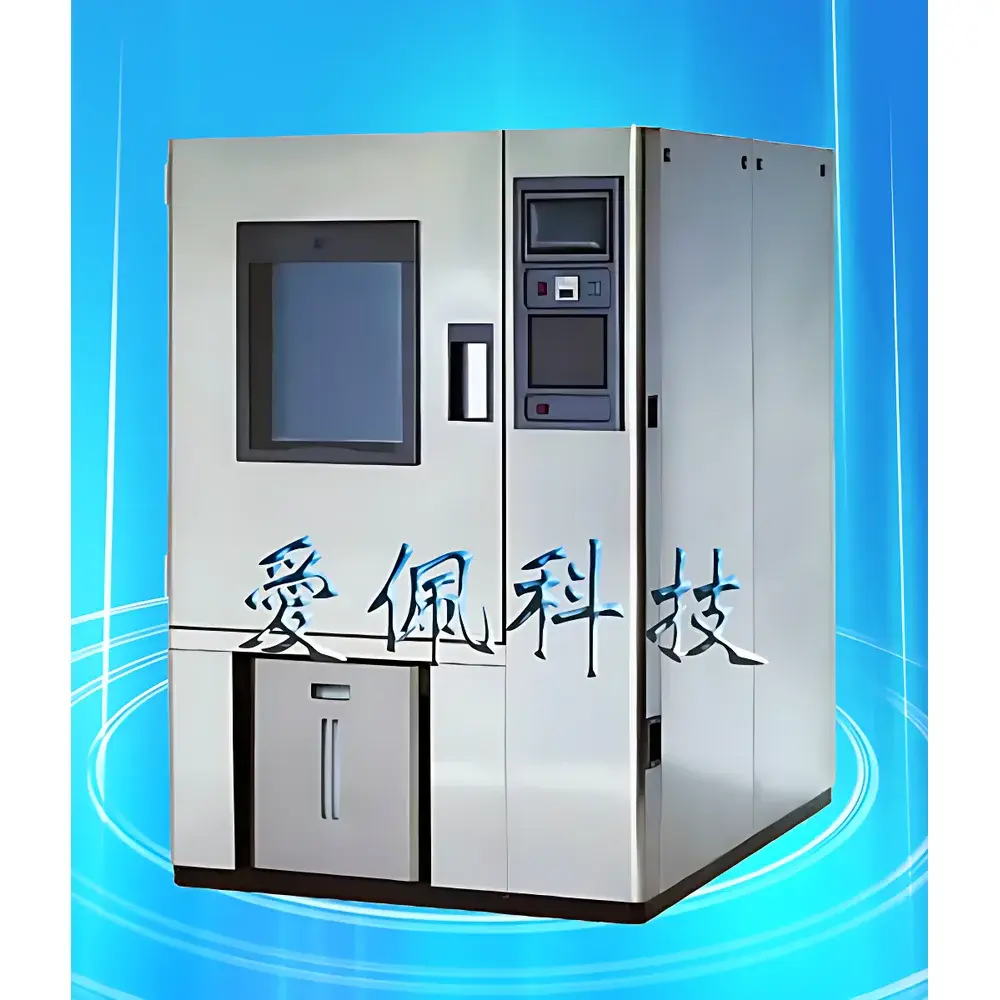
Apkji AP-GD Series High-Low Temperature & Humidity Environmental Test Chamber
| Brand | Apkji |
|---|---|
| Origin | Guangdong, China |
| Manufacturer Type | Direct Manufacturer |
| Country of Origin | China |
| Model | AP-GD- |
| Pricing | Available Upon Request |
| Temperature Range Options | A: 0°C to 150°C |
| B | −20°C to 150°C |
| C | −40°C to 150°C |
| D | −60°C to 150°C |
| E | −70°C to 150°C |
| Humidity Range | 20–98% RH |
| Temperature Uniformity | ≤ ±2°C |
| Temperature Fluctuation | ≤ ±0.5°C |
| Humidity Deviation | +2 / −3% RH |
| Internal Dimensions (W×D×H, cm) | AP-HX-80 (40×50×40) |
| External Dimensions (W×D×H, cm) | AP-HX-80 (95×165×95) |
| Control Modes | Programmable & Constant-Temperature/Humidity |
| Refrigeration | Variable-Speed Compressor (0–100% Capacity Modulation) |
| Compliance | GB/T 10589–2008, GB/T 10592–2008, GB/T 2423.1–2022 (Cold Test), GB/T 2423.2–2022 (Dry Heat Test), GJB 150.3A–2009, GJB 150.4A–2009, IEC 60068-2-1, IEC 60068-2-2, MIL-STD-810H |
Overview
The Apkji AP-GD Series High-Low Temperature & Humidity Environmental Test Chamber is an engineered environmental simulation system designed for rigorous reliability validation of materials and components under controlled thermal and hygrothermal stress conditions. It operates on the principle of forced-air convection combined with precision vapor compression refrigeration and steam-based humidification, enabling stable and repeatable generation of temperature-humidity profiles across wide operational ranges. This chamber is widely deployed in R&D laboratories, quality assurance departments, and certification testing facilities—particularly for silicone elastomers, adhesives, sealants, and other polymer-based products requiring accelerated aging, thermal cycling, or condensation resistance evaluation per industry-standard protocols.
Key Features
- Programmable multi-segment temperature/humidity profiles with up to 99 cycles and 999 steps per cycle, supporting ramp-hold-soak sequences compliant with IEC 60068-2-14 (change of temperature) and MIL-STD-810H Method 502.7 (temperature shock)
- Variable-speed scroll compressor with 0–100% capacity modulation—reducing energy consumption by ≥30% versus traditional on/off heating-balanced control systems
- SUS304 stainless steel inner chamber with high-density polyurethane foam insulation (≥100 mm thickness) and double-layer tempered glass observation window with anti-frost heating
- Dual PID-controlled steam humidifier and direct-expansion dehumidification circuit ensuring precise RH regulation between 20–98% RH at temperatures ≥+10°C
- Integrated over-temperature, over-humidity, compressor high-pressure, motor overcurrent, and phase-loss protection circuits—fully compliant with IEC 61000-6-2 EMC immunity requirements
- Standard Ethernet (RJ45) and USB 2.0 interfaces supporting MODBUS TCP/RTU protocol for integration into centralized lab management systems (LIMS) or SCADA environments
- Optional data logger with SD card storage (up to 32 GB), real-time CSV export, and audit-trail-capable event logging aligned with FDA 21 CFR Part 11 electronic record requirements
Sample Compatibility & Compliance
The AP-GD series accommodates a broad range of sample types—including molded silicone gaskets, extruded tubing, medical-grade elastomer components, PCB assemblies, and automotive sensor housings—without compromising chamber integrity or test fidelity. Its internal chamber geometry supports standard test fixtures (e.g., DIN 50017 Kesternich racks, ISO 9223 corrosion trays) and optional through-wall ports (Φ50 mm, sealed with silicone grommets) for external signal or power feedthrough. The system meets essential compliance benchmarks: GB/T 2423.1–2022 (cold), GB/T 2423.2–2022 (dry heat), GB/T 2423.3–2016 (damp heat, steady state), GJB 150.3A–2009 (low temperature), GJB 150.4A–2009 (high temperature), and IEC 60068-2-30 (cyclic damp heat). Optional IQ/OQ documentation packages are available for GLP/GMP-regulated environments.
Software & Data Management
The embedded controller runs a real-time OS with a 7-inch capacitive touchscreen HMI offering intuitive navigation, multi-language UI (English, Chinese, Spanish), and password-protected parameter locking. Firmware supports automatic calibration offset adjustment via built-in PT100 sensors (traceable to NIST-certified references) and stores ≥10,000 hours of time-stamped temperature/humidity logs internally. For enterprise deployment, the optional ApkjiTestSuite™ PC software provides remote monitoring, report generation (PDF/Excel), deviation alerting (email/SMS), and electronic signature workflows compliant with 21 CFR Part 11 Annex 11 requirements. All data exports include metadata such as operator ID, test ID, instrument serial number, and calibration certificate expiry dates.
Applications
This chamber serves critical functions across multiple verticals: silicone compound formulation validation (e.g., assessing compression set retention after 72 h at 150°C); qualification of encapsulated LED modules under thermal-hygral cycling (−40°C ↔ +85°C, 85% RH); shelf-life prediction of medical device packaging per ISO 11607; verification of aerospace seal performance under rapid decompression followed by thermal soak; and accelerated corrosion screening of metallic fasteners embedded in silicone matrices. Its extended low-temperature capability (down to −70°C) enables cryogenic characterization of high-purity silicone oils and RTV formulations used in satellite thermal interface materials.
FAQ
What standards does the AP-GD series comply with for silicone material testing?
It conforms to GB/T 2423.1–2022, GB/T 2423.2–2022, IEC 60068-2-1/2, and GJB 150.3A/4A—covering low/high temperature exposure, thermal shock, and cyclic humidity tests relevant to silicone elastomer stability.
Can the chamber perform simultaneous temperature and humidity cycling?
Yes—programmable profiles allow synchronized ramping of both parameters, including dew point tracking and condensation simulation per IEC 60068-2-30 Clause 5.2.
Is third-party calibration certification available?
Apkji provides optional factory calibration certificates traceable to CNAS-accredited labs, with uncertainty budgets reported per ISO/IEC 17025:2017.
What maintenance intervals are recommended for long-term reliability?
Compressor oil and refrigerant filter replacement every 24 months; humidifier tank cleaning weekly; chamber door seal inspection quarterly; full system performance verification annually.
Does the system support custom test protocol scripting?
Via ApkjiTestSuite™, users can import XML-based test definitions, define conditional logic (e.g., “hold at −40°C until chamber RH drops below 10%”), and trigger external devices via relay outputs.



